
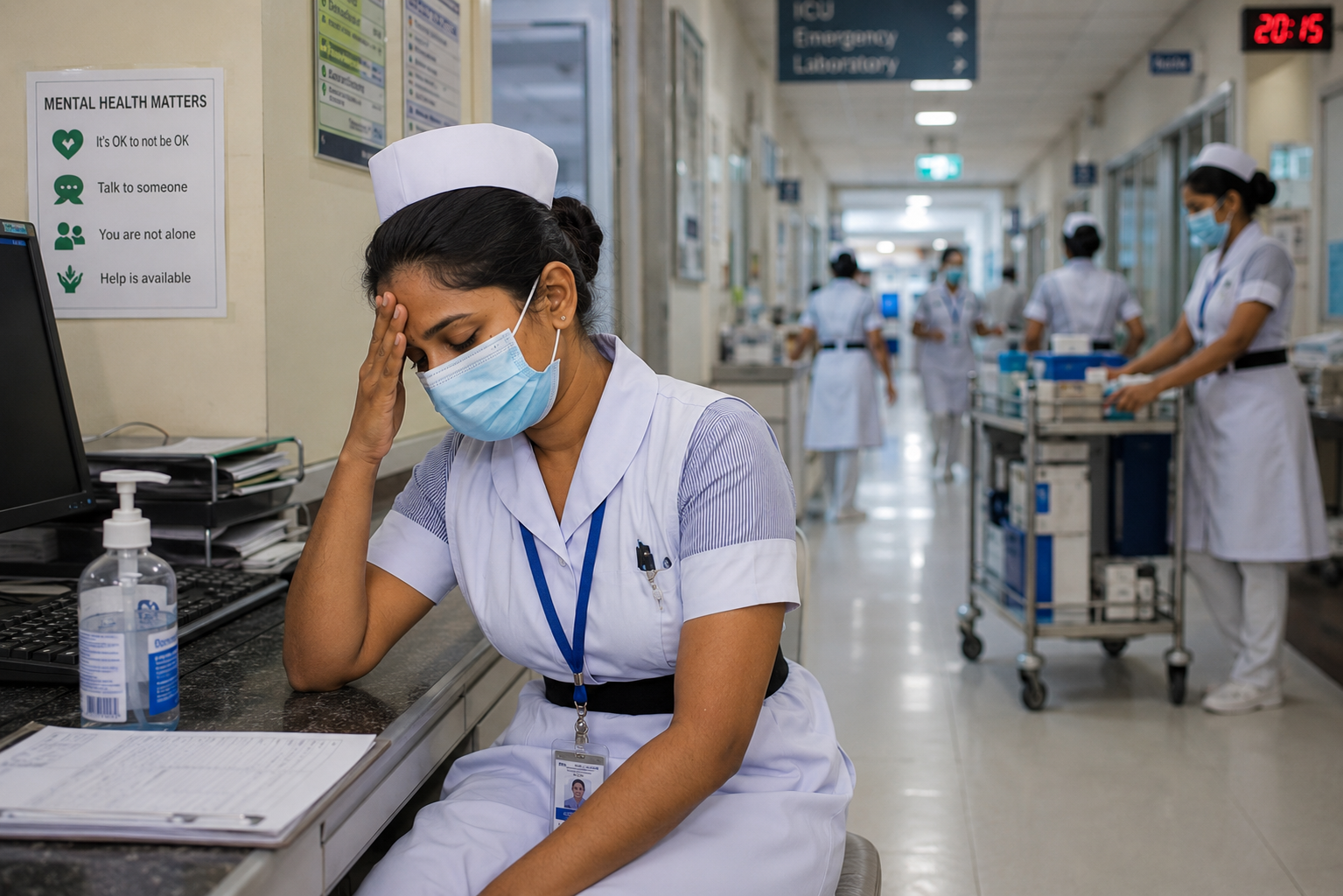
When Tiredness Becomes Something More
In the previous articles, we have looked at the shortage of nurses, long working hours, limited resources, and the financial pressures facing Sri Lanka's nursing workforce. When all of these pressures are combined over months and years, another serious problem begins to emerge: the mental health of the people providing care.
A word that appears with increasing frequency in conversations about nursing in Sri Lanka is burnout. It is worth being precise about what this means because burnout is not simply ordinary tiredness, and it is not something that can always be resolved with a good night's sleep.
Burnout develops through prolonged exposure to stress without adequate rest, support, or relief. It is commonly associated with emotional exhaustion, increasing detachment from work, and a declining sense of personal accomplishment. For nurses, who are expected to remain alert, compassionate, and emotionally present throughout demanding shifts, burnout represents a serious threat to both their wellbeing and the safety of their patients.
A Problem Measured in More Than Numbers
The scale of the problem in Sri Lanka is alarming. Research conducted in the period following the COVID-19 pandemic found that burnout among nurses was approximately 72.5 percent. That number should not be viewed simply as another professional statistic. It represents a human problem affecting thousands of healthcare workers.
More than seven out of every ten nurses included in that research were experiencing sustained exhaustion and disengagement associated with burnout. Behind that percentage are individual nurses going home exhausted after long shifts, struggling to recover before returning to work, and attempting to continue providing the same level of care despite having very little opportunity to recover themselves.
COVID-19 Did Not Create the Problem
The COVID-19 pandemic intensified many of these pressures, but it did not create them.
What the pandemic did was make visible, for a period, what many nurses had already been experiencing for years. Patient loads increased. Fear of infection became part of everyday work. Nurses worried about bringing illness home to their families. They cared for large numbers of critically ill patients while working with limited resources and considerable uncertainty.
When the acute phase of the pandemic passed, however, many of the underlying conditions remained. Staff shortages continued. Resources remained limited. Working conditions remained demanding, and wages did not necessarily reflect the additional pressures being placed on the workforce.
In other words, the emergency changed, but many of the conditions that created the exhaustion did not.
Resilience Has Its Limits
Research examining resilience among Sri Lankan nurses found that only about 28.4 percent demonstrated a high level of resilience at work, while the majority fell into moderate or low resilience categories.
It is important to understand what this means.
Resilience should not be interpreted simply as personal strength or weakness. It describes a person's capacity to recover and adapt after experiencing stress, and that capacity is influenced not only by individual characteristics but also by the environment in which someone works.
When nurses are already working long hours, dealing with staff shortages, managing difficult patient loads, and worrying about financial pressures, asking them to simply become "more resilient" misses the larger issue. People can only absorb so much pressure when the environment around them provides little opportunity for recovery.
When high burnout is combined with limited resilience, the risk of serious mental health difficulties increases. This can include anxiety, depression, and other significant psychological distress. In the most severe circumstances, nurses may also experience thoughts of self-harm or suicide. That possibility alone should make healthcare worker mental health a patient safety and workforce priority, not something that can be left to individual nurses to manage privately.
When Frustration Reaches the Street
These pressures have also contributed to public demonstrations and strikes by nurses and other health workers over issues including allowances, overtime payments, and working conditions.
For patients and families, a healthcare strike can be frightening and frustrating. People may already be waiting for treatment, worried about a loved one, or dealing with their own illness. Disruption to healthcare naturally creates anger and uncertainty.
For nurses, however, industrial action often comes after a long period of frustration. When routine discussions, requests, and negotiations do not produce meaningful change, patience can eventually give way to desperation.
Not every nurse will agree with every form of protest, and industrial action is certainly not without consequences. But the frequency of these disputes should also encourage us to look beyond the immediate disruption and ask why so many healthcare workers feel that stronger action is necessary.
The Missing Safety Net
Perhaps one of the most important gaps in Sri Lanka's government health system is structured psychological support for healthcare workers.
Most hospitals recognise that nursing is stressful. Recognition, however, is not the same as providing meaningful support. Confidential counselling, peer-support programs, accessible mental health services, and clear pathways for seeking professional help remain limited in many settings.
For nurses working irregular shifts, accessing private mental health services can also be expensive and difficult. There is another barrier that is harder to measure: the fear of being judged.
Mental health remains difficult to discuss openly in many workplaces and communities. A nurse may worry that admitting they are struggling could affect how colleagues, supervisors, or patients perceive them. As a result, many simply remain silent and continue working.
Mental Health Is Part of Patient Safety
International evidence increasingly makes one point clear: supporting the mental health of healthcare workers is not simply an employee benefit. It is an essential part of building a safe and sustainable healthcare system.
Healthcare systems that invest in the wellbeing of their workforce can benefit through better staff retention, reduced absenteeism, fewer errors, and healthier working environments. The World Health Organization has repeatedly highlighted mental wellbeing and fair working conditions as important components of a sustainable nursing workforce.
Sri Lanka already has much of what it needs to provide excellent healthcare: a publicly funded system, highly trained healthcare professionals, and a long tradition of nursing service.
What needs greater attention is the wellbeing of the people who keep that system running.
A nurse cannot continuously give compassion, concentration, patience, and clinical judgment without having an opportunity to recover. Supporting nurses' mental health is therefore not a luxury, and it should not be treated as a sign of weakness.
It is an investment in the nurses themselves, in patient safety, and ultimately in the future of Sri Lanka's healthcare system.