
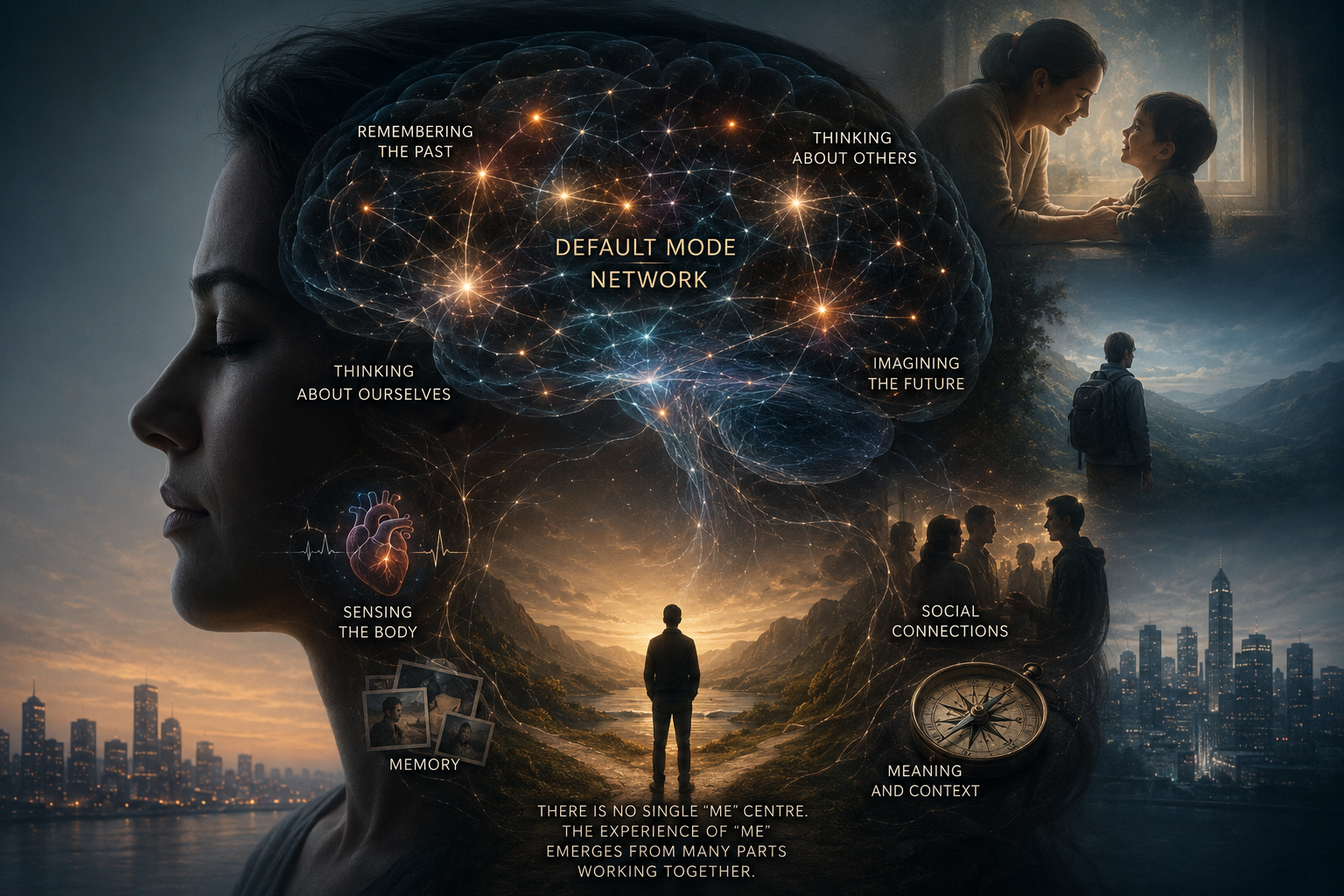
There Is No Single “Self Centre”
In Part 1, we asked what we really mean when we say “I.” We looked at the Present Self, the feeling that “I am here,” and the Story Self, the feeling that “this is my life.” Now we can take the next step and ask a surprisingly simple question:
If the brain creates the feeling of being “me,” where exactly is “me” in the brain?
It is tempting to imagine that somewhere inside our skull there must be a special place where our identity lives. Perhaps there is a small area quietly watching everything we see, hear, remember, and feel. But neuroscience has not found such a place. There is no single “self centre” that contains the whole person. Instead, the experience of being ourselves appears to involve several connected brain systems working together.
The Brain Works as a Network
This is an important idea in modern neuroscience. The brain is not simply a collection of separate boxes, with one box responsible for memory, another for emotion, and another for the self. Brain regions communicate continuously, and many participate in more than one function.
When you recognize yourself, remember something important, make a decision, feel an emotion, or think about your future, different parts of the brain are working together. What you experience as one simple thought, such as “This is happening to me,” may actually depend on communication across a much larger network.
This is why scientists increasingly study brain networks, rather than looking only for individual brain locations.
Meet the Default Mode Network
One of the most interesting networks connected with our sense of self is called the Default Mode Network, or DMN. Despite its name, the DMN is not simply the brain's resting mode. It becomes active during many forms of inward thinking, especially when our attention moves away from the immediate task and toward our own thoughts, memories, plans, and relationships.
Think about what happens when you are quietly sitting in a room and your mind begins to wander. You might remember something that happened years ago, think about a conversation from yesterday, wonder what someone thinks about you, or imagine what you will be doing next month. Your body may be sitting still, but your brain is moving through different moments and possibilities.
The DMN is involved in many of these internally focused processes. It helps the brain work with information about ourselves, our experiences, our possible future, and our social world.
The Brain Asks, “What Does This Mean for Me?”
One fascinating part of self-related thinking is that the brain does not simply record what happens. It tries to understand what an experience means in relation to us.
Imagine hearing that someone is moving to another city. That is simply information. But if you hear, “You are moving to another city,” your brain immediately begins doing something different. You may think about your home, your family, your work, the people you would leave behind, and what your new life might look like.
The event has become personal.
The brain has moved from “something is happening” to “something is happening to me.”
This kind of self-related processing involves several interacting brain systems, including parts of the default network. It is one reason researchers are interested in the DMN when studying how the brain creates a sense of personal meaning and identity.
The Brain Can Travel Through Time
There is another remarkable ability connected with these systems. Your brain can move mentally between the past and the future.
Think about planning a holiday. You might remember previous trips, imagine places you have never visited, predict what the experience might be like, and picture yourself walking through an unfamiliar city. The trip has not happened, yet your brain can construct a possible version of it.
This ability is sometimes called mental time travel. The hippocampus and broader brain networks involved in memory and imagination help make this possible.
The interesting part is that remembering and imagining are not completely separate activities. The brain can take pieces of past experience and use them to construct possible futures.
So the brain is doing more than asking:
“Who was I?”
It is also asking:
“Who might I become?”
That ability gives our identity a sense of continuity. We can look backward at the person we were and forward toward the person we might become.
“Me” Also Depends on Other People
There is another part of identity we often overlook. We do not discover who we are completely by ourselves. Much of our identity develops through relationships.
We may understand ourselves as a parent, child, partner, friend, colleague, caregiver, or member of a community. These identities exist because we are connected to other people.
The brain therefore needs to understand not only what we think and feel, but also what other people might think and feel. Brain networks involved in social cognition help us consider another person's perspective, intentions, beliefs, and emotions.
This means that our sense of “me” is partly built within a social world.
Who I am is influenced not only by what I remember about myself, but also by how I understand my place among other people.
There Is No Finished Version of You
Perhaps the most interesting part is that the brain does not create our identity once and then leave it unchanged.
It keeps updating.
A new relationship can change how we see ourselves. Becoming a parent can create a new part of our identity. Moving to another country can change how we think about belonging. Losing someone important can change our understanding of our own life. A major illness can change how we experience our body and imagine our future.
The brain continually incorporates new experiences into its understanding of the world and ourselves.
So the “me” you experience today is connected to your past, but it is also being shaped by what is happening right now.
So, Where Is “Me”?
After looking at all of this, we can return to our original question.
Where is “me” in the brain?
The best answer science can currently give is: there does not appear to be one place.
The experience of self involves multiple interacting systems that process memories, thoughts, emotions, bodily information, social relationships, and expectations. The Default Mode Network is an important part of this picture, but it is not the place where “I” is stored.
Perhaps the better question is not:
“Where is the self?”
but:
“How does the brain continuously create a sense of self?”
And that question leads us toward something even more fascinating.
If the brain uses information from the past to understand who we are today and to imagine who we might become tomorrow, then memory is not simply something we possess. It may be one of the processes that helps hold our sense of identity together.
And that takes us to the next stage of the journey.
Next: Part 3 — The Brain’s “Story Machine”
How the Brain Connects My Past, Present, and Future
In the next article, we will explore how the brain turns experiences into a personal story, why a smell, song, or familiar place can suddenly bring an entire part of our past back to life, and how the same brain systems that help us remember the past also help us imagine the future.