
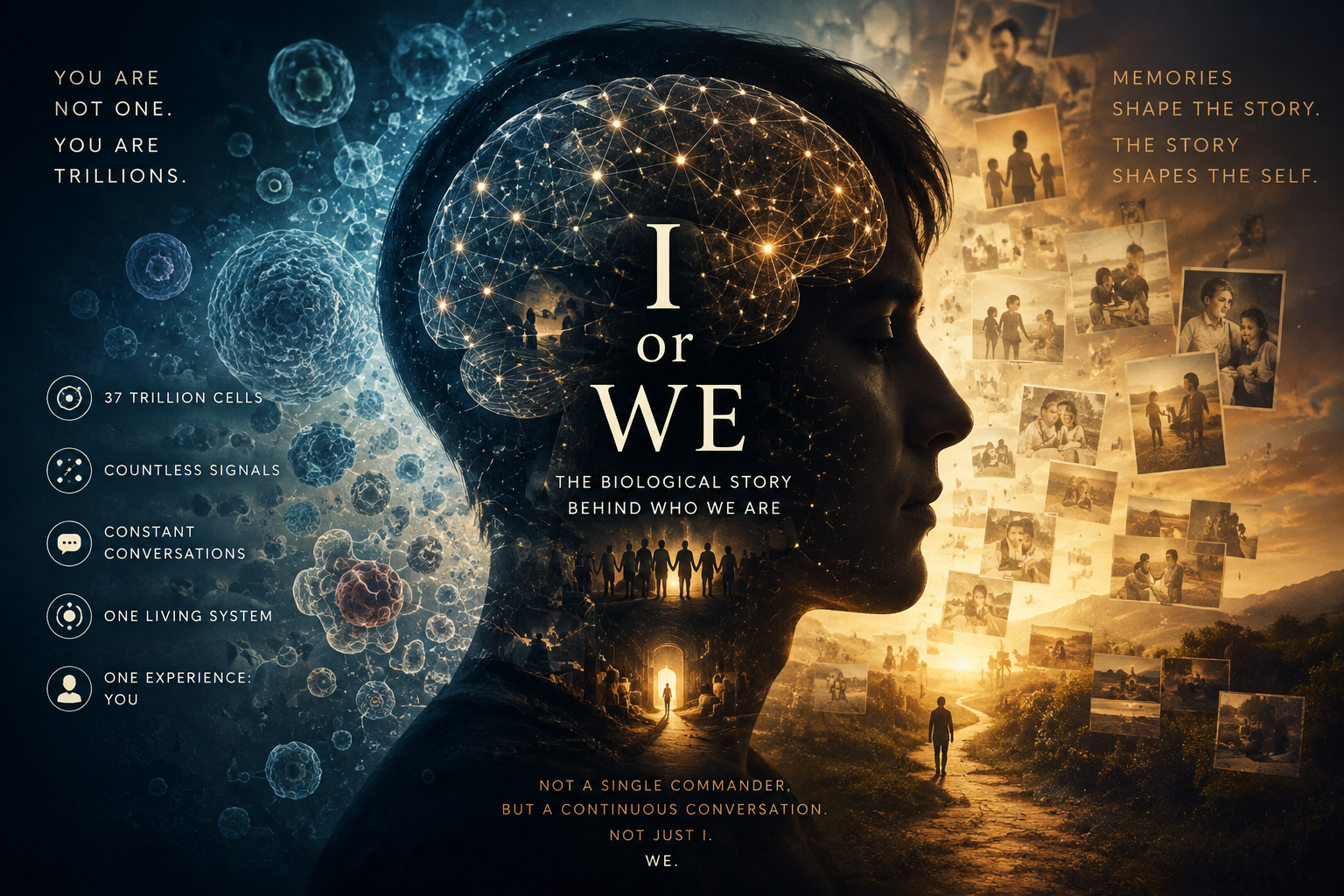
The Biological Story Behind Who We Are
Where Did They Go?
Every day, in our lives and especially when we encounter neurodegenerative conditions, we see how closely memory and identity are connected. Families may look at a loved one whose memory is changing and quietly ask, “Where did they go?” The person is still physically there, but names may disappear, familiar stories may become confused, and people they once knew may no longer be recognized. Behind this painful experience is a question that applies to every one of us: What exactly is “myself”?
What Do We Really Mean When We Say “I”?
We use the word “I” constantly without stopping to think about it. “I am hungry.” “I am tired.” “I remember.” “I decided.” “I am happy.” The word feels simple. It seems to describe one person, one mind, one continuous self experiencing life from somewhere behind our eyes. But when we look more closely through the lens of biology and neuroscience, the picture becomes much more complicated. There may be an “I,” but that “I” does not appear to be one single thing operating alone. In many ways, “we” may be a better place to begin.
A Body Made of Many Living Parts
The human body contains tens of trillions of cells, each carrying out its own specialized work. Nerve cells communicate with one another, heart cells keep the heart beating, liver cells perform their functions, and immune cells constantly monitor for threats. None of these individual cells knows your name. None looks into a mirror and thinks, “That is me.” Yet together, they produce a living human being who can think, remember, love, fear, plan, and ask the extraordinary question, “Who am I?”
There is no tiny person inside the brain controlling every cell. Instead, the body is a vast network of communication. Cells communicate with cells, organs communicate with the brain, and the brain communicates continuously with the body. Hormones carry chemical messages through the bloodstream, nerves carry electrical signals, and the senses constantly bring information from the outside world. From all of this activity emerges something that feels remarkably simple: the experience of being me.
Even Hunger Is a Team Effort
We can see this in something as ordinary as hunger. When we say, “I am hungry,” it feels like one simple personal experience, but many biological processes are involved. An empty stomach can trigger the release of ghrelin, a hormone involved in hunger signalling. Other parts of the body provide information about energy stores and nutrient availability, while the brain integrates these signals through systems including the hypothalamus, which plays an important role in regulating hunger and energy balance. At the same time, sights, smells, memories, and thoughts about food can influence the experience. Many different signals come together, yet our final experience is simply, “I am hungry.”
There is no single cell thinking, “The person is hungry.” There is a network of biological processes communicating with one another. The experience feels like one thing, while the biology underneath it is many things working together.
The Same Thing Happens With Emotions
The same principle can be seen with emotions. When we say, “I am anxious,” the experience feels like one thing, but it may involve changes in heart rate, breathing, muscle tension, hormones, attention, and memory. The brain brings these different signals together and produces a unified experience that we recognize as our own. Pain, thirst, fear, pleasure, fatigue, and excitement work in similarly complex ways. We experience them as “I feel,” “I think,” or “I want,” even though the biology underneath involves many systems working together.
This does not mean that the “I” is fake. It means that the “I” may be something that emerges from the activity of the whole system.
Is the “I” Real?
Think about an orchestra. We hear one piece of music, but that music comes from many instruments working together. No single instrument contains the entire symphony. The music emerges from their interaction.
The human brain and body are far more complicated than an orchestra, but the comparison helps us understand the basic idea. The experience of “me” may emerge from many different biological processes communicating and working together.
The self may therefore be less like a fixed object and more like a living process.
Memory Gives the “I” a Past
This is where memory becomes especially important. When someone asks, “Who are you?”, we usually answer with pieces of our personal story. We give our name, describe our family, remember where we grew up, talk about our work, our relationships, our interests, and the experiences that shaped us.
Much of this depends on memory.
We know our name because we remember it. We recognize our family because we remember the people and relationships connected to them. We know our own history because our brain has connected experiences across time.
Memory therefore does much more than help us remember where we left our keys.
Memory helps give the “I” a past.
It connects the person we were yesterday with the person we experience ourselves to be today. It helps create the feeling that, despite all the changes happening inside our bodies, there is still a continuous person moving through time.
What Happens When Memory Changes?
But this immediately creates another question:
What happens to the “I” when memory changes?
What happens when someone forgets their childhood? What happens when familiar names disappear? What happens when someone can no longer recognize a person they once loved? What happens when a brain injury changes the way a person thinks? What happens in dementia?
And perhaps the deepest question of all is this:
If some memories disappear, does some part of the person disappear with them?
These are not only questions about dementia. They are questions about every human being because every one of us is changing. Our bodies change, our brains change, our experiences change us, and our memories are constantly being formed, modified, strengthened, or forgotten.
Yet through all of these changes, we continue to experience a sense that there is someone here.
Me. I. Myself.
How does that feeling survive?
The Journey We Are About to Take
That is the question this series will explore. We will look at “Who am I?” through neuroscience, biology, psychology, memory, consciousness, aging, dementia, and the changing brain.
We will approach these questions from a science-based perspective, beginning with what we can observe and study: the human body, the brain, behaviour, memory, and consciousness. We will not assume that science has every answer. In fact, some of the most interesting questions remain unanswered.
As we move through the series, we will ask whether you are the same person you were ten or twenty years ago, where the sense of self comes from, how one memory can suddenly bring an entire emotional world back to life, why a person can forget an event but still respond emotionally to something connected with it, and what remains of “me” when memory begins to fade.
Eventually, the journey will take us into dementia and the changing brain, and then further toward the final stages of life. We will ask what happens when the brain can no longer maintain the memories, thoughts, language, and other processes that normally help us recognize ourselves and others. We will explore what science can tell us about the dying brain, and also where scientific knowledge reaches its limits.
One Final Thought Before We Begin
There may not always be comfortable answers. But perhaps that is exactly why we should ask these questions.
When you say “I think,” a living brain is producing patterns of electrical and chemical activity. When you say “I remember,” the brain is reconstructing information from the past. When you say “I feel,” the brain and body are continuously exchanging information. And when you say “I am me,” you are describing one of the most remarkable experiences produced by a biological system we are still trying to understand.
Perhaps the “I” is not a tiny person hiding somewhere inside the brain. Perhaps it is something that emerges from the conversation between many parts of us: a living story created by a changing brain, connected to a changing body, shaped by experience, relationships, emotions, and memory.
So before we ask “Who am I?”, we need to understand the biological system that allows a human being to ask the question in the first place.
That is where our journey begins.
A Note From the Author
I am not a neuroscientist or a researcher who has studied this field in depth. I am a healthcare professional who works with people living with neurodegenerative conditions, and this work has sparked my interest in understanding the brain, memory, identity, dementia, and consciousness. I also have two research fellows in this field in my family, which has further encouraged my curiosity and learning.
This series reflects my own questions, ideas, and reflections, supported and polished using relevant scientific findings and research. It is not intended to present me as a scientific authority, but rather as a healthcare professional exploring these fascinating questions through continued reading and learning.
This is the opening preface to a series exploring identity, memory, the brain, consciousness, dementia, aging, and end-of-life neurophysiology. The series is written in everyday language rather than academic terminology, making these complex ideas accessible to anyone who is curious about one of the most personal questions we can ask: Who am I?