Showing posts with label RecMike.ca. Show all posts

2026/08/30

බිඳුනු වැඩිහිටියෙක් තනන, ගුරු-දෙගුරු සුළු වැරදි

මුලින්ම කියන්න ඕන කරුණූ දෙකක් තිබෙනවා. එකක්,මේ වගේ මාතෘකාවක් දැක්ක ගමන් "අනේ අම්ම, තාත්තට ගුරුවරුන්ට මෙහෙම කියනවද" කියල හදවතට දැනෙන කම්පණයෙන් දුක හිතෙන අයත් මේ කියවන ඔබ අතර ඉන්න පුළුවන්. නමුත්, මේ ලියවෙන කරුණ ගැන සමබරව හිතාබලමින් , නැවත මාතෘකාවට හැරි බලන්නැයි ඒ අයට ආරාධනා කරනවා. එලෙසම, කළකට පෙර එක් කළ, "විසකුරු දෙමාපියෝ" ලිපියේ ලියවුනු සමහර කරුණූත් මේ ලිපිය තුල තිබෙන්නට පුළුවන්.

මේ ලිපිය ලියන්නට ප්රධානම හේතුව වුනේ, සිත් සුව අරණ තුල වගේම අපේ සමාජය තුල බහුලව දකින වැඩිහිටි ගැටළු බොහොමයක හේතු බීජය ඇත්තේ, එම පුද්ගලයා කාළයකට පෙර, එහෙම නැත්නම් ළදරු, ළමා හෝ යොවුන් වියේදි මුහුණදුන් මානසික කම්පණයන්ගේ (childhood trauma) බලපෑම් බව හදුනාගන්නට හැකි නිසා සහ එම හදුනාගැනීම් ගැන අද දවසේ වැඩි විමසීමක් කරන නිසාවෙන්.

අවිශ්වාසයන්, පවුල් තුල ඇති ගැටළු, අභියෝග වලට මුහුණදෙන ආකාරයන්, සමාජය ඉදිරියේ මුහුණදෙන පෞරුෂමය ගැටළු, වගේම සමහර කාළීන සෞඛ්යය ගැටළු වලටත් අදාල කාළය තුල මුහුණදුන්, විඳි මානසික පීඩාවන් සහ ඒ ඔස්සේ ඇතිවී, මනස තුල තැන්පත් වී ඇති ළමා හෝ යොවුන් කාළයේ විඳි මානසික කම්පණයන් හේතු වන බව මේ ඔස්සේ යමින් හදුනාගනිමින් තිබෙනවා.

මේ කරුණූ පදනම්ව ළමා කාළයේ සිදුවන මානසික කම්පණයන් (childhood trauma) පිළිබඳ කෙටි සටහන් කිහිපයක් එකතු කරමින් යම් කතාබහක් ආරම්භ කරන්නට උත්සාහ කරන අතරේ, ඒ වෙනුවෙන් මූලික වන මෙම ලිපිය එකතු කරන්නේ, දෙමාපිය, ගුරුවර, වගේම වෙන්ට දෙමාපිය , වෙන්ට ගුරුවරු සහ ළමා , යොවුන් , වැඩිහිටි ඔබ වෙනුවෙන්මයි. මේ සටහන කියවා එක් අයෙක් "(trauma) මානසික කම්පණය සහ එහි බලපෑම් සිතන්නට" පෙළඹේද, එයයි මගේ සතුට.

කතාව පටන් ගනිත්දිම කියන්න ඕන, ඔබ වගේම මාත් පොදුවේ පිළිගන්නා කරුණක් තමයි දෙමාපියන්, ගුරුවරුන් හැම වෙලාවෙම උත්සාහ කරන්නේ තම දරුවන්ගේ, තම සිසුන්ගේ යහපත. (පොදු අදහස) නමුත්, ඒ ආදරය තුල කරන , හෝ කෙරෙන සමහර සිදුවීම්, දරුවාගේ මනස තුල "තුවාලයක්" ඇති කරන trauma එකක් ඇති කරන්නට සහ එය මනස තුල රැඳී පවතිමින්, දරුවාගේ පමණක් නොව, එම දරුවා වැඩිහිටියෙක් වනදා, එම වැඩිහිටි ජීවිතයටද බලපෑමක් කරන්නට පුළුවන් .

දැන් කෙනෙක් කියන්න පුළුවන්

"අපේ අපි කොයිතරම් නම් ගුටි කාළ තියෙනවද" ,

එහෙම නැත්නම්

"ඕව දරුවන්ට අමතක වෙනවා"

කියල ඔබ තමයි මේ ලිපිය හුඟක් විමසිල්ලෙන් කියවන්නටම ඕන. හේතුව මේකයි, සමහර විට එදා කෑ ගුටි වගේම, ඒ තුල දැනුනු ලැජ්ජාව, මුදා හැරිය නොහැකි වූ ආවේගය නිසා වූ මානසික කම්පණයේ බලපෑම , අද වැඩිහිටියෙක් වුනත් තවමත් හොල්මන් කරනවා ඇති. අනෙක, මේ ඇතිවන තුවාල "අමතක" වෙලා යන්නේ නැහැ, මනසේ පතුලේ කිඳා, රැඳී පවතිනවා. ඒ හැඟීමත් එක්ක ඇතිවුනු "වේදනා+සිදුවීම" හැංගිලා වද දෙනවා. ඒ නිසාමයි මෙම මානසික කම්පණයන් “hidden wounds.” ලෙසත් හදුන්වන්නේ.

අනෙක, දරුවෙක් තුල මෙවන් මානසික කම්පණයන් ඇති වෙන්නට පුළුවන්, දරුවට පහරක් ගැසූ අවස්ථාවේ, එහෙම නැත්නම් ටිකක් සැරට බැන්න අවස්ථාවක පමණක්ම නොවෙන්න පුළුවන්. සමහර විට දරුවෙක්ට හිතේ දැනුනු දුකට , තමන්ගේ අම්ම, තාත්ත සංවේදී නොවුනු අවස්ථාවක්, ජීවිතේම විඳවන වේදනාත්මක කම්පණයක් වෙන්නටත් පුළුවන්. ඒ නිසා, වැදුනු පාරට වඩා, දරුවාගේ හිතට "දැනුනු බර" තමයි සැඟවුනු තුවාලය ඇති කරන්නේ.

මෙවන් අවස්ථා කිහිපයක් ගැන වර්ග කිරීමක් සහිත සටහන්, පහුගිය සති කිහිපය තුල සතියකට එක බැගින් "සිත් සුව අරණ" වෙත එක් කළත්, ඒවායෙන් යමක් ගන්නේ කීදෙනාද කියල හිතුණ අවස්ථා නැතිවාම නොවේ. ඒත් , මේ මාසයේ ආරම්භ කළ තේමාව නිමා කරන්නත් එක්ක මේ ලිපිය ලියන්නේ, කැමති අයෙක්ට කියවා, යමක් ගන්නටත්, කැමති නම් යමක් එකතු කරන්නටත් ආරාධනා කරමින්.

කතාව පහසුවෙන් ගෙනියන්නට උදව්වක් විදියට, පෙර කී විදියට, දරුවෙක් මුහුණදෙන, "මානසික කම්පණයක්" විය හැකි සිදුවීම් කිහිපයක් ගෙන ඒ ඔස්සේ යමක් ලියන්නටයි සැලසුම. එහෙම නම්, එන්න කතා කරන්න.

1) දරුවාගේ හැඟිම් නොසලකා හැරීම

හිතන්න, ඔබේ දරුවා කුමක් හෝ සිදුවීමක් නිසා හඬන්නට පටන් ගන්නවා. සමහර විට ඔබ අවිවේකයෙන්, එහෙම නැත්නම් වෙනත් කටයුත්තක යෙදෙමින් ඉන්නවා වෙන්න පුළුවන්. දැන් මේ ඇඬිල්ල "මහ කරදරයක්" කරගන්න ඔබ කිව්වොත් "නවත්ත ගන්නවා ඔබ ඇඬිල්ල" "ඕක අඬන්න දෙයක්ද" එහෙමත් නැත්නම් "ඔයා කොල්ලෙක් නේද ඔහොමත් අඬනවද" වගේ වචන කිහිපයක්, සමහර විට ඒ ඇති දරුවා තුල මානසික කම්පණ තුවාලයක් ඇතිවන්නට "අම්ම (තාත්ත) මගේ දුක දැක්කෙ නෑ," එහෙම නැත්නම් "මගේ දුක අඩු කරගන්න ආදරේ වෙනුවට අම්ම (තාත්ත) දුන්නේ මගේ හිත රිද්දන, මාව ලැජ්ජාවට පත් කරන දෙයක්" කියන හැඟීමෙන්. මේ තුවාල එක්ක වැඩිහිටියෙක් වෙත්දි ඔබේ දරුවා , තමන්ගේ හැඟීම් නිසි ලෙස මුදා හරින්නට විශ්වාසයක් නැති අයෙක් බවට පත් වෙලා, හැඟීම් හිරකරගෙන ඉඳලා, චිත්තවේග "පුපුරායන" අවස්ථාවන්ට පත් වෙන්නටත් පුළුවන්.

2) දරුවාගේ වැරදිම දැකීම

දරුවා කරන කටයුතු අතර , වැඩිපුරම දකින්නේ, සහ දරුවාට පෙන්වන්නේ "වැරදිම" නම් , තවත් විදියකින් කිව්වොත්, දරුවා කරන හොඳක් , ජයග්රහණයක් දරුවාට දැනෙන්නට නොදීමත් නිසා ඇතිවන "සැඟවුනු තුවාල" , මේ දරුවා වැඩිහිටියෙක් වනදා, තමන්ගේ වටිනාකම් නොහදුනන, හැමවෙලාවෙම තමන් වැරදි කළා හෝ ගත් තීරණ වැරදි ලෙස විඳවන, ඒ නිසාම ජීවිතේ අභියෝග බාර ගැනීමට බියක් දක්වන තරුණයෙක්, වැඩිහිටියෙක් බවට පත් වෙන්නට ඉඩක් තිබෙනවා.

3) නිරන්තර සැසඳීමට ලක් කිරීම

දරුවා, තම සහෝදර-සහෝදරියන්, එහෙම නැත්නම් පාසලේ අනෙක් මිතුරන් සමඟ සැසඳීමට ලක් කිරීම තුල දරුවාට දැනෙන පීඩාව , මනස තුල ඇති කරන "සැඟවුනු තුවාලය" , අනාගතයේ ඊර්ෂ්යාව සහ හීනමානය සහිත වැඩිහිටියෙක් නිර්මාණය කරන්නට හේතුවන්නට පුළුවන්. ඒ වගේම, තමන් කුඩා කාළයේ විඳි වේදනාවන්, අද වැඩිහිටියෙක් ලෙස පවත්වා ගත යුතු මිනිස් සම්බන්ධතා, බැඳීම් , විශ්වාසය පවත්වා ගැනීම් වෙත හානිකර ලෙස බලපෑමෙන්, එම පුද්ගලයා සමාජය තුල නැවතත් පීඩාවකට ලක්වෙන්නටත් වැඩි ඉඩක් තිබෙනවා.

4) හානිකර ආකාරයේ දැඩි "විනය"

දරුවා "හොඳින් හදා ගැනීමට" හෝ දරුවාගේ "වැරදි හදා ගැනීමට" තවත් විදියකින් කිව්වොත් දරුවාගේ විනය හදාගැනීමට ( ලෙස සිතමින්) දරුවාට පහර දීම, බැන වැදීම්, පිරිස ඉදිරියේ දරුවා ලැජ්ජාවට පත් කිරීම් නිසාවෙන් ඇතිවන මානසික තුවාල සමඟ ජීවත්වන, ඒ ඔස්සේ වැඩිහිටියෙක් වන පුද්ගලයා සමාජය ඉදිරියේ නිරන්තර අසාමාන්ය බියකින්, අවිශ්වාසයකින් සිටීමට පෙළඹිය හැකි අතර, ඒ නිසාම පවුල , රැකියාව තුල ගැටුම් ඇති කරගනිමින්, තමන්ගේ ආක්රමණශීලී බව මතු කරමින් ගැටුම් වලට පත්වීමටත් ඒ නිසාම සමාජීය ලෙස කොන්වී, වෙන්ව ජීවත්වීමට පෙළඹීමටත් ඉඩක් තිබෙනවා.

5) ආදරය , දැනෙන්නට නොදීම

දරුවෙක් අම්ම තාත්තගේ ආදරය කෑදරයි. ඒ ආදරය ලැබිම දරුවා තුල මානසික සතුටක් වගේම මානසික ශක්තියක් ලබා දෙන අතරේ, එසේ "ආදරය අපේක්ෂා කරන" දරුවාට , නිසි අවස්ථාවේ දෙමාපිය-ගුරු වෙතින් නිසි ආදරය "දැනෙන්නට නොලැබීම" නිසා එම වේදනාත්මක මානසික කම්පණයන් සමඟ වැඩිහිටියෙක් වන පුද්ගලයා, තම සමාජ ජීවිතය තුල පවත්වා ගත යුතු බැඳීම් සහ ඒ තුල තිබිය යුතු විශ්වාසයන් පවත්වා ගැනීමට අපහසු, ආදරය සුහද බව තවත් අයෙකුට ලබා දීමට නොදන්නා හෝ එසේ "දැනෙන්නට දීමට" අපහසු අයෙක් වන්නට පුළුවන්.

6) අනපේක්ෂිත ප්රතිචාර

දෙමාපිය හෝ ගුරවරයා වරින්වර , දරුවා අනපේක්ෂිත (හෝ දරුවාට වටහා ගත නොහැකි) චිත්තවේග ප්රතිචාර දැක්වීම, උදාහරණයක් මොහොතකට පෙර දරුවාට ආදරයෙන් කතා කරන කෙනා, තවත් මොහොතකින් "කිසිදු හේතුවක්" නැතිව දරුවා වෙත කඩා පණිමින් බැන වදිනවා නම් , මේ තුල ඇතිවන මානසික කම්පණය, දරුවා වැඩිහිටියෙක් වනදා , නිරන්තර කාංසා සහගත තත්ත්වය (හේතුවක් නොමැති බියකින් පිරුණූ හිතක් ඇති) , හැම සමාජ බැඳීමකදීම, කටයුත්තකදීම "අති පරිස්සම්" ලෙස කටයුතු කරන, සමාජ බැඳීම් තුල හමුවන අනෙක් අය නිරන්තර සැකයට භාජනය කරන, ඒ නිසාම වැඩිහිටි සමාජ ජීවිතය තුල විඳවන අයෙක් වන්නට පුළුවන්.

7) අධික අපේක්ෂාවන් දරුවා වෙත පැටවීම.

කිසිදු අතපසුවීමකට, වැරදීමකට, ලකුණූ අඩුවීමකට අවස්ථාවක් නොතබා, හැම විටම ඉහළම, හොඳම දේ ලබා ගන්නට "බල කිරීමකට" ලක්වන දරුවා වැඩිහිටියෙක් වෙත්දී, වැඩිහිටි ජීවිතය, සමාජ ජීවිතය, රැකියා තුලද "හොඳම, ඉහළම" යන හැඟීමට කෑදර වීම නිසාවෙන්, වැරදි වලට මුහුණ දීමට බිය, තමන්ගේ අඩුපාඩුවක් වෙනත් අයෙක් වෙතින් ඇසීමට බිය, හැම දේම "අති පරිපූර්ණ perfectionism) තත්ත්වයෙන් කරන්නට උත්සාහ කරන , ඒ නිසාම නිරන්තර මානසික පීඩනය, ආතතිතයට පත්ව ජීවත්වන අයෙක් ලෙස සමාජගත වන්නටත්, මේ හේතුව නිසාම කාළීන කායික සහ මානසික රෝග, පීඩා වලට ගොදුරු වන්නටත් වැඩි ඉඩක් තිබෙනවා.

8) වරද නොහදුනාගැනීමේ බර

දෙමාපිය, ගුරු , වැඩිහිටි අප අතිනුත් සමහර අවස්ථා වල වැරදි වෙන්නට පුළුවන්. දැනුවත්ව හෝ නොදැනුවත්ව වන මෙවන් වැරදීමකදි, එය දරුවාට අදාල වන තැන , තමන්ට වැරදුනු බවත් ඒ වෙනුවෙන් සමාව ඉල්ලන්නට නොපෙළඹෙමින්, තමන්ගේ වැඩිහිටිකම ඔස්සේ සිදුවුනු වරද සඟවා , එසේ නොවුනා සේ සිටින බව දරුවාට දැනීම නිසා ඇතිවන වේදනාව, මානසික කම්පණයක් වන්නට පුළුවන්. "තාත්ත කළ දේ වැරදියි, ඒත් තාත්ත ඒ වෙනුවෙන් සමාව ගන්නවා වෙනුවට ...." ලෙස හිතට හැඟීමක් එක් කරගනිමින් වැඩිහිටියෙක් වන මේ දරුවා, සමාජය තුල දී තම වගවීම්, වගකීම් නොගන්නා, හෝ වැරදීම් බාර බාර ගෙන , නිවැරදි වීමට උත්සාහ කරනවා වෙනුවට , වැරදීම් නිසා අසාමාන්ය ලෙස පීඩාවට පත්වන අයෙක් වන්නට පුළුවන්.

9) දරුවා "නොදැකීම"

මේ කියන්නේ, තම දරුවා, එහෙම නැත්නම් තමන්ගේ ශිෂ්යයා තුල ඇති හැඟීම්, වටිනාකම් ගැන දෙමාපිය හෝ ගුරුවරයා කිසිදු හදුනාගැනීමක් නොකරයි නම්, තවත් විදියකින් කිව්වොත් "දරුවා නොදකී" නම් ඒ "තමාව නොදැකීම" (මේ කියන්නේ ඇසින් නොදැකීමම පමණක් නොවේ) නිසාවෙන් දුකට, වේදනාවට පත්වන, එයම සැඟවුනු තුවාලයක් ලෙස මනස තුල තැන්පත් කරගන්නා දරුවා, වැඩිහිටියෙක් වනදා, අධිෂ්ඨානනය බිඳුනු, තමන් වටා ඉන්නා හැමෝම සතුටු කරවන්නටම පෙළඹෙන, තමන්ගේ සීමාවන් ගැන අවධානයක් නැති අයෙක් ලෙස සමාජය තුල රැදෙන්නටත් ඒ නිසාම පීඩාවට පත්වන්නටත් පුළුවන්.

10) අධි ආරක්ෂාව ලබා දීම

තම දරුවාට කිසිදු "හානියක්" , අපහසුතාවයක් ඇති නොවීමට යැයි සිතමින් "දැඩි" රැකවරණයක් ලබා දීමට කටයුතු කිරීම තුල , දරුවාගේ ස්වාධීත්වය ගොඩනගා ගැනීමට බාධාවක් වන අතර, ඒ "අධි රැකවරණය" තුල වැඩිහිටියෙක් වනදා, තමන්ගේ හැකියාවන් ගැන නිසි අවබෝධයක් නැති, තවත් අවස්ථාවක තමන් ගැන පවා විශ්වාසයක් නැති , වැඩිහිටි සමාජ ජීවිතය තුල "ගත යුතු අභියෝග" පවා බාර ගැනීමට බියවන වැඩිහිටියෙක් වීමට වැඩි ඉඩක් තිබෙනවා.

මේ කියාගෙන ගියේ, දරුවෙක් තුල හානිකර ලෙස මානසික කම්පණයක් ඇති කළ හැකි, ඒ ඔස්සේ සැඟවුනු තුවාල මනස තුල ඇති කරමින් අනාගත වැඩිහිටියා වෙත බලපැමක් කළ හැකි , ගුරු-දෙගුරු අප අතින් විය හැකි යම් සිදුවීම් කිහිපයක්. ඇත්ත, අප කවුරුවත් "සර්ව සම්පුර්ණ" නැහැ. අප අතින් අඩුපාඩු , වැරදි, සමහර විට නොසිතා සිදුවන්නට පුළුවන් වගේම, තවත් අවස්ථාවක, සිතා සැලසුම් කර, දරුවාගේ යහපත වෙනුවෙන් යැයි සිතා අප ගන්නා ක්රියාමාර්ග දරුවාගේ මනස තුවාල කරන්නත් පුළුවන්. ඒ නිසා, මේ childhood trauma සහ ඒවායේ අනාගත බලපෑම් ගැන යම් දැනුවත් බවක් ලබා ගැනීම, ඔබ, අපට වගේම, අපේ දරුවන්ගේ අනාගතයටද සුබදායී කරගන්නට පුළුවන් බව මතක් කරමින් ලිපිය නිමා කරනවා. මතක තබා ගත යුතුම දේ, මේ කතා කළ සහ මෙතැන නොලී තවත් සිදුවීම් ඇති දරුවාගේ මනස තුල "සැඟවුනු තුවාල" ඇති කරමින් ඔවුන්ට childhood trauma ඇති කරන. මේවා සැඟවුනු තුවාල, ඒ නිසා ඒ මොහාතේම, එහෙම නැත්නම් ටික දවසකින් එළියට එන හෝ දරුවාට අමතක වෙලා යන දේ නොව, දරුවාගේ අනාගතයට බලපෑම් කරන්නට පුළුවන්, දරුවාගේ මනස තුල සැඟවී තිබෙන තුවාල බව වටහා ගැනීමයි වැදගත්.

එහෙම නම් childhood trauma ගැන ඔබේ අදහස්, අත්දැකීම් එකතු කරන්නට කොමෙන්ට් තීරුව විවෘතව තබමින් ලිපිය නිමා කරනවා. trauma සහ ඩිමෙන්ෂියා තත්ත්වන් පිළිබඳව, වෘත්තීමය කටයුතු වෙනුවෙන් කළ අධ්යයනය කිහිපයක කරුණූ ඔස්සේ, සහ කැනඩානු මනෝ විද්යාඥයකු වන Dr. Gabor Maté ගේ The Myth of Normal: Trauma, Illness, and Healing in a Toxic Culture නම් ඇබ්බැහිවන සුළු පොතේ සමහර කරුණුද එක් කර මේ ලිපිය ලියූවේ.


Welcome to Canada- Part 18

💰 Starting With What You Have

In the previous articles, we talked about finding your first home, understanding rental agreements, getting your first job, and beginning to understand Canadian workplace culture. As life starts becoming more settled, another important part of your new life begins to take shape: managing your money.

When you first arrive in Canada, you may have many expenses at the same time. You may be paying rent, buying furniture, arranging transportation, purchasing groceries, paying utility bills, and sending money to family members. At the same time, you are trying to build a new career and understand a financial system that may work differently from the one you knew before.

This is where budgeting becomes important.

Budgeting does not mean that you cannot enjoy your life. It simply means knowing where your money is going before it disappears.

📊 Understanding Your Newcomer Budget

Your first Canadian budget does not need to be complicated. Start by looking at the money coming into your household and the money going out.

Rent, utilities, transportation, groceries, insurance, phone bills, and other regular expenses should be part of your planning. You should also think about expenses that do not happen every month, such as clothing, school costs, vehicle maintenance, medical expenses, or unexpected repairs.

At first, your budget may feel restrictive. Over time, however, it can actually give you more freedom because you know what you can afford.

One of the biggest mistakes a newcomer can make is comparing their new income with their old lifestyle without considering the cost of living in Canada. Your financial situation may change significantly during your first few years, so give yourself time to adjust.

The goal is not to look wealthy. The goal is to become financially stable.

🏦 Your Credit Score Is Part of Your Financial Life

Sooner or later, you will probably hear Canadians talking about a credit score.

For newcomers, this can be confusing because you may have an excellent financial history in your home country, but that history may not automatically follow you to Canada.

A credit score is one part of Canada's credit system. It is based on information in your Canadian credit history and helps lenders assess how you have managed credit. A good credit history can become important when you apply for things such as loans, credit cards, or financing.

This is why a newcomer can sometimes face an unusual situation.

You may have money in your bank account, a good education, a successful career, and a history of paying your bills responsibly in another country, but your Canadian credit history may still be very limited.

In other words, you are financially experienced, but the Canadian credit system does not know your history yet.

🌱 Building Credit From Zero

Building credit takes time.For someone who has just arrived in Canada, having little or no Canadian credit history is normal. It does not mean that you are financially irresponsible. It simply means that you are starting a new credit history.

One common way to begin is by obtaining a credit card that you qualify for and using it responsibly. The important part is not simply having a credit card. It is how you use it.

Using credit for purchases you can afford and making your payments on time can help establish a positive credit history. Keeping your credit use under control is also important. A credit card should not become an excuse to spend money that you do not actually have.

This is where budgeting and credit building connect.If your monthly budget says you can afford something, using credit and paying it responsibly may help you build your financial history. If you cannot afford it, using a credit card simply because the available credit is there can create problems.

⏰ Credit Takes Time

One thing newcomers should understand is that building a credit history does not happen overnight.

You may wonder why your credit score has not changed much after only a few months. The answer is simple: credit history is built over time.

Think of it like building a house. You do not build the entire house in one afternoon. You begin with the foundation, then slowly add one part after another.

Your financial foundation works in much the same way. Paying bills on time, managing credit carefully, avoiding unnecessary debt, and maintaining responsible financial habits can gradually establish your reputation with the Canadian credit system.

🚨 Be Careful With Easy Credit

When you first arrive in Canada, you may receive offers for credit cards, financing, store credit, or other forms of borrowing. It can be tempting to accept everything because you are trying to establish credit.But building credit does not mean collecting as much credit as possible.

Every borrowing decision should fit into your overall financial plan. Before accepting a credit offer, understand the interest rate, fees, payment requirements, and other conditions.

Credit can be a useful financial tool when managed responsibly. It can also become a serious financial burden when it is used without a plan.

👨👩👧👧 Building a Financial Future Together

For families, financial planning becomes even more important.

When you arrive in Canada with a spouse and children, there may be many competing priorities. You want to provide your children with good opportunities, create a comfortable home, enjoy your new surroundings, and perhaps send money to relatives back home.

All of these goals may be important, but they need to fit within your financial reality.

It is perfectly reasonable to enjoy your new life in Canada. Going for a family outing, exploring your new city, or buying something special for your children is part of creating memories.

The important thing is finding a balance between enjoying today and preparing for tomorrow.

🤝 Ask Questions Before Making Big Decisions

The Canadian financial system can be complicated, especially when you are seeing terms and processes that are unfamiliar.

Do not be afraid to ask questions.Banks, credit unions, settlement organizations, and qualified financial professionals can help explain financial products and services. Before signing an agreement or borrowing a significant amount of money, make sure you understand what you are agreeing to.

You do not need to become a financial expert overnight. You simply need to become comfortable asking, "How does this work?" .That question can save you a lot of trouble.

🌱 Reflection: Building Slowly

When newcomers think about building a life in Canada, they often think about finding a job, buying a home, giving their children a good education, and creating a better future.

All of those things are important. But behind many of those goals is something less visible: financial stability.

Your first budget may be simple. Your first Canadian bank account may have very little money in it. Your credit history may begin with almost nothing.That is okay. Everyone starts somewhere.

The important thing is to build slowly and responsibly. Learn where your money goes. Spend within your means. Understand credit before using it. Pay what you owe on time and give your Canadian credit history time to grow.

Your financial life in Canada does not need to be perfect from the beginning. It simply needs a good foundation.

And just like the other steps in this newcomer journey, small and responsible decisions today can eventually become the foundation for a much more secure tomorrow.

Sri Lanka's Unsung Heroes- Part 14

Looking at the Whole Picture

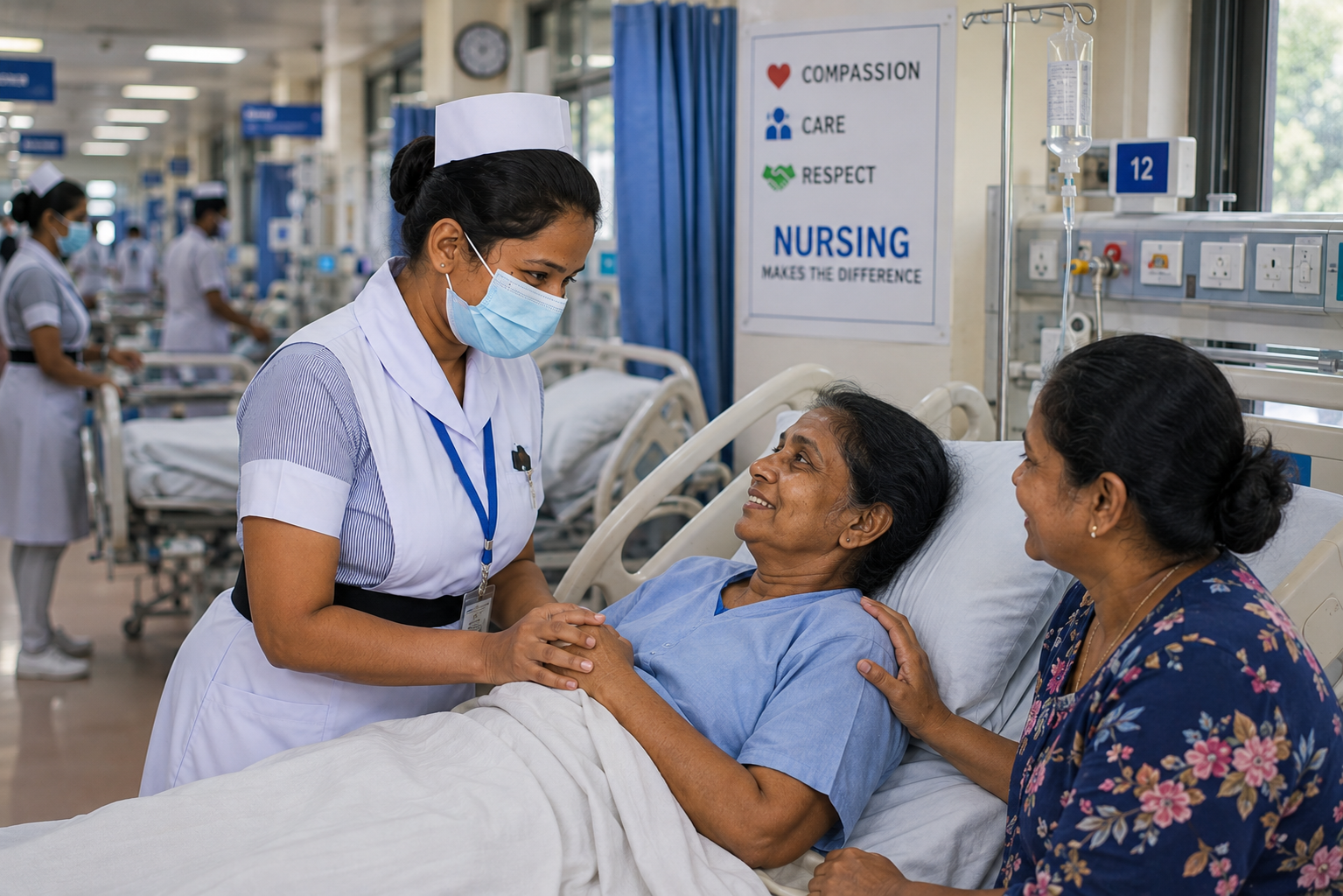
In the previous articles, we have looked closely at the pressures facing Sri Lanka's nursing workforce, from staff shortages and long working hours to limited resources, financial pressures, and burnout. At the same time, we have also explored the strong relationship of trust that nurses have built with patients and communities over generations.

So, if we are going to talk honestly about how the public sees nurses, we have to look at the whole picture. There are positive perceptions, but there are also negative ones. Acknowledging both is not about blaming nurses or the public. It is about understanding why those perceptions exist and what they mean for the future of the profession.

When Frustration Falls on Nurses

Anyone who has spent time in a crowded government hospital knows how quickly frustration can build. Patients are waiting, families are anxious, wards are overcrowded, and everyone wants answers. In these situations, nurses often become the most visible representatives of the healthcare system, even when the problem is much bigger than the individual nurse standing in front of them.

Long waiting times, limited resources, treatment delays, and overcrowded wards can lead some patients and families to describe their encounters with nurses as short-tempered, unhelpful, or difficult. When similar experiences are repeated over many years, they can gradually create a generalized image of the stern government nurse.

That image can be damaging. It affects the public standing of the profession, but it can also affect the morale of nurses who genuinely care about their patients and take pride in their work.

Context Matters

There is, however, an important part of the story that is often missing.

A nurse who has been on her feet for twelve hours, caring for twenty patients, without a proper meal break and with colleagues absent because of staff shortages, is working under very different circumstances from a nurse in a well-staffed ward with reasonable patient ratios and adequate resources.

Both are professional nurses. The difference is the environment in which they are expected to work.

This does not mean that poor communication or unprofessional behaviour should simply be excused. Nurses have a responsibility to communicate respectfully, maintain professional standards, and treat patients with dignity. But understanding the working conditions helps us understand why interactions can sometimes become difficult.

The person standing in front of the patient may be carrying the pressure of an entire system on their shoulders.

The Difficult Question of Strikes

Few issues create stronger public reactions toward nurses than strikes.

When nurses take industrial action, public opinion can divide sharply. Some people see a strike as a betrayal of the duty of care that nursing represents. From the patient's perspective, this reaction is understandable. People seek healthcare because they are vulnerable, and any disruption can create fear, uncertainty, and additional hardship.

Others look at the same situation differently. They see nurses who have raised concerns about wages, overtime, staffing, and working conditions through official channels and believe that industrial action may come only after other efforts have failed.

Both perspectives contain something important.

Strikes do affect patients, and that matters. At the same time, strikes generally do not happen without underlying grievances. They can be a sign that a workforce has reached a point where ordinary discussions and requests have failed to produce meaningful change.

The answer, therefore, is not to pretend that one side is completely right and the other completely wrong. A mature public discussion needs to recognise the impact of industrial action on patients while also understanding why healthcare workers reach the point of taking such action.

The Gender Stereotype That Starts Early

There is another issue that has influenced nursing for generations: the idea that nursing is primarily a woman's profession.

Nursing is often associated with femininity, compassion, and a natural instinct to care. Those qualities are certainly valuable in nursing, but they can overshadow something equally important: nursing is a skilled profession requiring education, clinical knowledge, judgment, technical ability, and significant responsibility.

Male nurses can face particular challenges because of these stereotypes.

I experienced this myself. When my aunt suggested nursing as a career during my school years, my immediate reaction was dismissive. I remember thinking of nursing as a female job and saying that it was not for me.

Looking back, that reaction tells me something about how deeply those ideas were embedded in Sri Lankan culture. At that age, I simply did not understand what nursing really involved.

Once I entered the profession and experienced the work firsthand, those attitudes disappeared completely. I began to understand the level of knowledge, responsibility, clinical judgment, communication, and practical skill that nursing demands.

The experience changed my perception entirely.

But the fact that the stereotype existed so strongly in the first place points to a wider cultural issue. When society continues to view nursing primarily as a caring role rather than a skilled professional discipline, it can influence who chooses nursing as a career, how nurses are treated, and how nurses themselves understand their professional identity.

Beyond the "Hero" Label

The idea of nurses as heroes also deserves some thought.

During the COVID-19 pandemic, nurses were publicly recognised as heroes. For many nurses, that recognition was meaningful. After years of working under pressure, it was powerful to see society acknowledge the risks they were taking and the contribution they were making.

But there is another side to the hero narrative.

When nurses are repeatedly described as heroes, extraordinary sacrifice can slowly become something people expect from them. Long hours, staff shortages, emotional exhaustion, and inadequate resources can begin to seem acceptable because nurses are assumed to be strong enough to cope.

That is not sustainable.

A healthcare system should not depend on nurses being heroic simply to keep the system functioning.

What Real Respect Looks Like

Genuine respect for nursing has to go beyond applause, appreciation posts, and words of gratitude during a national emergency.

Respect should be visible in the way the profession is supported.

It should mean fair wages, adequate staffing, reasonable working conditions, professional support, opportunities for career development, and meaningful involvement of nurses in decisions that affect healthcare delivery. These are not special privileges. They are practical foundations for a safe and sustainable nursing workforce.

Sri Lankan nurses have already demonstrated their dedication countless times. The question is not whether they are willing to give more. They have been giving more for years.

The more important question is whether the system and society are prepared to give nurses the support they need to continue doing their work safely, professionally, and with the dignity they deserve.

පාන් පිටි දෙන ලෙඩ

“ඉස්සර වගේ නොවෙයි අනේ, දැන් කෑම කාපු ගමන් බඩපුරෝලා දාල වගේත ඇඟපතත් රිදෙනවා, ඔළුවත් බරයි වගේ හරිම කරදරයක් මේක”

සමහර විට මේ ඔබේ කතාව වෙන්න පුළුවන්, නැත්නම් මේ වගේ කතාබහට ඔබ එකතු වෙලා ඇති.

විශේෂයෙන්ම පාන්, සැන්විච් හෝ පාං පිටි වලින් හදපු කෑම කාළ ටික වෙලාවක් යත්දි බඩ පුරෝල දාල, හරියට අර pufferfish වගේ බඩගෙඩිය පිම්බිලා ඇවිත්, කරමින් හිටිය වැඩකටයුතු කරන්න තියා, හුස්ම ගන්නත් බැරි තද ගතියක් එන්නත් බැරි නෑ. ඇඟපත රිදෙන, බඩේ කැක්කුම් එක්ක ඊළඟ පැය ගණනාවම ගත කරන්නට වන මේ තත්ත්වයට හේතු ගණනාවක් තියෙන්න පුළුවන් වුනත්, ඒ අතරින් ගැටළු කිහිපයක් ඇති කරන්න පුළුවන් ප්රධාන හේතුකාරකයා අපේ කෑම එකේ ඉන්න පාං පිටි වෙන්නත් පුළුවන්.

ඔව්, පාං පිටි කියල අප පොදුවේ කියන, තිරිඟු පිටි වල (තිරිඟු විතරක් නොවේ, බාර්ලි, රයිල් වගේ සමාන ධාන්ය වර්ග වල) තියෙන එක්තරා ප්රෝටීනයක් ඔබට මේ අපහසුතා ඇති කරනවා වෙන්නත් බැරි නෑ. තිරිඟු ඇටේට , අවශ්ය කරන ශක්තිය, බැඳීම් පවත්වා ගන්න වගේම, තිරිගු ඇටේ කවද හරි ලොකු වෙන්න , තිරිඟු පැළයක් වෙත්දි අවශ්ය උදව් කරන්නට ඉන්න මේ ග්ලූටන් කියල ප්රෝටීනට, තිරිඟු පිටි, එහෙම නැත්නම් පාංපිටි එක්ක ඇවිත් අපටත් “උදව්” කරනවා බේකිං වලදි.

🌾පිටි මෝලියේ ග්ලූටන්

ඔබ ගෙදරදි බේකිං කරනවා නම් පාං පිටි වලට වතුර දාල අනත්දි පිටි මෝලියේ එන ඇදෙනසුළු ගතිය ඇති කරන්න උදව් වෙන්නේ මේ ග්ලූටන්මයි. ඒ විතරක් නොවෙයි, පිටි ඇනිල්ලේ ඊළඟ පියවරට ගිහින්, යීස්ට් ටිකක් එහෙම දාල ටික වෙලාවක් තියත්දි, යීස්ට් හදන කාබන් ඩයොක්සයිඩ් , වායු බුබුලු විදියට පිටි මෝලිය අස්ස රඳවගෙන, කුහර හදල, බේක් කරන කේක් එකේ, එහෙම නැත්තම් පාං ගෙඩියේ මෘදු වගේම රසවත් බව වැඩි කරන්නත් මේ කියන ග්ලූටන් ප්රෝටීනය උදව් වෙනවා. දැන් මතක් කරගන්නකෝ, සාම්ප්රදායික විදියට හාල් පිටි වලින් කළ බේකිං එකකුයි, මේ පාං පිටි වලින් කළ බේකිං එකකයි වෙනස. පාං පිටි බේකිං එකේ එන මෘදු බව, සවිවර බව ඇති කරන්නේ මෙයාගේ උදව්වෙන්.

මේ කියන ග්ලුටන් ප්රෝටීන් අප හුඟක් අයට ලොකු ප්රශ්නයක් නොවේ. එය, අනෙක් ප්රෝටීන වගේම ජීරණය වෙලා, ඇමයිනෝ අම්ල විදියට දේහයට උරාගන්නව. හැබැයි සමහරෙක්ට, මේ ග්ලූටන් ප්රෝටීනට සම්පුර්ණයෙන් දිරවා ගැනීම අපහසු වෙන්න පුළුවන්. අන්න එතැනදි, හැදෙන බාගෙට දිරවූ ග්ලුටන් ( ග්ලූටන් පෙප්ටයිඩ) වල බලපෑමෙන් තමයි පෙර කී ලක්ෂණ වගේම පහත කියන්නට හදන සෞඛ්යය ගැටළු හෝ රෝග ඇති වන්නේ.

🌾ග්ලූටන් සමඟ සම්බන්ධ ප්රධාන සෞඛ්ය තත්ත්ව තුනක්

මේ ඔස්සේ ඇතිවිය හැකි රෝග/සෞඛ්යය ගැටළු ප්රධාන කාණ්ඩ තුනක් බහුලව හදුනගන්නට පුළුවන්. ඒ තමයි
සීලියැක් රෝගය , ග්ලූටන් අසාත්මිකතාවය, සීලියැක් නොවන ග්ලූටන් අතිසංවේදීතාවය. අපි දැන් මේ එක් එක් තත්ත්වය ගැන බොහොම කෙටියෙන්, සාමාන්ය ප්රජාව විදියට පොදුවේ දැනගන්නට අවශ්ය කරුණූ කිහිපයක් කතා කරමු.

🌾සීලියැක් රෝගය. Celiac Disease

මෙතැනදි වෙන්නේ, පෙර කිව්ව විදියට, ග්ලුටින් ප්රෝටීනය සම්පුර්ණයෙන්ම දිරවා ගන්න බැරිව හැදෙන අතුරුඵල gluten peptides ආහාර මාර්ගයේ පටක තුලට ඇතුළු වෙත්දි තවත් වෙනස් වෙලා, (ඒ වෙනස් කිරිල්ල කරන්නේ, tTG කියන එන්සයිමය) අමුතු දෙයක් ඇඟට ඇතුළු වුනා කියල පණිවිඩය ප්රතිශක්තිකරණ පද්ධතියට ගියාම යුද්දේ පටන් ගන්නවා. ඒ කියන්නේ, මේ “අමුතු ප්රෝටීන කෑල්ල” අවදානමක් විය හැකි කෙනෙක් කියල , දේහයේ ප්රතිශක්තිකරණ පද්ධතිය ඒ “අමුතු කෑල්ලට” පහර දෙන්න පටන් ගන්නවා.

අන්න එතැනදි තමයි ඔය ඇඟපත අමාරුකං, බඩ පුරොදාපු ගතිය , ඔළුවෙ බර ගතිය වගේ විවිධාකාර ලක්ෂණ මතු වෙන්නේ. දැන් මෙතැන යුද්දයක් වෙන නිසා, මේ පහර දීම් වල හානි, ආහාර මාර්ගයේ බිත්ති වලටත් වෙනවා. ඒවත් තුවාල වෙනවා. ඔබට මතක නම් විද්යාව පාඩම, කුඩා අන්ත්රයේ ඇතුලේ තියෙන, පෝෂක උරාගන්න උදව් වෙන ඇගිලි වගේ විලයි වලටත් මේ පහරදීම් වදිනවා. ඒව තුවාල වෙනවා, කාලයක් යත්දි විලයි වලට බැරිව යනවා එයාල සාමාන්යයෙන් කරන පෝශක උරාගැනීම හරියට කරන්නට . අන්න එතැනදි පෙර කී ලක්ෂණ වලට වඩා අවදානම් ඔස්ටියෝපොරෝසියාව, නිරක්තිය, ස්නායු රෝග, අක්මා එන්සයිම ඉහළ යාම් වගේම තවත් අවදානම් ගැටළු , ඔව් පිළිකා වර්ග ගණනාවක් සඳහා මෙය හේතුකාරකයක් වෙන්නට පුළුවන්.

🌾සීලියැක් රෝගය හඳුනාගැනීම සහ පාලනය

මෙම තත්ත්වය වෛද්ය පරික්ෂණයක්, රුධිර පරික්ෂණ කිහිපයක් සහ ආහාර මාර්ගයේ පටක පරික්ෂාවක් ඔස්සේ හදුනාගන්නට පුළුවන්. දැනට, සියයට සියයක්ම සාර්ථක ඖෂධ මෙම තත්ත්වය “සුව” කිරීම සඳහා නැතත්, ග්ලූටන් සහිත ආහාර වලින් ඉවත්විම තමයි කරන්නට පුළුවන් හොඳම වලක්වාගැනීමේ ක්රමය.

මේ තත්ත්වය අප හිතනවාට වඩා බහුල, වගේම පුංචි කාළේ නොතිබී, ටිකක් වයසට ගියාම ඇති වෙන්නත් පුළුවන්. ඔව්, ටිකක් මැදි වයසට එත්දි එන දැඩි මානසික පීඩනයන්, වගේම ආහාර රටාවන්ගේ වෙනස්වීම් , වෙනත් ඖෂධ ඔස්සේ ආහාර මාර්ගයේ බැක්ටීරියාවන් ගහණයේ වෙනස්වීමත් මෙයට විය හැකි හේතු වෙනවා.

🌾ග්ලූටන් අසාත්මිකතතාවය Gluten & Wheat Allergy

නමේ හැටියටම මේක “අසාත්මිකතාවයක්”. මේ තත්ත්වය තියෙන අයට, පාං පිටි සහිත කෑම ගත්තම ඇඟ පත කසන්න අරගෙන පළු දාල , රතු වෙලා සමහර විට හුස්ම ගැනීම අපහසු වෙන්න පුළුවන්. කළාතුරකින් ජීවිත අවදානමට පත්වන තරමේ අතිසංවේදීතාවයට පත් වෙලා ශ්වසන මාර්ගය ඉදිමිලා, අවහිර වෙලා හුස්ම ගැනීම නවතින තැනට යන්නත් බැරි නෑ.

මේක අසාත්මික තත්ත්වයක් නිසා, කෙනෙක්ට සමහර විට ලක්ෂණ නොදැනෙන තරමේ අඩු ලක්ෂණ මතුවීමක් වගේම, පාංපිටි වලදි අසාත්මික වුනත්, බාර්ලි පිටි වලට අසාත්මික නොවන වගේ වෙනස්කම් මෙතැනදි ඇති වෙන්නට පුළුවන්.

🌾අසාත්මිකතාව හඳුනාගැනීම සහ ආරක්ෂාව

හොඳම දේ ලක්ෂණ මතුවීම ඔස්සේ, Skin prick tests එකක් කරල, හරියටම අසාත්මික මොනවාටද කියල දැනගෙන ඒවායෙන් ඉවත්වී ඉන්න එක. ඒ වගේම මේ අයට අවදානම් මට්ටමේ අසාත්මිකතාවයක් ආවොත් එතැනදී ජීවිත ආරක්ෂාව සඳහා ඉක්මණින් භාවිතයට ගත හැකි එපිපෙන් එකක් හැම තිස්සේම තියා ගන්නවා නම් වටිනවා.

මේ තත්ත්වය නම් හුඟක් දුරට ඒ පුද්ගලයා පොඩි කාළෙ ඉඳලම තියෙන්න පුළුවන් වුනත්, සමහර වෙනස්වීම් වැඩිහිටි වයසෙදි මුලින්ම මතු වෙන්නත් පුළුවන්.

🌾සීලියැක් නොවන ග්ලූටන් අතිසංවේදීතාවය Non-Celiac Gluten Sensitivity (NCGS)

මෙතැනදිත් පෙර කී ලක්ෂණ වගේම, ඊට අමතරව බ්රේන් ෆොග් එන්න පුළුවන්. ඒ කිව්වේ, සුළු මොහාතකට හැමදේම අමතක වෙලා යනවා වගේ දැනෙන කෙටි කාළින අමතක වීම් සහිත අපහසුතා මතු වෙන්නට පුළුවන්. මේක අදාල ප්රෝටීනයේ කොටස් වලට ඇතිවන සංවේදීතාවයක් වුනත්, මෙය ඕනැම වයසකදි මතු වෙන්නට පුළුවන්. ඒ කියන්නේ, පොඩි කාළේ පාංපිටි කෑම කෑවට කිසි ප්රශ්නයක් වුනේ නැති අයෙක්ට, තරුණ වයසේදි, එහෙම නැත්නම් මැදි වයසෙදි වුනත් මතු වෙන්නට පුළුවන්.

🌾ග්ලූටන් ආශ්රිත ගැටළු හඳුනාගැනීම

මේ හුඟක් අවස්ථා වලදි කරන්න පුළුවන් හොඳම දේ තමයි, ප්රමාද නොකර රෝගය හෝ සෞඛ්යය ගැටළුව හරියට හදුනාගෙන, අදාල ගැටළු ඇති කරන ග්ලූටන් රහිත ආහාර රටාවකට ක්රමයෙන් හුරු වීම.

ඔබටත් පෙර කී විදියේ, ආහාරය සමඟ උදරාබාධ, ඒ ආශ්රිත අපහසුතා, මළපහ කිරීමේ වගේම මළපහ වල වෙනස්වීම් ඇති වුනොත් , ඒ ලක්ෂණ පාං පිටි හෝ ඒ ආශ්රිත ආහාර වර්ග සමඟ මතුවන බව හදුනාගත්තොත් ප්රමාද නොකර වෛද්යවරයෙක් හමුවෙලා පරික්ෂණ සහ උපදෙස් වලට යොමු වෙන්න.

🌾සීලියැක් තත්ත්වය සමඟ ජීවත්වීම

ඔබ, සීලියැක් තත්ත්වය සමඟ ජීවත්වන්නෙක් බව වෛද්ය නිර්දේශය ලෙස ලැබුණොත්, ඒ සෞඛ්යය උපදෙස් අනුව ආහාර රටාව වෙනස් කරගන්න. මේ තත්ත්වයත් එක්ක “සෙල්ලම් කරන්න” එපා. මොකද, කල්ගත වෙත්දි අවදානම් ගණනාවකට මේ පුංචි ප්රෝටීනය හේතු වෙන්න පුළුවන්. ඒ වගේම, ඔබේ ආහාර වලට ග්ලූටන් මිශ්ර නොවීමට වග බලාගැනීම තමයි අමාරුම දේ වෙන්නේ. විශේෂයෙන්ම ගෙදර උයත්දි අනෙක් අයගේ ආහාර ඔස්සේ, ආහාර සැකසීම් ඔස්සේ මේ මිශ්රවීම වෙන්නට පුළුවන්. ඒවගේම ආපනශාලාවකින් ආහාර ගැනීමෙදිත් , තමන් සීලියැක් තත්ත්වය සමඟ ජීවත්වනවා නම් අදාල ආහාර සකසන්නන් දැනුවත් කර, තම ආහාරය සමඟ පාං පිටි හෝ සමාන ක්රමයක් ඔස්සේ ග්ලූටන් එකතු වීම වලක්වා ගන්නට උත්සාහ කරන්න. එය “ඔබේ ජීවිතයට” විය හැකි අවදානම් අඩු කරාවි.

🌾නිමාවට පෙර,

එහෙම නම් මේ ගැන ලිව්ව ඇති , වැඩි දුර කියවන්න කැමති අය ඉන්නවා නම් අන්තර්ජාලයේ පිළිගත් සෞඛ්යය වෙබ් අඩවි ගණනාවක් ඒ වෙනුවෙන් තිබෙනවා. ඒ වගේම ඔබේ පවුලේ වෛද්යවරයාගෙනුත් උපදෙස් සහ විමසීම් කරන්නට පුළුවන් ඔබට.

2026/08/29

When Pain Doesn't Go Away Part 10 [End]

Living Well With Fibromyalgia, One Step at a Time

As we come to the final part of this series, we have explored Fibromyalgia from several different angles: movement, pacing, relaxation, healthy thinking, sleep, meaningful goals, and knowing when to reach out for additional support. When these pieces are brought together, they lead to an important message: living well with Fibromyalgia is not about waiting for the pain to disappear before you start living.

For someone who has spent years searching for an answer, accepting that Fibromyalgia may be a long-term condition can be difficult. It can feel discouraging to hear that the goal is management rather than a complete cure. But that does not mean giving up. In fact, research into chronic pain management offers a much more hopeful picture. People who consistently use strategies such as gentle movement, pacing, relaxation, better sleep habits, healthier thinking, and meaningful goal setting can make real improvements in their daily functioning, emotional well-being, and, for many, their overall pain experience.

Progress Does Not Always Look Dramatic

Fibromyalgia rarely improves in a straight line. Progress is often much quieter than we expect.

It might mean having a few better days in a week, sleeping a little more comfortably, walking a little farther, or recovering from a flare more quickly. It might mean returning to a hobby you once enjoyed, spending more time with the people you love, or feeling less afraid when symptoms suddenly increase.

These changes may seem small when compared with the idea of becoming completely pain-free. But they matter. Each one represents something important: the gradual return of confidence, independence, and a sense of control.

A Flare Does Not Erase Your Progress

There will be difficult days. There will be setbacks. There will be times when your body does not cooperate with the plans you made.

That does not mean you have failed.

A flare is not proof that everything you have learned is no longer working. It is part of living with a condition that can change from day to day. What matters is learning how to respond rather than becoming discouraged by every setback.

When things become difficult, return to the foundations we have discussed throughout this series. Slow down when necessary. Use pacing. Keep moving gently when you can. Give your body opportunities to relax. Protect your sleep. Notice thoughts that increase fear and replace them with more balanced ones. Most importantly, keep your attention on goals that have genuine meaning in your life.

Building a Life Beyond the Symptoms

There is no single strategy that can manage every aspect of Fibromyalgia. That is why a combination of approaches can be so valuable.

The goal is not to create a perfect life without pain, fatigue, or difficult days. The goal is to build a life in which Fibromyalgia is part of your experience without becoming the definition of your life.

You can still have relationships, interests, meaningful work, hobbies, laughter, learning, and moments of joy. Some things may need to be adapted. Your pace may change. Your priorities may evolve. But your life does not have to become smaller simply because you live with chronic pain.

Keep Moving Forward

The journey requires patience. It requires flexibility. And perhaps most importantly, it requires compassion toward yourself.

Some days you will move forward. Other days, your most important achievement may simply be resting and allowing your body to recover. Both are part of the process.

A small step is still a step. A better night's sleep is still progress. Taking a break before exhaustion is still progress. Asking for help is still progress.

Over time, these small actions can add up to something much bigger.

Fibromyalgia may not always be something you can control, but there are many things you can influence: how you move, how you pace yourself, how you respond to stress, how you care for your sleep, how you think about difficult moments, and how you continue pursuing the things that give your life meaning.

And perhaps that is the most realistic message of hope we can take from this entire series:

You may have to learn to live alongside the pain, but you do not have to build your whole life around it.

When Pain Doesn't Go Away Part 10 [End]

Living Well With Fibromyalgia, One Step at a Time

As we come to the final part of this series, we have explored Fibromyalgia from several different angles: movement, pacing, relaxation, healthy thinking, sleep, meaningful goals, and knowing when to reach out for additional support. When these pieces are brought together, they lead to an important message: living well with Fibromyalgia is not about waiting for the pain to disappear before you start living.

For someone who has spent years searching for an answer, accepting that Fibromyalgia may be a long-term condition can be difficult. It can feel discouraging to hear that the goal is management rather than a complete cure. But that does not mean giving up. In fact, research into chronic pain management offers a much more hopeful picture. People who consistently use strategies such as gentle movement, pacing, relaxation, better sleep habits, healthier thinking, and meaningful goal setting can make real improvements in their daily functioning, emotional well-being, and, for many, their overall pain experience.

Progress Does Not Always Look Dramatic

Fibromyalgia rarely improves in a straight line. Progress is often much quieter than we expect.

It might mean having a few better days in a week, sleeping a little more comfortably, walking a little farther, or recovering from a flare more quickly. It might mean returning to a hobby you once enjoyed, spending more time with the people you love, or feeling less afraid when symptoms suddenly increase.

These changes may seem small when compared with the idea of becoming completely pain-free. But they matter. Each one represents something important: the gradual return of confidence, independence, and a sense of control.

A Flare Does Not Erase Your Progress

There will be difficult days. There will be setbacks. There will be times when your body does not cooperate with the plans you made.

That does not mean you have failed.

A flare is not proof that everything you have learned is no longer working. It is part of living with a condition that can change from day to day. What matters is learning how to respond rather than becoming discouraged by every setback.

When things become difficult, return to the foundations we have discussed throughout this series. Slow down when necessary. Use pacing. Keep moving gently when you can. Give your body opportunities to relax. Protect your sleep. Notice thoughts that increase fear and replace them with more balanced ones. Most importantly, keep your attention on goals that have genuine meaning in your life.

Building a Life Beyond the Symptoms

There is no single strategy that can manage every aspect of Fibromyalgia. That is why a combination of approaches can be so valuable.

The goal is not to create a perfect life without pain, fatigue, or difficult days. The goal is to build a life in which Fibromyalgia is part of your experience without becoming the definition of your life.

You can still have relationships, interests, meaningful work, hobbies, laughter, learning, and moments of joy. Some things may need to be adapted. Your pace may change. Your priorities may evolve. But your life does not have to become smaller simply because you live with chronic pain.

Keep Moving Forward

The journey requires patience. It requires flexibility. And perhaps most importantly, it requires compassion toward yourself.

Some days you will move forward. Other days, your most important achievement may simply be resting and allowing your body to recover. Both are part of the process.

A small step is still a step. A better night's sleep is still progress. Taking a break before exhaustion is still progress. Asking for help is still progress.

Over time, these small actions can add up to something much bigger.

Fibromyalgia may not always be something you can control, but there are many things you can influence: how you move, how you pace yourself, how you respond to stress, how you care for your sleep, how you think about difficult moments, and how you continue pursuing the things that give your life meaning.

And perhaps that is the most realistic message of hope we can take from this entire series:

You may have to learn to live alongside the pain, but you do not have to build your whole life around it.

What Is a Memory?

How Does the Brain Turn an Experience Into a Memory?

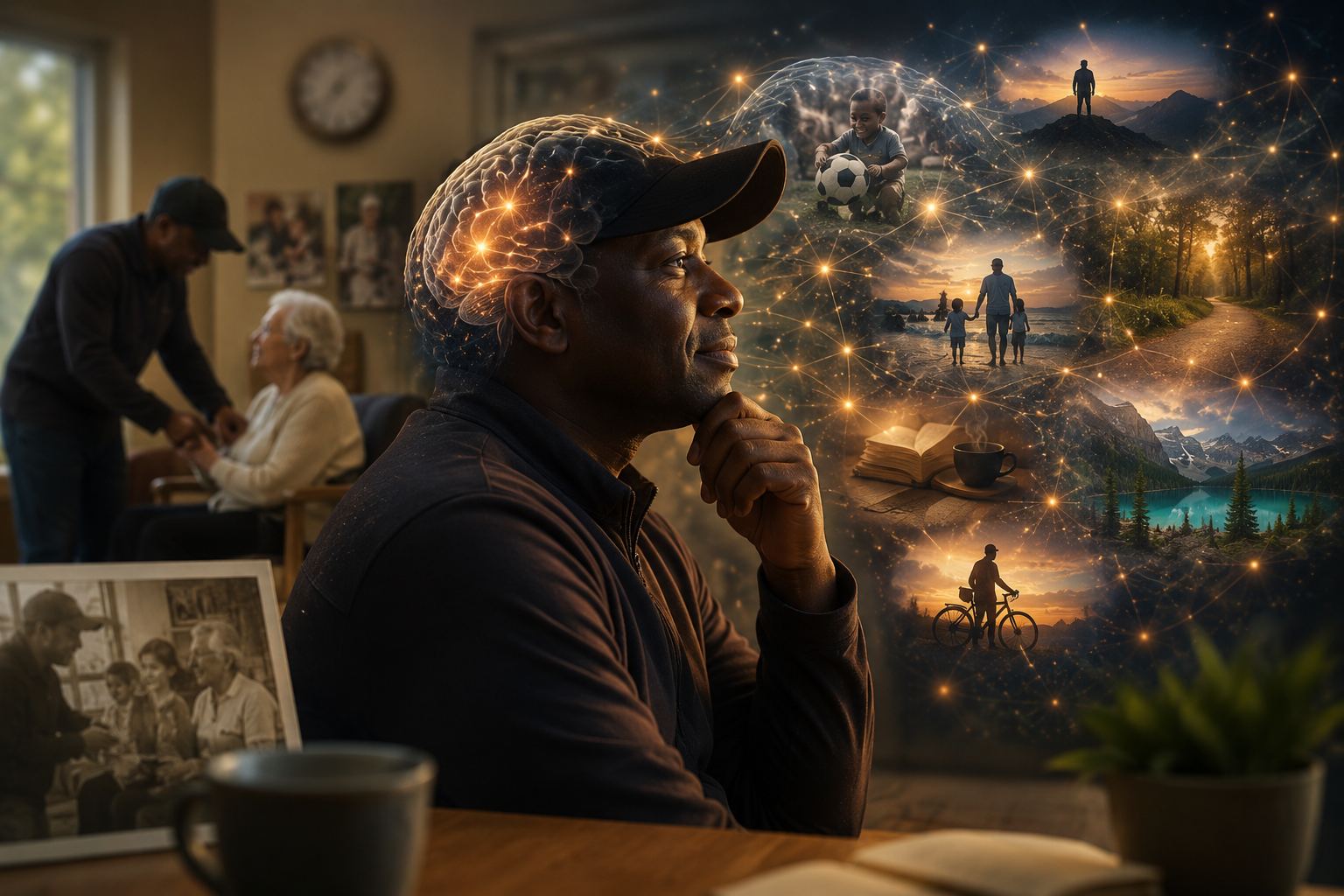
In my work with people living with dementia, I have sometimes seen something that stays with me long after a session ends. A person may struggle to remember a conversation from a few minutes earlier, yet suddenly recognize a familiar song and begin humming along. For a moment, something seems to reconnect. It reminds me that memory is far more complex than simply remembering or forgetting.

So, what actually is a memory?

We often imagine memory as a recording stored somewhere inside the brain. But biologically, it is much more interesting than that. A memory begins with an experience and the changes that experience produces within the nervous system. Most moments leave little lasting trace. Some, however, produce changes that can remain for years or even decades.

How Does an Experience Become a Memory?

The first stage is called encoding. This is the process through which the brain processes information from an experience so that it can potentially be remembered later.

Attention matters. If someone introduces themselves while your mind is somewhere else, you may forget their name almost immediately. If you are interested in the person and pay attention, the information has a much better chance of being retained. Emotion, importance, and novelty can also influence how strongly an experience is encoded.

The Hippocampus Helps Connect the Pieces

One of the brain structures most important for forming new episodic memories is the hippocampus, located deep within the temporal lobe.

It is better to think of the hippocampus as an organizer rather than a storage box. An experience contains many pieces: where you were, what you saw, what you heard, what happened, and how you felt. The hippocampus helps bind these different elements together so that they can later be retrieved as an event.

That is how separate pieces of information can eventually become something you recognize as a memory of an experience.

A Memory Can Change the Brain

At a much smaller level, memory involves changes in communication between neurons. These cells communicate through connections called synapses, and experience can alter the strength and efficiency of those connections.

Scientists call this ability synaptic plasticity.

In simple terms, learning something can physically and functionally change the way groups of neurons communicate. Your experiences do not simply pass through your brain and disappear. Some leave lasting biological changes behind.

Something that happened to you can change the brain that remembers it.

Why Do Some Memories Last?

Not every experience becomes a long-term memory. Some information disappears within seconds or minutes, while other memories become more stable through a process called consolidation.

Sleep appears to play an important role in this process. While we sleep, the brain remains biologically active and continues processing information from our waking experiences. Some recently formed memories can be reactivated and reorganized, helping strengthen their representation over time.

So, while we may feel that nothing is happening, the sleeping brain can still be quietly working with what we experienced during the day.

Memory Is Not One Single System

There is also no single type of memory. Episodic memory helps us remember events and experiences. Semantic memory supports facts and general knowledge. Procedural memory helps us learn skills and actions.

These forms of memory depend on partly different brain systems. This distinction will become especially important later in our series, when we explore dementia and why some abilities can remain even when other types of memory become seriously affected.

A Moment Can Outlive the Moment

An experience may last only a few seconds, but the biological changes associated with it can sometimes remain for decades.

A moment happens. The brain processes it. Neural connections change. Some information fades, while some becomes part of the network we can later retrieve.

But there is still something deeper to understand.

Why does one memory feel like simple information, while another feels like a piece of my life?

Why can a familiar song, smell, photograph, or voice suddenly bring an old moment back with such emotional force?

That is where we begin to discover the fascinating connection between memory and “me.”

Next: Part 4B

When a Memory Becomes “Mine”

Why Some Memories Become Part of Who We Are

In the next article, we will explore why certain memories feel deeply personal, why remembering can create the feeling “I was there,” and how the brain connects an experience with our sense of self.

2026/08/19

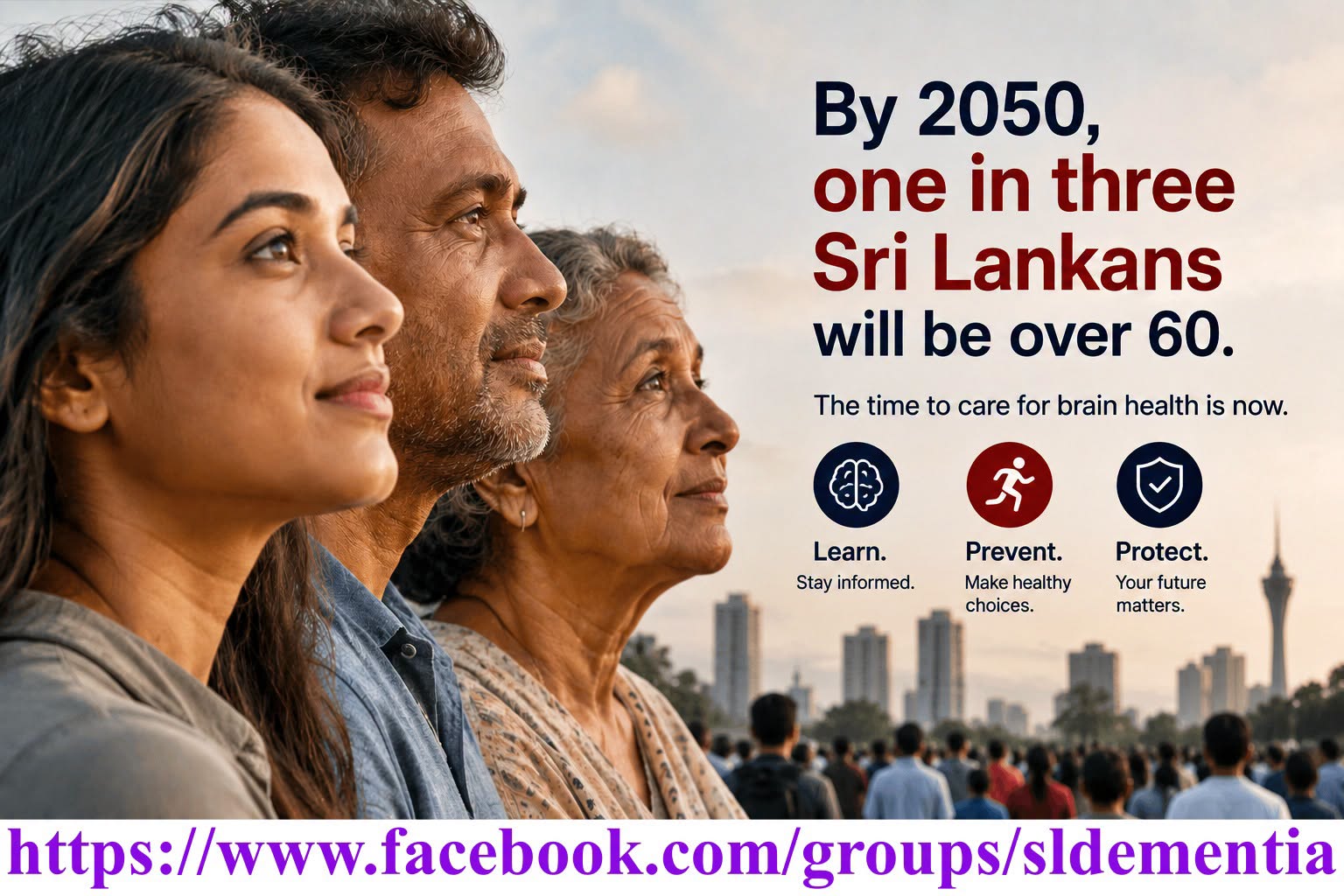
2050දි, තුනෙන් එකෙන් ගැලවෙන්නට

ඩිමෙන්ෂියාව ඔබේ පවුලේ වැඩිහිටියන්ට පමණක්ද?

ඩිමෙන්ෂියාව කියන්නේ, ඔබේ අත්තම්මා, සීයාට විතරක් හැදුනු හෝ ඇති කියන හිතන තත්ත්වයක් කියලම හිතන්න එපා.

අපේ රට හුඟක් වයසට යන රටවල් අතර ඉහළින් ඉන්න තැනක්. ඒ කිව්වේ, වියපත් ජනගහණය ඉක්මණින්ම වැඩිවන රටක්.

2050 වෙත්දි සිදුවෙන්නේ කුමක්ද?

2050 වෙත්දි, දළ වශයෙන් සිරි ලාංකිකයන් තුන් දෙනෙක්ගෙන් එක් අයෙක් අවුරුදු 60 සීමාව පැනපු අය වේවි.

ඒ කියන්නේ, ඩිමෙන්ෂියාව ගැන කතා කරත්දි අවදානම් වයස් සීමාවක්.

දැන් මේ කියන තුන් දෙනාගෙන් එක් අයෙක් අතර ඔබ නොසිටීවි යැයි කියන්න පුළුවන් කාටද?

අනාගතයේ බෙහෙතක් තිබේවිද?

දැන් කෙනෙක් කියන්න පුළුවන්,

"අ‍පෝ ඒ වෙත්දි ඩිමෙන්ෂීයාවට බෙහෙතක් හදාගෙන තියේවි"

කියල.

ඔව්, සමහර විට.

නමුත්, එතැනදීත් "සම්පුර්ණ සුව" කියන වචනයට වඩා ලක්ෂණ අඩු කිරීම හෝ ඩිමෙන්ෂියාව ඇති වීම පමා කරගැනීමට උදව් වන කියන පැහැදිලි කිරීම සහිත ඖෂධ අනාගතයේ නිශ්පාදනය වෙන්නට පුළුවන්.

බෙහෙතක් තිබුණත්, එය අපට ලැබේවිද?

ඒත්, එහෙම නිශ්පාදනය වුනත්, වෙළඳපලට ආවත්, මේ පර්යේෂණ පසුපස සමහර ඖෂධ සමාගම හඹායන ආකාරය දැක්කාම, එහෙම බෙහෙතක් හැදුනත් අපේ මිනිසුන්ට දරා ගන්න පුළුවන් මිලකට එය ලැබේදැයි සැක හිතෙන තරම්.

අද ගන්න පියවර, හෙට වෙනුවෙන් කරන ආයෝජනයක්

ඒ නිසා, තවමත් නැති බෙහෙතක් ගැන හිතමින් ඉන්නවාට වඩා, ඩිමෙන්ෂියාව වලක්වා ගැනීම හෝ ප්‍රමාද කරගැනීම සඳහා කළ හැකි දේ, ගත හැකි පියවර අදම ගන්නේ නම් එය ඔබේම හෙට දවස වෙනුවෙන් කරන ආයෝජනයක් වේවි.

දැනුවත් වෙන්න

ඒ පියවර සහ තවත් තොරතුරු "ඩිමෙන්ෂියා සුව අසපුව" තුල තිබෙනවා.

ඇවිත් කියවන්න, දැනුවත් වෙන්න. ඒ තමයි ඔබ වෙනුවෙන් කළ හැකි සරළ සහ වැදගත් ආයෝජනයක්. ඩිමෙන්ෂියා සුව අසපුව

අවදානම හඳුනාගන්න

අවදානම හදුනාගන්න වගේම තවත් තොරතුරු සඳහා මෙන්ටියෝ ඇප් එකට එන්න මෙතැනින්. Mentio

The brain's story machine

"Do you know who this is?" Ron pointed to a face in an old black and white photograph.

His wife had early onset dementia. Her speech was still clear, she could carry on a conversation, and she managed most of her daily routines at home without much trouble. But her memory was slipping fast, faster than everything else about her.

One of my favorite tools during my years working in the dementia field was reminiscence therapy. Sitting down with someone and going through old photographs, listening to old songs, and talking about stories from their life. I loved it because I could watch a person’s eyes light up when they talked about their school days, a first date, or a family gathering. And then, in the same session, that same person sometimes could not recognize themselves in the very photograph they were looking at.

Ron's wife studied the picture for a moment and said, "No honey, I know that lady, she looks very familiar, but I don't remember who she was. But I know this is my uncle Greg."

The woman in the photo was her, at eighteen years old, at a family party. She could name almost everyone else in the picture. She could not find herself.

Moments like that stayed with me. They are part of why I have spent so much time thinking about memory and how closely it is tied to our sense of who we are.

In the first two parts, we looked at what "I" means and why there is no single place in the brain where the self lives. Now we can move into something closer to everyday life. How does the brain turn raw experience into a story about who you are?

Think about your own life. You have lived through thousands of days, conversations, meals, journeys, successes, and disappointments. Most of it is gone. You remember a small fraction of what actually happened to you. Somewhere in the brain, a decision gets made about which experiences deserve attention, which become memories, and which eventually become part of the story you tell about yourself.

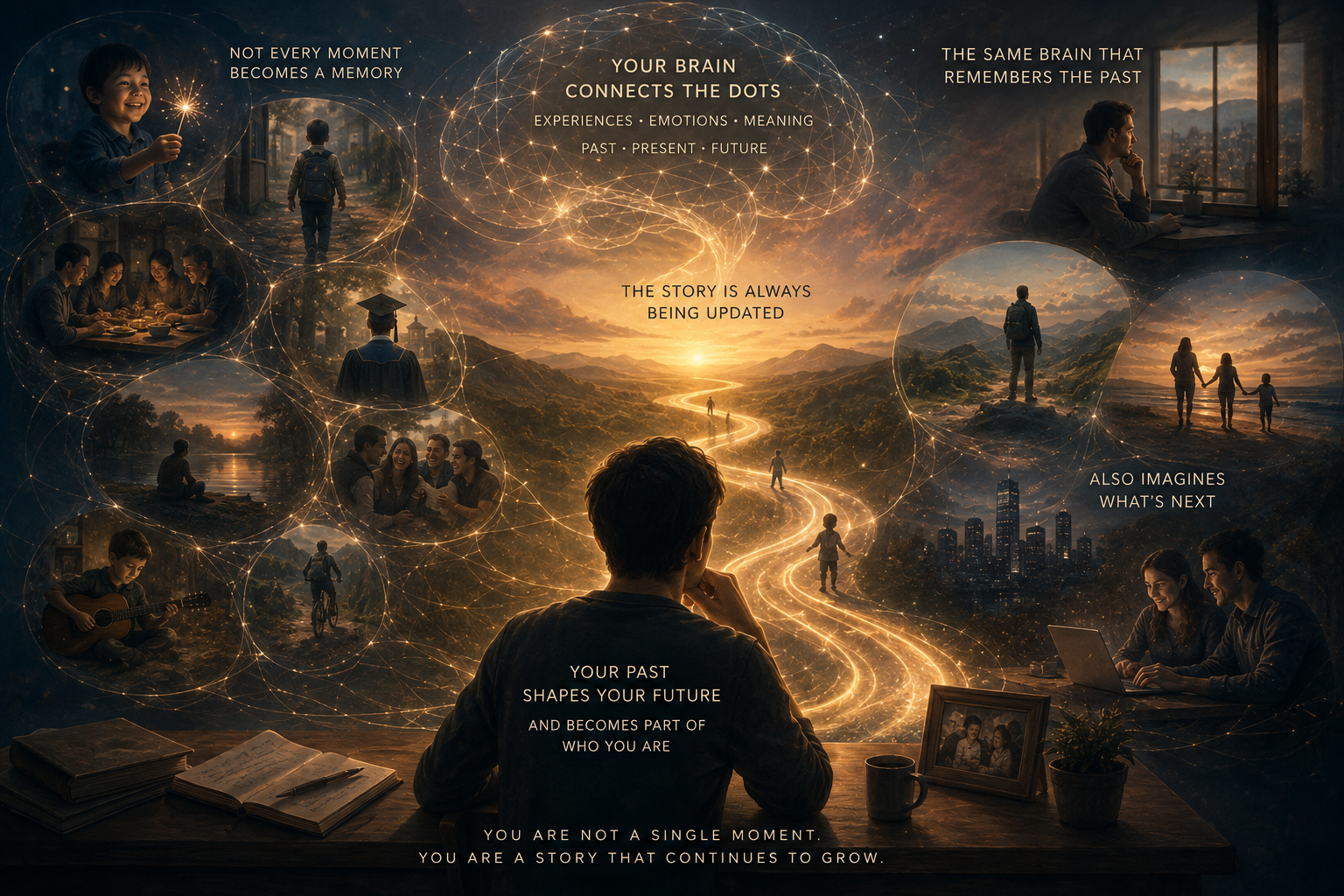
Not everything becomes a memory

Every second, your senses hand your brain an overwhelming amount of information. Sights, sounds, touch, smell, movement, and your own internal reactions all arrive at once. The brain does not have the capacity to store all of it with equal weight, so it filters.

Attention is one filter. If you are not paying attention to something, it is far less likely to be encoded as a memory at all. Emotion is another. The amygdala, a small structure near the center of the brain, responds to emotionally charged events and signals to the hippocampus that this particular moment is worth holding onto. That is part of why you can remember exactly where you were during a piece of frightening or joyful news, while an ordinary Tuesday from the same month has vanished completely. Novelty matters too. A brain that has seen the same commute, the same kitchen, and the same faces a thousand times stops flagging them as new information worth storing in detail.

This is why two people can sit through the same event and remember it differently afterward. They were in the same room, but their brains were not doing the same work. One person's attention was on the conversation, another's was on how they felt about it, and each ended up encoding a different version of what happened.

Your brain is not recording your life the way a camera does. It is deciding, moment by moment, what is worth keeping.

From experience to personal memory

Picture meeting someone who eventually becomes important in your life. At the start, it is just an experience. You see their face, hear their voice, register what they say, and feel some kind of reaction, curiosity, comfort, maybe nothing much at all.

If that encounter turns out to matter, the different pieces of it start getting bound together into something the brain can retrieve later as a single memory. This binding is largely the job of the hippocampus. It does not store the memory permanently in one place. Instead, it acts more like an index, linking the sight of that person's face, the sound of their voice, the room you were in, and your emotional state at the time, so that all of it can be pulled back together later. Over months and years, through a process called systems consolidation, much of that information gradually shifts toward the neocortex, spread across networks rather than held in a single structure. This is one reason very old memories can survive even after hippocampal damage, while very recent ones are often the first to be lost.

Years later, you may not remember a single word that was spoken. But you might remember where you were, what the person looked like, and most of all, why that moment mattered to you.

An experience has become part of your personal history.

Memory gives experience meaning

A memory is rarely just a fact sitting in storage.

Think about an old photograph. You recognize the people, the place, roughly the year. But the photograph also pulls up feelings, relationships, and other memories tied to that period of your life. That pull is not a side effect. It is close to the whole point of what memory does.

This is where memory and identity start to overlap. An experience gets linked to emotions, beliefs, relationships, and later events, and those links can keep shifting. Something that felt ordinary at the time can turn into something important years later, once your understanding of it has changed.

A hard experience can become the story "I got through that."
A failure can become "that taught me something."
A relationship can become "that person changed how I see things."

The event itself happened once. What it means to you can keep developing long after it is over.

The story can change

Here is one of the stranger features of memory. Remembering is not replaying a recording.

When you retrieve a memory, the hippocampus and related regions reconstruct it using whatever information is available to you right now, not just what was encoded at the original moment. Your current mood, your present knowledge, and everything that has happened to you since can all shape how you understand something from the past. There is even evidence that memories become briefly unstable each time they are recalled, a process researchers call reconsolidation, before being stored again, sometimes with small changes.

This does not mean your memories are false. It means human memory works more like an ongoing edit than a fixed video file.

You may remember the same event differently at fifty than you did at twenty. The event has not changed. Your understanding of it has.

That is one reason your personal story keeps evolving throughout your life, even when nothing new is happening to you.

The past also helps you imagine tomorrow

The brain does something even more useful with these stored experiences. It uses them to imagine futures that have not happened yet.

If you have sat through a difficult interview before, your brain draws on that memory when you are preparing for the next one. If you have traveled before, those memories give your mind material to picture the next trip. This is not a coincidence of language. Brain imaging studies have found that remembering the past and imagining the future activate overlapping networks, including the hippocampus and regions involved in constructing scenes. The same machinery that reconstructs where you have been also builds where you might go.

So memory is not only the brain looking backward. It is raw material the brain uses to look forward.

But what happens when the story starts to fade?

This is where the series is heading next, and where the questions get harder.

If memories build our personal story, what happens when those memories become difficult to retrieve?

What happens when someone remembers their childhood clearly but cannot remember what happened yesterday?

What happens when a person can no longer tell us the story of their own life?

And the harder question underneath all of this: if parts of my story disappear, what happens to my sense of "me"?

To get anywhere close to answering that, we first need to understand memory itself in more detail. What actually happens inside the brain when an experience becomes a memory? Where does it go? How does it survive for decades? And why can a single smell, a song, or a familiar voice suddenly open a door to a part of your past you thought was gone?

Next: Part 4, Memory and "me": why do my memories feel like they belong to me?

The next article goes into the connection between memory and identity, and why remembering an event carries the powerful feeling that it happened to you, specifically, and not to someone else.

Where Is “Me” in the Brain?

There Is No Single “Self Centre”

In Part 1, we asked what we really mean when we say “I.” We looked at the Present Self, the feeling that “I am here,” and the Story Self, the feeling that “this is my life.” Now we can take the next step and ask a surprisingly simple question:

If the brain creates the feeling of being “me,” where exactly is “me” in the brain?

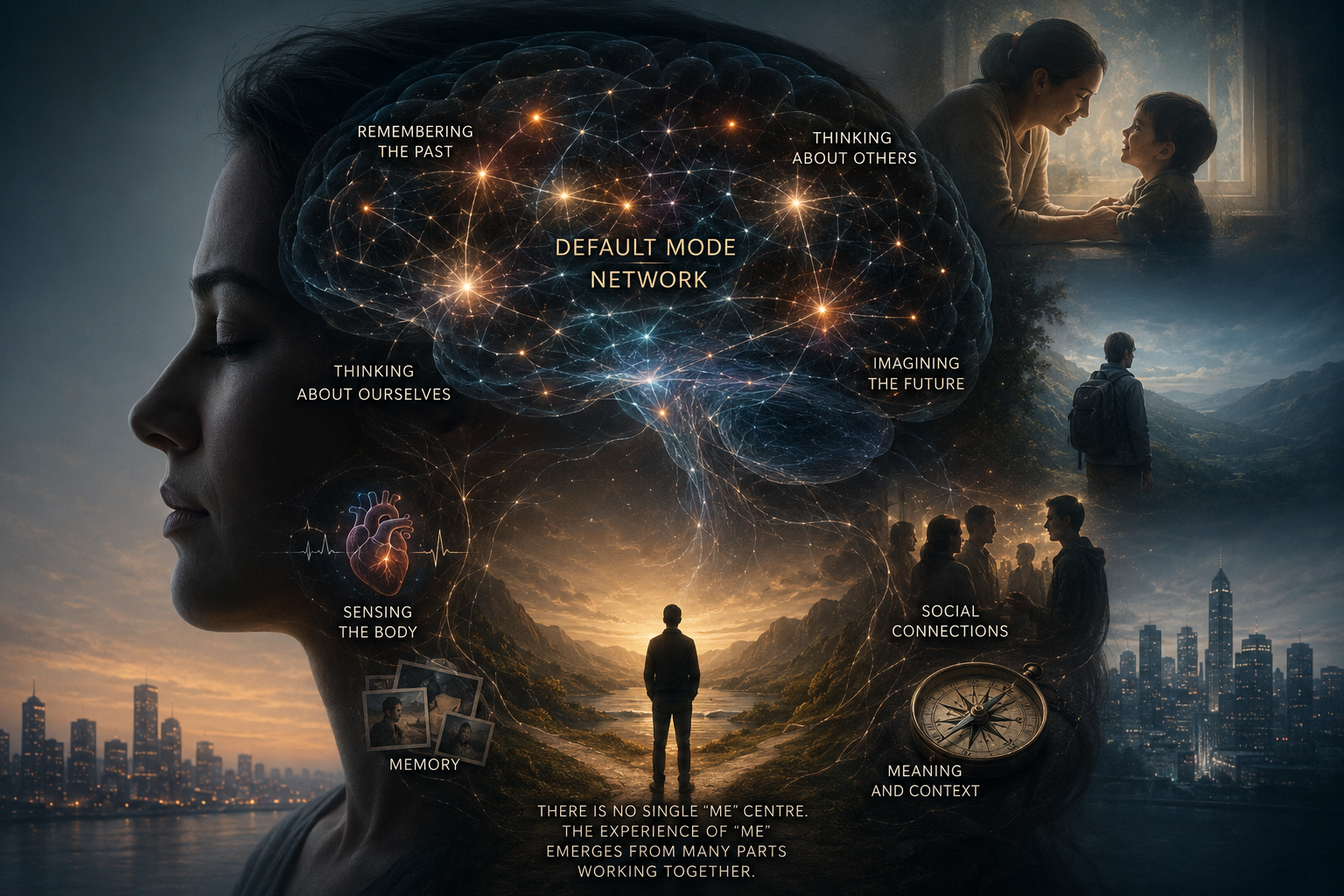
It is tempting to imagine that somewhere inside our skull there must be a special place where our identity lives. Perhaps there is a small area quietly watching everything we see, hear, remember, and feel. But neuroscience has not found such a place. There is no single “self centre” that contains the whole person. Instead, the experience of being ourselves appears to involve several connected brain systems working together.

The Brain Works as a Network

This is an important idea in modern neuroscience. The brain is not simply a collection of separate boxes, with one box responsible for memory, another for emotion, and another for the self. Brain regions communicate continuously, and many participate in more than one function.

When you recognize yourself, remember something important, make a decision, feel an emotion, or think about your future, different parts of the brain are working together. What you experience as one simple thought, such as “This is happening to me,” may actually depend on communication across a much larger network.

This is why scientists increasingly study brain networks, rather than looking only for individual brain locations.

Meet the Default Mode Network

One of the most interesting networks connected with our sense of self is called the Default Mode Network, or DMN. Despite its name, the DMN is not simply the brain's resting mode. It becomes active during many forms of inward thinking, especially when our attention moves away from the immediate task and toward our own thoughts, memories, plans, and relationships.

Think about what happens when you are quietly sitting in a room and your mind begins to wander. You might remember something that happened years ago, think about a conversation from yesterday, wonder what someone thinks about you, or imagine what you will be doing next month. Your body may be sitting still, but your brain is moving through different moments and possibilities.

The DMN is involved in many of these internally focused processes. It helps the brain work with information about ourselves, our experiences, our possible future, and our social world.

The Brain Asks, “What Does This Mean for Me?”

One fascinating part of self-related thinking is that the brain does not simply record what happens. It tries to understand what an experience means in relation to us.

Imagine hearing that someone is moving to another city. That is simply information. But if you hear, “You are moving to another city,” your brain immediately begins doing something different. You may think about your home, your family, your work, the people you would leave behind, and what your new life might look like.

The event has become personal.

The brain has moved from “something is happening” to “something is happening to me.”

This kind of self-related processing involves several interacting brain systems, including parts of the default network. It is one reason researchers are interested in the DMN when studying how the brain creates a sense of personal meaning and identity.

The Brain Can Travel Through Time

There is another remarkable ability connected with these systems. Your brain can move mentally between the past and the future.

Think about planning a holiday. You might remember previous trips, imagine places you have never visited, predict what the experience might be like, and picture yourself walking through an unfamiliar city. The trip has not happened, yet your brain can construct a possible version of it.

This ability is sometimes called mental time travel. The hippocampus and broader brain networks involved in memory and imagination help make this possible.

The interesting part is that remembering and imagining are not completely separate activities. The brain can take pieces of past experience and use them to construct possible futures.

So the brain is doing more than asking:

“Who was I?”

It is also asking:

“Who might I become?”

That ability gives our identity a sense of continuity. We can look backward at the person we were and forward toward the person we might become.

“Me” Also Depends on Other People

There is another part of identity we often overlook. We do not discover who we are completely by ourselves. Much of our identity develops through relationships.

We may understand ourselves as a parent, child, partner, friend, colleague, caregiver, or member of a community. These identities exist because we are connected to other people.

The brain therefore needs to understand not only what we think and feel, but also what other people might think and feel. Brain networks involved in social cognition help us consider another person's perspective, intentions, beliefs, and emotions.

This means that our sense of “me” is partly built within a social world.

Who I am is influenced not only by what I remember about myself, but also by how I understand my place among other people.

There Is No Finished Version of You

Perhaps the most interesting part is that the brain does not create our identity once and then leave it unchanged.

It keeps updating.

A new relationship can change how we see ourselves. Becoming a parent can create a new part of our identity. Moving to another country can change how we think about belonging. Losing someone important can change our understanding of our own life. A major illness can change how we experience our body and imagine our future.

The brain continually incorporates new experiences into its understanding of the world and ourselves.

So the “me” you experience today is connected to your past, but it is also being shaped by what is happening right now.

So, Where Is “Me”?

After looking at all of this, we can return to our original question.

Where is “me” in the brain?

The best answer science can currently give is: there does not appear to be one place.

The experience of self involves multiple interacting systems that process memories, thoughts, emotions, bodily information, social relationships, and expectations. The Default Mode Network is an important part of this picture, but it is not the place where “I” is stored.

Perhaps the better question is not:

“Where is the self?”

but:

“How does the brain continuously create a sense of self?”

And that question leads us toward something even more fascinating.

If the brain uses information from the past to understand who we are today and to imagine who we might become tomorrow, then memory is not simply something we possess. It may be one of the processes that helps hold our sense of identity together.

And that takes us to the next stage of the journey.

Next: Part 3 — The Brain’s “Story Machine”

How the Brain Connects My Past, Present, and Future

In the next article, we will explore how the brain turns experiences into a personal story, why a smell, song, or familiar place can suddenly bring an entire part of our past back to life, and how the same brain systems that help us remember the past also help us imagine the future.

2026/08/18

What Is “I”?

How the Brain Creates the Feeling of Being Me

Every person uses the word “I” thousands of times without thinking about what it actually means. “I am tired.” “I am hungry.” “I remember.” “I am happy.” “I want to go home.” The word seems simple, but behind that small word is one of the most fascinating questions in neuroscience: what exactly is the “I” that we experience as ourselves?

Is “I” my body? Is it my brain? Is it my memories, personality, thoughts, or emotions? Or is the feeling of being “me” created from all of these things working together? Neuroscience does not point to one particular place in the brain and say, “This is where the self lives.” Instead, our sense of self appears to develop from many interacting brain systems, together with information coming continuously from our body and the world around us.

The “I” Begins With the Body

Before we knew our name, we had a body. Before we had childhood memories, we could feel hunger, pain, warmth, cold, touch, and discomfort. Our brains constantly receive information about what is happening inside the body, including signals related to heartbeat, breathing, digestion, temperature, and muscle activity. This process is known as interoception, which simply means the brain's ability to sense the internal condition of the body.

One brain region involved in processing many of these internal signals is the insula. The insula is not a place where the “self” is stored, but it is part of a larger network involved in bodily awareness, emotions, and conscious experience. Through this continuous communication between the body and brain, we develop a basic feeling that “this is my body” and “I am here.”

This is what we can think of as the Present Self. It does not require a detailed personal history. You do not need to remember your childhood to feel pain today. You do not need to know your name to feel warmth or comfort. It is the immediate experience of being a living person in the present moment.

Then We Develop a Story About Ourselves

As we grow, something more complex begins to develop. We learn our name, recognize our family, remember important experiences, develop preferences, form relationships, and begin to understand where we came from and where we might be going. Gradually, the brain builds a personal story.

We can describe ourselves by saying, “This is where I grew up,” “This is my family,” “This is what I do,” “This happened to me,” or “This is what I want to do in the future.” These statements are not simply facts about us. Together, they help create our sense of personal identity.

This is what we can call the Story Self. It is the feeling that “this is my life and this is my story.”

The Brain Behind Our Personal Story

Several interconnected brain systems contribute to this sense of personal identity. One important network is the Default Mode Network, or DMN. Despite its complicated name, the basic idea is quite simple. This network is active during many forms of inward thinking, such as remembering personal experiences, thinking about ourselves, imagining the future, and considering what other people may be thinking.

The DMN works together with other brain systems, including memory-related areas such as the hippocampus. Together, these systems help connect different moments of our lives. We can remember something from yesterday, think about something that happened twenty years ago, and imagine what might happen next year. Our brain links these experiences across time, helping create the feeling that the person we were in the past and the person we are today belong to the same continuing story.

Two Sides of the Same “I”

The Present Self and the Story Self are not two separate people living inside the brain. They are two useful ways of understanding different parts of our experience of being ourselves.

The Present Self gives us the feeling:

“I am here.”

The Story Self gives us the feeling:

“This is who I am.”

Most of the time, our brain combines these experiences so smoothly that we never notice the process. We can feel our body while remembering our past. We can think about yesterday while sitting in the present. We can imagine tomorrow while still feeling that we are the same person who lived yesterday.

All of these experiences come together into one simple word:

“I.”

But What Holds the Story Together?

Now we reach an important point.

If part of our identity comes from our personal story, what allows us to maintain that story?

The answer brings us to one of the most important functions of the human brain:

memory.

Your name is connected to memory. Your childhood is connected to memory. Your relationships, experiences, achievements, disappointments, and important moments are connected to memory. Memory helps link the person you were with the person you believe yourself to be today.

This means memory may be much more than a system for remembering where you left your keys.

Memory may be one of the threads that holds the story of “me” together.

And that leads us to the next question:

If memory is part of who I am, where is “me” in the brain?

Next: Part 2 — Where Is “Me”?

Is There a Self Centre in the Brain?

2026/08/17

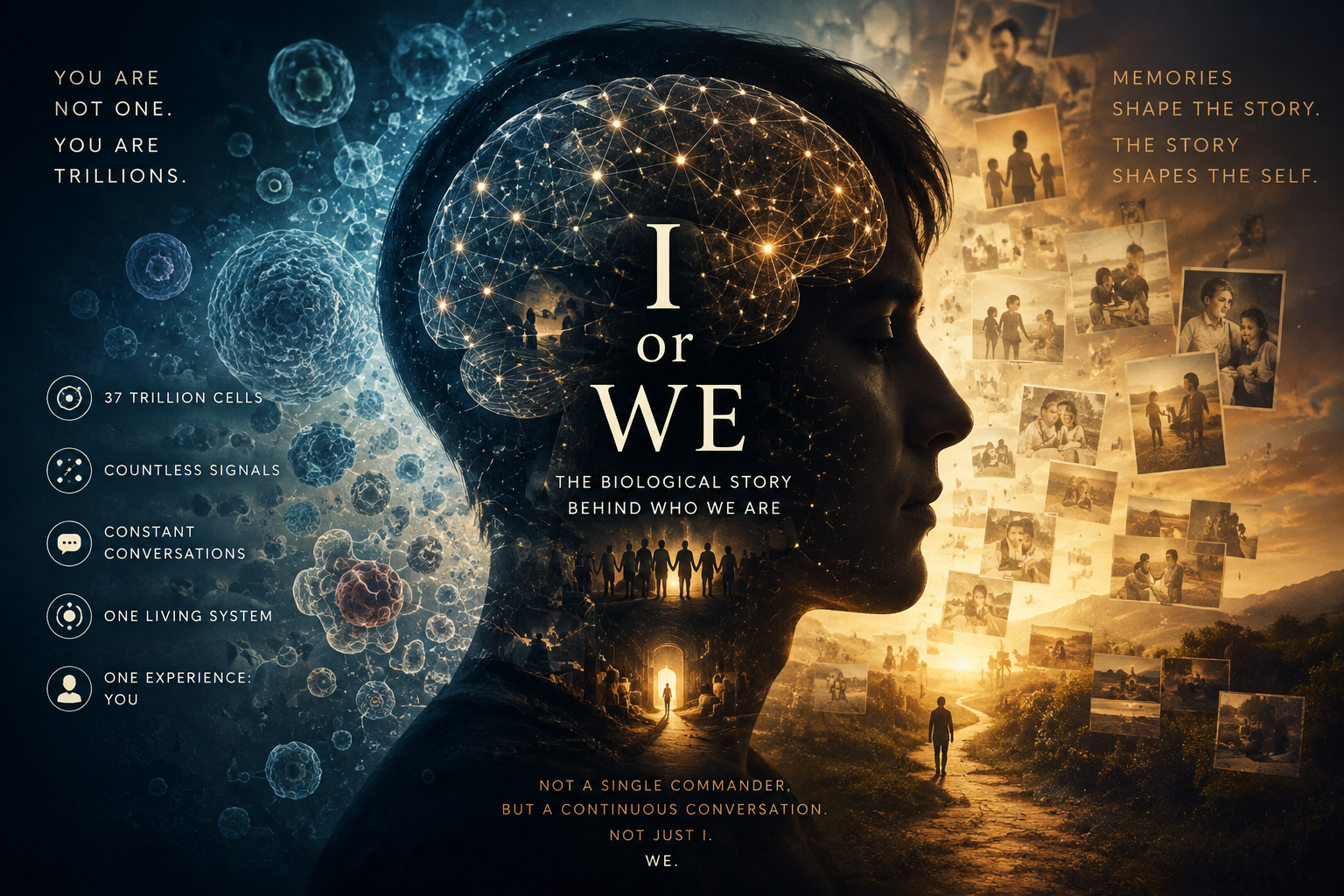
“I” or “We”?

The Biological Story Behind Who We Are

Where Did They Go?

Every day, in our lives and especially when we encounter neurodegenerative conditions, we see how closely memory and identity are connected. Families may look at a loved one whose memory is changing and quietly ask, “Where did they go?” The person is still physically there, but names may disappear, familiar stories may become confused, and people they once knew may no longer be recognized. Behind this painful experience is a question that applies to every one of us: What exactly is “myself”?

What Do We Really Mean When We Say “I”?

We use the word “I” constantly without stopping to think about it. “I am hungry.” “I am tired.” “I remember.” “I decided.” “I am happy.” The word feels simple. It seems to describe one person, one mind, one continuous self experiencing life from somewhere behind our eyes. But when we look more closely through the lens of biology and neuroscience, the picture becomes much more complicated. There may be an “I,” but that “I” does not appear to be one single thing operating alone. In many ways, “we” may be a better place to begin.

A Body Made of Many Living Parts

The human body contains tens of trillions of cells, each carrying out its own specialized work. Nerve cells communicate with one another, heart cells keep the heart beating, liver cells perform their functions, and immune cells constantly monitor for threats. None of these individual cells knows your name. None looks into a mirror and thinks, “That is me.” Yet together, they produce a living human being who can think, remember, love, fear, plan, and ask the extraordinary question, “Who am I?”

There is no tiny person inside the brain controlling every cell. Instead, the body is a vast network of communication. Cells communicate with cells, organs communicate with the brain, and the brain communicates continuously with the body. Hormones carry chemical messages through the bloodstream, nerves carry electrical signals, and the senses constantly bring information from the outside world. From all of this activity emerges something that feels remarkably simple: the experience of being me.

Even Hunger Is a Team Effort

We can see this in something as ordinary as hunger. When we say, “I am hungry,” it feels like one simple personal experience, but many biological processes are involved. An empty stomach can trigger the release of ghrelin, a hormone involved in hunger signalling. Other parts of the body provide information about energy stores and nutrient availability, while the brain integrates these signals through systems including the hypothalamus, which plays an important role in regulating hunger and energy balance. At the same time, sights, smells, memories, and thoughts about food can influence the experience. Many different signals come together, yet our final experience is simply, “I am hungry.”

There is no single cell thinking, “The person is hungry.” There is a network of biological processes communicating with one another. The experience feels like one thing, while the biology underneath it is many things working together.

The Same Thing Happens With Emotions

The same principle can be seen with emotions. When we say, “I am anxious,” the experience feels like one thing, but it may involve changes in heart rate, breathing, muscle tension, hormones, attention, and memory. The brain brings these different signals together and produces a unified experience that we recognize as our own. Pain, thirst, fear, pleasure, fatigue, and excitement work in similarly complex ways. We experience them as “I feel,” “I think,” or “I want,” even though the biology underneath involves many systems working together.

This does not mean that the “I” is fake. It means that the “I” may be something that emerges from the activity of the whole system.

Is the “I” Real?

Think about an orchestra. We hear one piece of music, but that music comes from many instruments working together. No single instrument contains the entire symphony. The music emerges from their interaction.

The human brain and body are far more complicated than an orchestra, but the comparison helps us understand the basic idea. The experience of “me” may emerge from many different biological processes communicating and working together.

The self may therefore be less like a fixed object and more like a living process.

Memory Gives the “I” a Past

This is where memory becomes especially important. When someone asks, “Who are you?”, we usually answer with pieces of our personal story. We give our name, describe our family, remember where we grew up, talk about our work, our relationships, our interests, and the experiences that shaped us.

Much of this depends on memory.

We know our name because we remember it. We recognize our family because we remember the people and relationships connected to them. We know our own history because our brain has connected experiences across time.

Memory therefore does much more than help us remember where we left our keys.

Memory helps give the “I” a past.

It connects the person we were yesterday with the person we experience ourselves to be today. It helps create the feeling that, despite all the changes happening inside our bodies, there is still a continuous person moving through time.

What Happens When Memory Changes?

But this immediately creates another question:

What happens to the “I” when memory changes?

What happens when someone forgets their childhood? What happens when familiar names disappear? What happens when someone can no longer recognize a person they once loved? What happens when a brain injury changes the way a person thinks? What happens in dementia?

And perhaps the deepest question of all is this:

If some memories disappear, does some part of the person disappear with them?

These are not only questions about dementia. They are questions about every human being because every one of us is changing. Our bodies change, our brains change, our experiences change us, and our memories are constantly being formed, modified, strengthened, or forgotten.

Yet through all of these changes, we continue to experience a sense that there is someone here.

Me. I. Myself.

How does that feeling survive?

The Journey We Are About to Take

That is the question this series will explore. We will look at “Who am I?” through neuroscience, biology, psychology, memory, consciousness, aging, dementia, and the changing brain.

We will approach these questions from a science-based perspective, beginning with what we can observe and study: the human body, the brain, behaviour, memory, and consciousness. We will not assume that science has every answer. In fact, some of the most interesting questions remain unanswered.

As we move through the series, we will ask whether you are the same person you were ten or twenty years ago, where the sense of self comes from, how one memory can suddenly bring an entire emotional world back to life, why a person can forget an event but still respond emotionally to something connected with it, and what remains of “me” when memory begins to fade.

Eventually, the journey will take us into dementia and the changing brain, and then further toward the final stages of life. We will ask what happens when the brain can no longer maintain the memories, thoughts, language, and other processes that normally help us recognize ourselves and others. We will explore what science can tell us about the dying brain, and also where scientific knowledge reaches its limits.

One Final Thought Before We Begin

There may not always be comfortable answers. But perhaps that is exactly why we should ask these questions.

When you say “I think,” a living brain is producing patterns of electrical and chemical activity. When you say “I remember,” the brain is reconstructing information from the past. When you say “I feel,” the brain and body are continuously exchanging information. And when you say “I am me,” you are describing one of the most remarkable experiences produced by a biological system we are still trying to understand.

Perhaps the “I” is not a tiny person hiding somewhere inside the brain. Perhaps it is something that emerges from the conversation between many parts of us: a living story created by a changing brain, connected to a changing body, shaped by experience, relationships, emotions, and memory.

So before we ask “Who am I?”, we need to understand the biological system that allows a human being to ask the question in the first place.

That is where our journey begins.

A Note From the Author

I am not a neuroscientist or a researcher who has studied this field in depth. I am a healthcare professional who works with people living with neurodegenerative conditions, and this work has sparked my interest in understanding the brain, memory, identity, dementia, and consciousness. I also have two research fellows in this field in my family, which has further encouraged my curiosity and learning.

This series reflects my own questions, ideas, and reflections, supported and polished using relevant scientific findings and research. It is not intended to present me as a scientific authority, but rather as a healthcare professional exploring these fascinating questions through continued reading and learning.


This is the opening preface to a series exploring identity, memory, the brain, consciousness, dementia, aging, and end-of-life neurophysiology. The series is written in everyday language rather than academic terminology, making these complex ideas accessible to anyone who is curious about one of the most personal questions we can ask: Who am I?

2026/08/15

Welcome to Canada- Part 17

💼 Beyond Getting Your First Job

In the previous article, we talked about finding your first job in Canada, including preparing a Canadian-style résumé and writing a strong cover letter. Getting that first opportunity is an important step, but it is only the beginning of your working life in Canada. Once you enter the workplace, another journey begins. You start learning how people communicate, how decisions are made, how colleagues work together, and what employers expect from you. At the same time, you begin building relationships that may become important throughout your career.

For many newcomers, understanding Canadian workplace culture, building a professional network, and gaining experience through volunteering can make the transition much easier.

Understanding Workplace Culture

Every country has its own workplace habits and expectations. Something that is considered normal in your home country may be understood differently in Canada. Canadian workplaces generally place a strong value on respect, punctuality, communication, teamwork, and professionalism. People may expect you to express your ideas, ask questions when you are unsure, and communicate openly with your supervisor and coworkers.

For some newcomers, this can take time to understand. In some cultures, employees may be expected to wait for a manager to give instructions before speaking up. In many Canadian workplaces, however, employers appreciate employees who show initiative and respectfully share ideas. Communication style can also be different. Canadian workplaces often use polite and relatively informal communication, even between employees and managers. A supervisor may ask, "How are you doing?" or "What do you think?" This does not necessarily mean they are treating you as a close friend. It is often simply part of creating a comfortable and respectful workplace.

Learning these small differences can help you feel more confident and avoid unnecessary misunderstandings.

🤝 Building Your Professional Network

Getting a job is important, but building relationships can be just as important for your long-term career. Networking does not have to mean walking into a room full of strangers and handing out business cards. For many newcomers, networking simply begins with talking to people. Your coworkers, former classmates, neighbours, community members, instructors, volunteers, and people you meet through professional activities can all become part of your network.

Sometimes a simple conversation can lead to something unexpected. Someone may tell you about an opening at their workplace. Another person may introduce you to someone working in your profession. Someone else may explain how to obtain a Canadian certification or where to find additional training. This is why it is important not only to search for jobs online but also to build genuine connections with people around you.

Networking should not be about asking everyone you meet for a job. It is about building relationships, learning from others, and becoming part of your professional community.

🌱 Volunteering Can Open Doors

For newcomers who are struggling to find their first job, volunteering can be a valuable way to gain Canadian experience. Volunteering allows you to use your existing skills while learning about Canadian workplaces and meeting people from different backgrounds. It can also help you develop new skills and demonstrate your reliability, communication, teamwork, and willingness to contribute.

For example, someone with administrative experience might volunteer at a community organization. Someone with healthcare experience might find an appropriate community role where they can learn about the Canadian environment. Someone interested in technology might help a nonprofit with its digital activities.

Volunteering does not mean giving away your professional skills indefinitely or accepting unfair treatment. It should be a meaningful experience where you can contribute while learning and developing. Over time, the people you meet through volunteering may become references, professional contacts, or simply friends who help you feel more connected to your new community.

🌎 Your Previous Experience Still Has Value

One of the biggest challenges for newcomers is believing that they have to start their entire professional life from zero. You do not. You may need to learn how your profession operates in Canada, obtain additional certification, improve your language skills, or understand local workplace expectations. But the knowledge and experience you gained before arriving are still part of you.

Your previous career, education, leadership experience, problem-solving skills, and life experience can all contribute to your future. The goal is not to erase your previous experience. The goal is to connect what you already know with the opportunities available in Canada.

🧩 Give Yourself Time

Career development rarely happens overnight. You may start with a job that is different from your previous career. You may volunteer while searching for paid employment. You may take a course or certification. You may meet someone who introduces you to a completely different opportunity.

These steps can sometimes feel like delays, but they are not necessarily delays. They may be part of the process of rebuilding your professional life in a new country. The important thing is to keep moving forward. Continue learning, meeting people, improving your communication, and looking for opportunities that match your goals.

🌱 Reflection: Becoming Part of the Workplace

Your first Canadian job may have been the first door that opened. Understanding workplace culture helps you know how to walk through that door with confidence. Networking helps you meet the people who may open other doors, while volunteering can give you another opportunity to learn, contribute, and demonstrate what you can do.

Slowly, the unfamiliar becomes familiar. You learn how meetings work, become comfortable talking with coworkers, understand workplace expectations, and begin recognizing people in your professional community. Eventually, something changes. You stop thinking only about finding a job and start thinking about building a career.

That is another important part of the newcomer journey. Canada is not simply a place where you came to work. It can become a place where you continue learning, contribute your experience, build new relationships, and create a professional future that combines where you came from with where you are going.

When Pain Doesn't Go Away- Part 9

You Don't Have to Manage Fibromyalgia Alone

So far in this series, we have explored movement, pacing, relaxation, healthy thinking, sleep, and setting meaningful goals. These tools can make a real difference, but sometimes they are not enough on their own.

That is when building a larger care team can help.

The Right Support at the Right Time

Fibromyalgia management often works best when healthcare professionals work together.

Your primary care provider can coordinate your overall care and make sure other possible health problems are properly assessed. A rheumatologist can help with diagnosis and related conditions. A physiotherapist can help you build movement safely and gradually. A psychologist or other behavioural health professional can support coping, stress, sleep, and unhelpful thought patterns.

Asking for more help does not mean you have failed at self-management. It means you are using the right resources at the right time.

When Should You Ask for More Help?

Consider speaking with your healthcare provider if pain or fatigue continues to severely interfere with your daily activities despite consistently using strategies such as movement, pacing, relaxation, sleep management, and healthy coping skills.

Persistent sleep problems may also need further assessment, particularly when good sleep habits have not helped.

And remember, not every new symptom should automatically be blamed on Fibromyalgia. A new, unusual, or significantly different symptom deserves medical attention so that other conditions can be considered.

Your Mental Health Matters Too

Living with chronic pain can be emotionally exhausting. Feeling discouraged is understandable, but persistent hopelessness, significant changes in mood, or thoughts of self-harm should never be ignored.

These concerns deserve prompt professional support and should be addressed separately from the physical symptoms of Fibromyalgia.

Asking for Help Is a Strength

After working hard on self-management, it can feel disappointing to realize you need additional support. Try looking at it differently.

You would not consider it a failure to seek additional medical care when managing diabetes, heart disease, or another long-term condition. Fibromyalgia is no different.

It is a complex and changing condition, and sometimes your treatment plan needs to change with you.

You Are Part of the Team

The goal is not to depend on healthcare professionals for everything. The goal is to build a partnership where you understand your condition, develop practical self-management skills, and know when additional expertise can help.

You have already learned several tools in this series. Movement, pacing, relaxation, healthy thinking, sleep, and meaningful goals all work together.

And sometimes, the most important skill is knowing when to say:

"I could use a little more help."

Sri Lanka's Unsung Heroes- Part 13

Beyond the Challenges

In the previous articles, we have looked closely at the pressures facing Sri Lanka's nursing workforce, including staff shortages, long working hours, limited resources, financial pressures, and the growing concern about burnout and mental health. But there is another part of the story that deserves attention: the relationship between nurses and the public they serve.

Public perception matters enormously to the future of any profession, and nowhere more so than in healthcare. Public funding depends on public support, while public confidence influences whether people seek care, follow medical advice, and engage with the health system when they need it.

Despite all the challenges discussed throughout this series, there is good news for Sri Lankan nursing. At the level of direct patient experience, respect and appreciation for nurses remain genuinely strong.

The Nurse People Remember

Former patients frequently describe their nursing care in warm and deeply personal terms. People remember the nurse who stayed close during a painful procedure, the nurse who adjusted a pillow in the middle of the night, or the nurse who offered a few words of comfort when fear was at its most intense.

These memories are real, and they reflect something important about Sri Lankan nursing. At an individual level, nurses often succeed in delivering care that genuinely matters to the people receiving it. Even when the healthcare system around them is struggling with limited resources or heavy workloads, the human connection between a nurse and a patient can remain remarkably strong.

That connection is one of the profession's greatest strengths.

A Changing Image of Nursing

Over time, the public image of nursing in Sri Lanka has also evolved in a positive direction. Nursing was once viewed primarily as a caregiving role, but it is increasingly recognised as a skilled profession requiring education, knowledge, clinical judgment, and serious responsibility.

The development of formal nursing schools and structured education pathways has contributed significantly to this change. Nurses are no longer seen simply as people who assist doctors or provide basic bedside care. Their professional knowledge and responsibilities are increasingly recognised as an essential part of modern healthcare.

The international recognition received by Sri Lankan nurses when they work abroad has reinforced this perception. Families and communities see nurses leaving Sri Lanka and successfully working within healthcare systems in countries such as Canada, Australia, the United Kingdom, and elsewhere. Their success provides another reminder that Sri Lankan nurses possess skills and professional knowledge that are valued well beyond the country's borders.

Respect Built in the Community

Community-based nurses have played a particularly important role in strengthening public respect for the profession. Public health nurses who make home visits, support people living with long-term illnesses, provide health education, and guide families through difficult health situations often become trusted figures within their communities.

Their work creates a different kind of relationship from that experienced in a hospital. A hospital nurse may care for a patient for several days during an illness, while a community nurse may return to the same home repeatedly over months or years.

When a nurse visits a family, checks someone's blood pressure, provides health advice, explains how to manage a chronic illness, and does so with patience and professional knowledge, the people in that home begin to understand what nursing actually involves. That kind of respect is earned through repeated direct experience, and it tends to be both deep and lasting.

When Society Called Them Heroes

The professional image of nursing reached another high point during the COVID-19 pandemic.

For a period, society collectively recognised the risks nurses were taking and the dedication they demonstrated. Nurses worked while facing the possibility of infection, worried about taking the virus home to their families, and continued caring for patients during a period of enormous uncertainty.

Many nurses found that period, despite the fear and exhaustion, also created a powerful sense of shared purpose. The public was watching. Communities expressed gratitude, families acknowledged the risks healthcare workers were taking, and nurses experienced a level of public recognition that was deeply meaningful.

It was a genuine moment of connection between the profession and the people it serves.

Admiration Is Not Enough

But that moment eventually passed.

As the immediate crisis of the pandemic faded, the underlying mixed perceptions returned. The public continued to appreciate individual nurses, but concerns about communication, strikes, waiting times, and the broader healthcare system remained.

This creates an important challenge for nursing in Sri Lanka. The goal cannot simply be to recreate the admiration generated during a crisis. The greater challenge is to translate that admiration into lasting respect for the profession and, ultimately, into the kind of structural change that becomes possible when nurses are consistently valued rather than celebrated only during emergencies.

A profession should not have to wait for a pandemic, disaster, or national emergency before society fully recognises its importance.

From Appreciation to Lasting Respect

The previous articles in this series have highlighted many areas where Sri Lanka's nursing system faces genuine challenges. But those challenges should not erase what the profession has achieved or the trust nurses have built over generations.

Sri Lankan nurses continue to be respected by countless patients and families because of the care they provide every day, often under extremely demanding circumstances. That foundation of trust is something worth protecting.

The next step is to build on it.

If society already recognises the value of nurses at the individual level, that recognition should extend to the profession as a whole. Appreciation should translate into better working conditions, appropriate staffing, fair compensation, mental health support, professional development, and policies that allow nurses to provide the standard of care they were trained to deliver.

The admiration is already there.

The challenge now is turning that admiration into lasting respect, meaningful support, and a stronger future for Sri Lanka's nursing profession.