
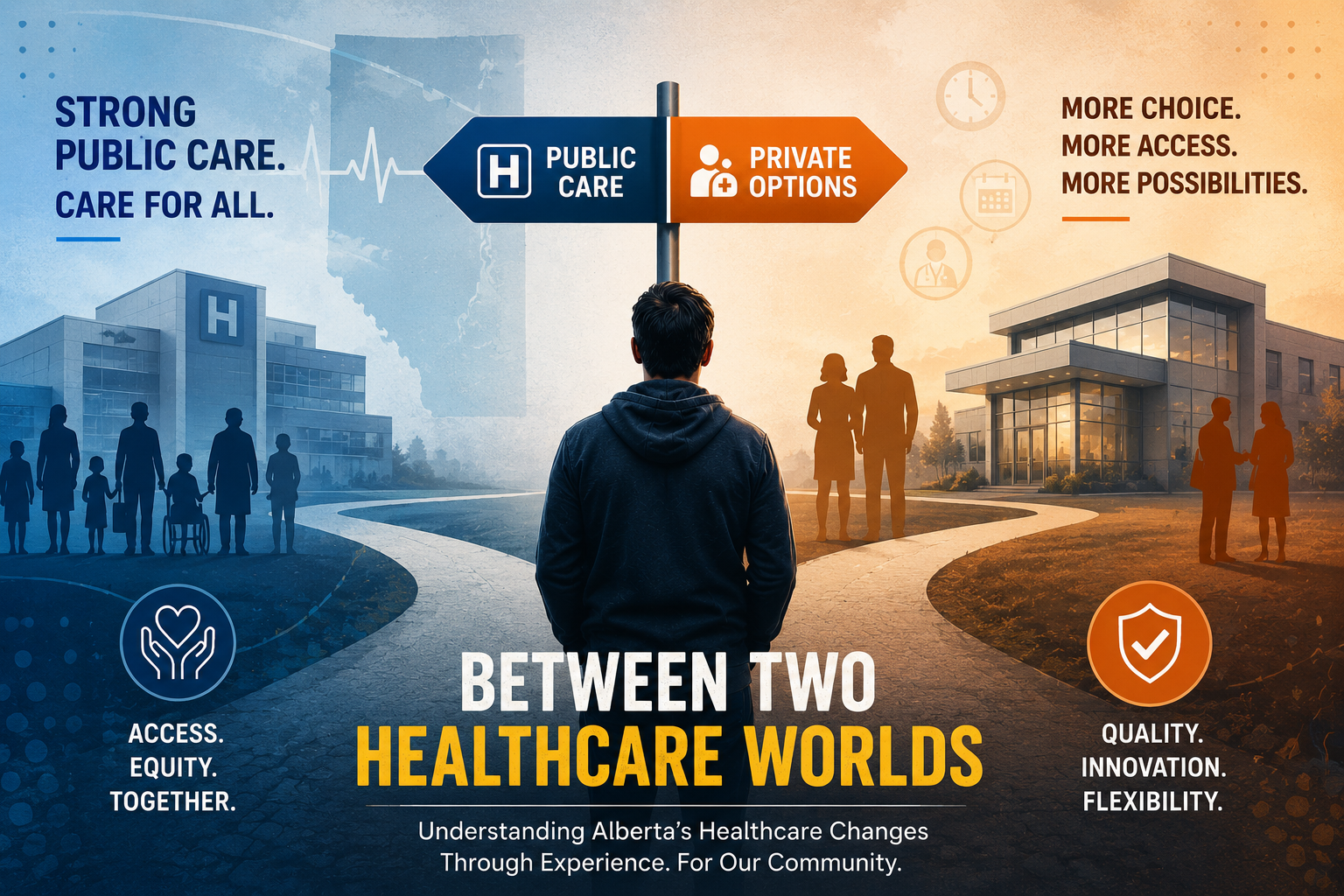
It started during a home visit with a family I had been supporting through our homecare team. We had finished talking about my client's needs, the next appointment, and some general health advice. As we sat around the dining table with cups of tea, the conversation shifted in a direction I had not expected.
One family member looked at me and asked, "Mike, are we becoming like the United States? Are we going to end up paying for everything out of our own pockets?" Before I could answer, another family member added, "Someone told me that if you have money, you will be able to get surgery faster while everyone else waits. Is that true?"
For a moment, nobody spoke.
These were not political questions. They were questions from ordinary people worried about their families, their future, and a healthcare system they had trusted since the day they arrived. As part of a community health team in Calgary, I work with people from every walk of life. Newcomers finding their footing. Asylum seekers navigating an unfamiliar system. Families who have been here for decades. People with comfortable incomes and people who are counting every dollar. The questions I hear from all of them are remarkably similar: Will I have to pay for surgery? Will people with money receive treatment first? Are we becoming more like the United States?
I cannot predict the future. What I can do is share what I have seen across three very different healthcare systems. I spent fourteen years working as a nurse in both Sri Lanka's public hospitals and private healthcare settings. Later, I worked closely with Qatar's health system before moving to Canada, where I now support clients through Alberta's community healthcare system.
Sri Lanka: When Two Systems Share the Same Workforce
Sri Lanka's public healthcare system is genuinely impressive for a lower-middle-income country. The public sector provides nearly 95% of all inpatient care, and every citizen can access it free of charge. That commitment has produced health outcomes that consistently outperform regional neighbours, including a life expectancy and maternal mortality rate that compare well with countries spending far more on healthcare.
What many people do not realize is that Sri Lanka has operated a dual healthcare system for decades. After 1977, the government formally allowed health professionals to work in both public hospitals and private clinics outside their government hours. I worked inside that arrangement and saw its benefits and its tensions up close.
Private hospitals offered shorter wait times, more comfortable facilities, and more one-on-one time with healthcare professionals. Research has confirmed that clinical outcomes in Sri Lanka's public and private sectors are broadly similar, but the private experience felt markedly different, and that difference drove demand even among people who could barely afford it.
The deeper issue was workforce. The health professionals working in private hospitals were the same professionals the public system depended on. Their knowledge did not change between settings. Their available time did. When private practice expanded, the public system absorbed that pull quietly, not as a sudden crisis, but as a gradual redistribution of attention toward those paying directly for care.
For serious conditions, including major surgery, cancer treatment, and intensive care, the public system remained where most patients ultimately returned. Private care complemented the public system for routine and elective needs. But regulation never kept pace with the sector's growth. A 2024 National Audit Office review in Sri Lanka identified significant structural weaknesses in private healthcare oversight and called for urgent legislative reform, decades after the dual model had become established practice.
Qatar: When the Dividing Line Is Not Income
In Qatar, I encountered a different version of the same problem. Two systems ran in parallel, but the dividing line was not income. It was citizenship and employment status.
Qatari nationals accessed a well-resourced government healthcare system, with modern facilities and clinical expertise imported from around the world. Expatriate workers, who make up the vast majority of Qatar's population, accessed healthcare through their employers. A senior professional on a corporate benefits package received excellent private hospital care with minimal out-of-pocket costs. A construction or domestic worker on a basic employer-provided plan waited in a different queue entirely, at a facility with fewer resources.
The clinical expertise in Qatar was often very good. The equity was not. What Qatar reinforced for me is something I carry into every conversation about health reform: a healthcare system reflects the society it sits inside. When deep structural inequalities exist in a society, they will appear in the hospital, regardless of how modern the building is.
The Global Picture: Dual Systems Are Common
Alberta is not inventing something unusual. Dual health systems are the norm in many high-performing countries. What differs is the regulatory framework and the level of public investment that sits underneath them.
In the United Kingdom, the publicly funded National Health Service covers the entire population, while a private sector offers faster access to elective procedures and specialist consultations for those who can pay. Around 10.5% of the UK population holds private health insurance. In Australia, the government-funded Medicare program covers essential hospital and primary care, while approximately 46% of Australians also hold private health insurance for shorter elective wait times and private hospital access. In Germany, health coverage is mandatory for all, but the system runs on two tracks. Most residents hold statutory public insurance, while higher earners can opt into fully private insurance, which typically offers faster specialist access. In the Netherlands, all residents must purchase regulated basic health insurance from private insurers, with the government controlling minimum coverage and premium structures to maintain equity.
These countries are not without their own debates about fairness and access. But they demonstrate that public and private healthcare can coexist, when the regulatory framework is strong and investment in the public system remains genuine and sustained.
Alberta's Bill 11: What It Actually Does
Alberta's Health Statutes Amendment Act, known as Bill 11, passed in December 2025 and made Alberta the first province in Canada to legislate a formal dual-practice model for healthcare. Under the legislation, health professionals can work simultaneously in the publicly funded system and a private-pay system. A new category called "flexibly participating physicians" allows surgeons and specialists to bill Alberta's public insurance plan while also charging patients privately for non-insured services.
The procedures initially flagged for private delivery include hip and knee replacements, cataract surgery, and hernia repair. Family medicine and emergency care remain outside the model for now, and the government has stated that no Albertan will be required to pay out of pocket for medically necessary treatment. Regulations governing which specialties can participate and what safeguards apply are still being developed, with implementation planned through 2026.
The wait time problem driving this reform is real. According to the Fraser Institute, Canadians waiting for medically necessary treatment lost an estimated $5.2 billion in productivity in 2024 alone. Alberta's surgical wait times have been a persistent concern, and the government argues that a dual model will attract and retain health professionals while creating additional surgical capacity.
Critics, including the Canadian Centre for Policy Alternatives, argue that empirical evidence from comparable countries shows that private-pay tiers draw resources away from the public sector, increasing public wait times rather than reducing them. The CCPA has also raised concerns that Bill 11 creates Canada's first private insurance market for medically necessary care, with unknown long-term consequences for the Canada Health Act and federal health transfer funding.
What I Tell People When They Ask Me
I do not oppose private healthcare on principle. My family and I have used it. In Sri Lanka and Qatar, it was sometimes the only realistic way to get timely care. I understand why people choose it.
What I tell community members is that the outcome of Alberta's reform depends heavily on two things that are not yet settled: the strength of the regulatory framework and the continued level of public investment. Countries that have made dual systems work did not do so by opening the door and hoping for the best. They built robust oversight structures and maintained genuine public funding alongside private growth. They treated the private sector as a supplement to the public system, not a replacement for it.
A Final Thought
The questions people ask me around dining tables and in community halls are not naive. They are exactly the right questions. And they deserve honest answers, even when the honest answer is that we do not yet know.