
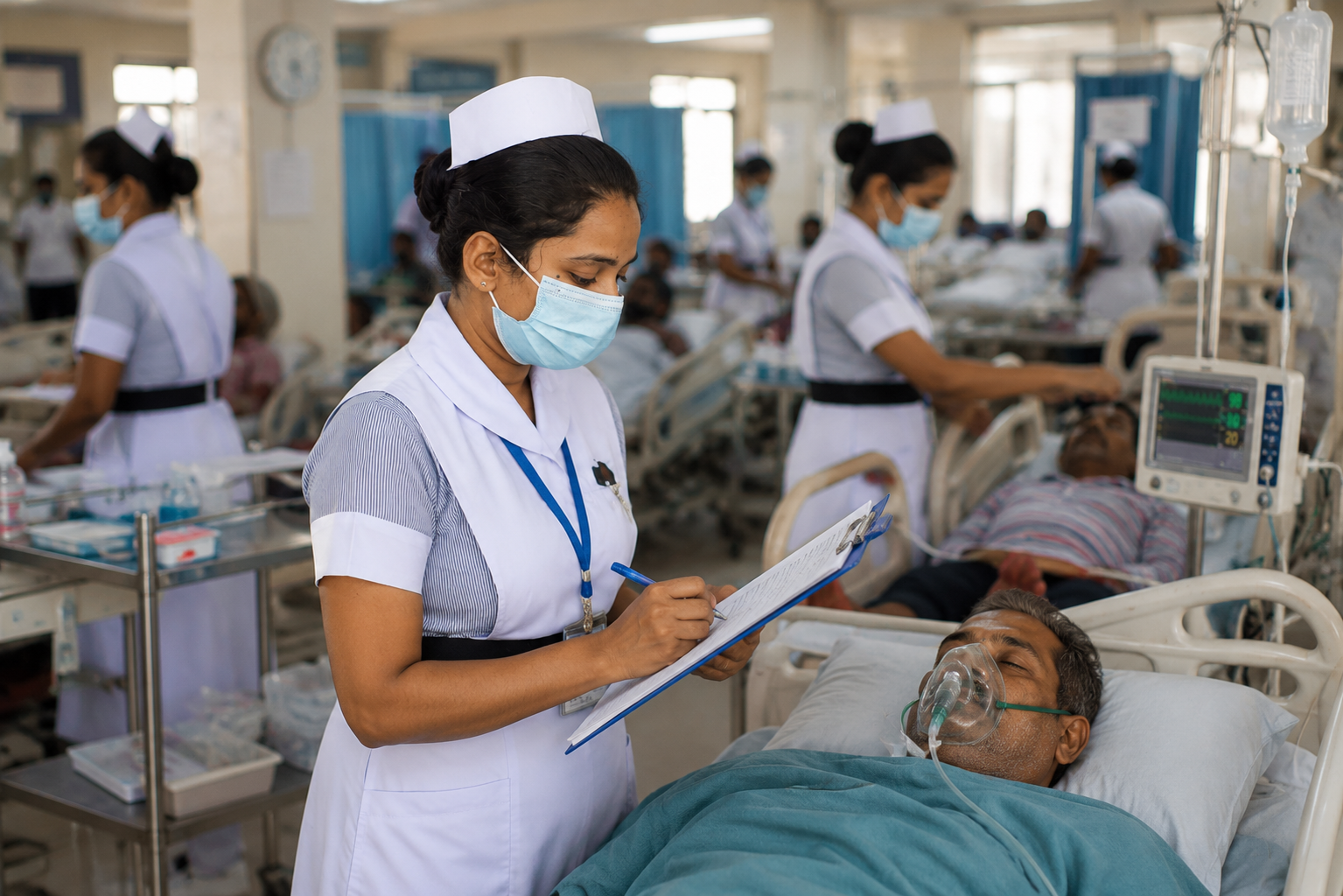
Part 9: A Workforce in Crisis — Understanding Sri Lanka's Nurse Shortage
A Quick Note Before We Begin
If you're reading this series from another country, you may be getting the wrong impression about Sri Lanka's healthcare system by reading only about its challenges. You might assume that Sri Lanka has a poor-quality healthcare system.
That would not be true.
Although Sri Lanka is a developing country, it has built one of the strongest public healthcare systems in the region. Healthcare is provided free of charge through a publicly funded system that serves the entire population. The country has a well-established two-tier healthcare system, high standards of medical and nursing education, and all healthcare professionals are licensed and professionally trained. In many important health indicators, Sri Lanka performs remarkably well and competes with countries that are often considered far more developed.
Having worked as a Registered Nurse in Sri Lanka for fourteen years and later within Western healthcare systems, I have been fortunate enough to experience different models of healthcare delivery. Every healthcare system has strengths, and every system has challenges. Throughout this article series, I am focusing specifically on the nursing profession because, based on my own experience, I believe there are areas where Sri Lanka can further strengthen and support its nursing workforce.
My intention is not to criticize Sri Lanka's healthcare system. It is to examine the challenges nurses face, explore possible improvements, and contribute to conversations that may help an already successful healthcare system become even stronger.
With that little introduction out of the way, let's look at this week's topic.
When There Simply Aren't Enough Nurses
When visitors to government hospitals see crowded waiting areas, overflowing wards, and long delays, frustration is understandable. What is far less visible, and far more important to understand, is that many of these problems trace back to one serious structural challenge: there are simply not enough nurses.
The numbers from 2023 tell the story clearly. Sri Lanka's public health sector has approximately 53,283 nursing officers working across 672 government hospitals, serving around 90,392 hospital beds. By workforce density, the country has approximately 241.8 nurses per 100,000 people. The World Health Organization recommends substantially higher levels of healthcare professionals, including nurses, doctors, and midwives, to provide safe and effective care. Current estimates suggest that Sri Lanka requires an additional 24,000 to 48,000 Registered Nurses before staffing levels could reasonably be considered safe.
What Those Numbers Mean on the Ward
Statistics can sometimes feel distant, but inside a hospital ward those numbers become very real.
Internationally, a commonly accepted benchmark for a general medical ward is approximately one nurse for every five patients. In many Sri Lankan government hospitals, particularly in teaching and provincial hospitals, a single nurse may care for fifteen to twenty patients during the day shift, while thirty or more patients may be assigned to one nurse during the night shift. In some rural hospitals, colleagues have described night shifts where only two or three nurses were responsible for seventy to ninety patients, resulting in a ratio of approximately one nurse to thirty patients.
The question of whether true patient-centred care is even possible under these conditions deserves to be asked honestly. Based on both published evidence and the lived experience of nurses, the answer is that it is not.
When Something Has to Give
When nurses are responsible for so many patients, something inevitably gives. Fortunately, it is rarely emergency care. Nurses instinctively prioritize medication administration, deteriorating patients, emergencies, and urgent clinical procedures. Instead, it is the equally important but less urgent aspects of care that quietly disappear from the day.
The patient education that should have happened but did not. The conversation with a worried family member that had to be postponed until tomorrow. The detailed documentation completed more quickly than it should have been because another patient urgently needed attention. Individually, these may seem like small compromises. Collectively, they increase risk and reduce the overall quality of patient care.
Constantly Choosing Between Priorities
The shortage forces nurses into a constant state of triage, not only of patient needs but also of their own time, attention, and energy. Administering medications, checking vital signs, responding to emergencies, assisting with clinical procedures, documenting care, and answering patient calls often happen simultaneously. Over time, this impossible balancing act simply becomes accepted as part of the job.
Saying no to an additional shift becomes extremely difficult because every nurse understands what that decision means. Refusing an extra shift often means another colleague will work beyond safe limits or that patients will receive less care than they deserve. A healthcare system should never rely on the personal sacrifice of its workforce simply to continue functioning. Yet that is precisely what has happened, and it continues to consume the very people holding the system together.
When Rest Becomes a Luxury
Staff shortages affect more than patient care. They also affect the wellbeing of nurses themselves.
Many nurses work six days each week. Although annual leave and other leave entitlements exist on paper, taking leave becomes difficult when there is no one available to replace them. During national health emergencies, leave may even be suspended altogether. Over months and years, the accumulated fatigue becomes more than ordinary tiredness. It develops into physical exhaustion, emotional burnout, and chronic stress that eventually affects both the health of nurses and their ability to continue providing safe, effective care.
Holding the System Together
In the busiest government hospitals, the effects of understaffing are impossible to ignore. Emergency departments often operate beyond capacity for extended periods. Wards receive more patients than they were designed to accommodate, with additional beds placed in corridors whenever space runs out. Nurses are expected to remain alert, calm, compassionate, and clinically accurate throughout every shift despite working under conditions that would challenge almost anyone's ability to perform at their best.
The remarkable thing is not that Sri Lanka's healthcare system occasionally struggles under these pressures. The remarkable thing is how often, through the extraordinary dedication, resilience, and personal sacrifice of its nurses, it continues to deliver safe and compassionate care despite the overwhelming demands placed upon it.