
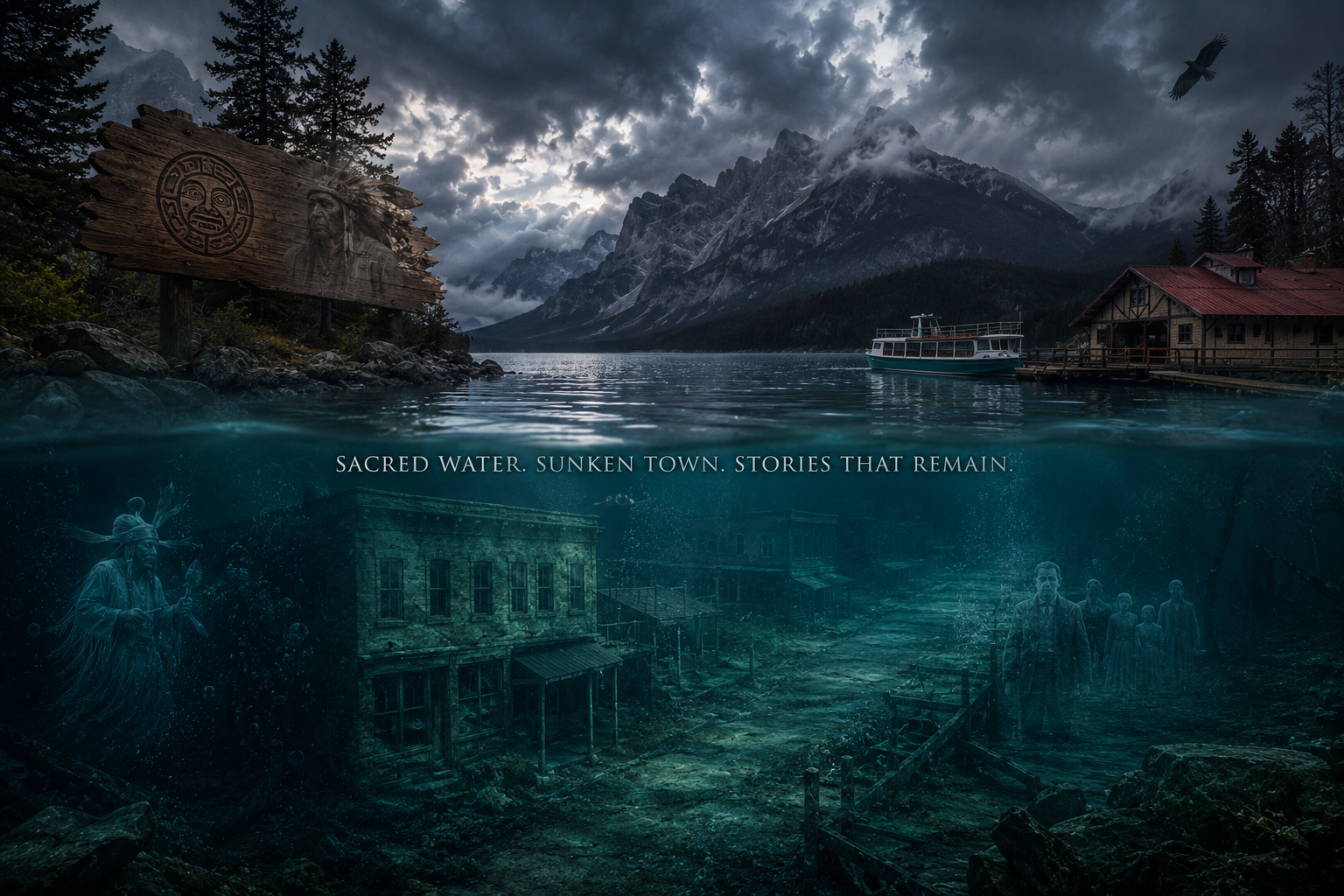
A few days ago, one of our closest friends visited us from Ontario. It had been almost ten years since we last spent real time together, and after a long overdue visit, we drove out to the Lake Minnewanka area. Standing by that water again brought back something I had been meaning to write for a while. Over the years, several of my clients have shared pieces of the lake's story with me, including a dear Indigenous friend whose account of the lake stayed with me long after our conversation ended. This article grew out of that visit and those conversations.
There is a place in Banff National Park where the wind can rise out of nowhere and rake across still water, where a drowned town sits in the dark below the surface, and where the name itself carries a warning that has been passed down for longer than Canada has existed as a country. Lake Minnewanka is one of the most visited lakes in the Canadian Rockies, and it is also one of the most haunted, not in a cheap or theatrical sense, but in the way that only a place with real history and real loss can be haunted.
I want to tell this story carefully, because it belongs first to the Stoney Nakoda people, and only afterward to the settlers, engineers, and tourists who came later and left their own mark on the lake.
The name that means Sacred Water
Long before Banff was a townsite or a national park, the Stoney Nakoda people knew this lake as mînî wakâ, which in the Nakoda language means sacred water or water of the spirits. Elders have described how travellers passing near the lake would sometimes hear voices carried on the wind, voices that seemed to come from nowhere and belonged to no one they could see. The lake was treated with both reverence and caution. It was not simply scenery. It was a living, spiritual place.
One version of the origin story tells of a man who climbed one of the mountains overlooking the water and looked down to see a fish so enormous it seemed to stretch the length of the entire lake. He came to call it the lake of the evil water spirit, and the name and the caution attached to it were carried forward through generations. Stoney Nakoda elder Watson Kaquitts has spoken of the lake's healing reputation as well, describing a mountain pass his people once used to reach the water, and the belief that it held the power to heal both body and mind. Both things can be true at once. A place can be feared and also sought out for its healing, the way many sacred sites around the world hold that same tension.
When European surveyors and settlers arrived in the nineteenth century, they heard fragments of these stories secondhand, misunderstood much of what they heard, and gave the lake their own unsettling name: Devil's Lake. That name has mostly faded from use, but it tells you something about how the original meaning got flattened and distorted as it passed through unfamiliar ears. What the Stoney Nakoda understood as sacred and spiritually significant, settlers translated into something closer to a horror story. It is worth sitting with that difference for a moment, because it shapes how we should read every ghost story that follows.
It is also worth remembering that the Stoney Nakoda were formally excluded from what became Banff National Park between 1890 and 1920, decades during which their access to a lake they had used for centuries was cut off by the very government that was busy naming and renaming it. They were not officially welcomed back until 2010. Any story about the ghosts of this lake has to hold that history too, not as a footnote, but as part of the reason the water carries so much weight.
A resort town built on the shore
By the 1880s, settlers had built a log hotel called the Beach House on the shores of the lake, and within a few decades a small resort community known as Minnewanka Landing had grown up around it. By the early 1900s it had hotels, a general store, cottages, wharves, and boats that carried visitors from Calgary out onto the water for the day. For a stretch of years it was a lively, ordinary little lakeside town, the kind of place where families spent their summers and children ran along the shoreline.
Then came the dams. Between the early 1900s and 1941, the lake was dammed multiple times to generate hydroelectric power for the growing region. Each dam raised the water level higher, and with the final dam completed in 1941, Minnewanka Landing was deliberately flooded. The buildings were not moved. They were left standing, and the lake was allowed to rise over them, foot by foot, until an entire town disappeared beneath water that was already, in Stoney Nakoda tradition, understood to be inhabited by spirits.
Today the lake is roughly 21 kilometres long, the second-longest in the Canadian Rockies, and somewhere beneath its cold, glacier-fed surface the old townsite is still there. Divers who make the difficult, frigid descent report finding building foundations, a stone oven, sidewalks, bridge pilings, and even the old wharf, still resting where they were left more than eighty years ago. Parks Canada has called it one of the most intact submerged historic sites in the country.
What lingers below
This is where the ghost stories take on their modern shape. Divers who have gone down into Minnewanka speak of a stillness that feels different from other lakes, an intact street grid rising out of the silt like a town waiting for its residents to come home. Some describe a heaviness to the place that has nothing to do with water pressure. Visitors on the surface, especially at dusk, have reported sudden gusts that seem to come from a clear sky, echoing the old Stoney Nakoda accounts of wind and voices rising without warning.
Whether you take these accounts as supernatural or simply as the natural effect of standing beside a genuinely uncanny piece of history, the feeling is the same. There is a drowned town under that lake. Real families once lived in those foundations. Real children once walked those sidewalks. And the lake that swallowed them was never just an empty basin of water to begin with. It was mînî wakâ long before it was a reservoir, sacred and watched over, and then it became the grave of a settler town on top of that.
I think that layering is what makes Lake Minnewanka's ghost stories different from the usual campfire fare. This is not a single haunted house with one tragic backstory. It is centuries of Indigenous spiritual understanding, followed by decades of settler development, followed by a flood that erased an entire community for the sake of electricity, all stacked on the same body of water. When people say the lake feels haunted, they may be responding to something real: a landscape that holds more human history, more displacement, and more loss than its calm blue surface lets on.
Visiting with respect
If you go to Lake Minnewanka, and I would encourage you to, since it is one of the most striking places in Banff National Park, go with that layered history in mind. The lake is still considered sacred by the Stoney Nakoda First Nation, and the healing reputation elders describe is not folklore to be consumed for entertainment. It is a living cultural connection that survived exclusion, relocation, and flooding, and it deserves the same respect you would give any sacred site.
Walk the shoreline trail. Watch for the bighorn sheep and elk that move through the surrounding forest. If the wind picks up suddenly on a clear day, you will understand exactly why the Stoney Nakoda gave this water the name they did, long before anyone called it haunted, and long before anyone built a town they would later drown.
Some places do not need embellishment to feel ghostly. Lake Minnewanka is one of them. The truest ghost story here is not a legend at all. It is the history itself, sacred water, a buried town, and a people who were kept from their own shoreline for thirty years, all resting quietly beneath the surface where you can still, if you look closely enough, see it.