
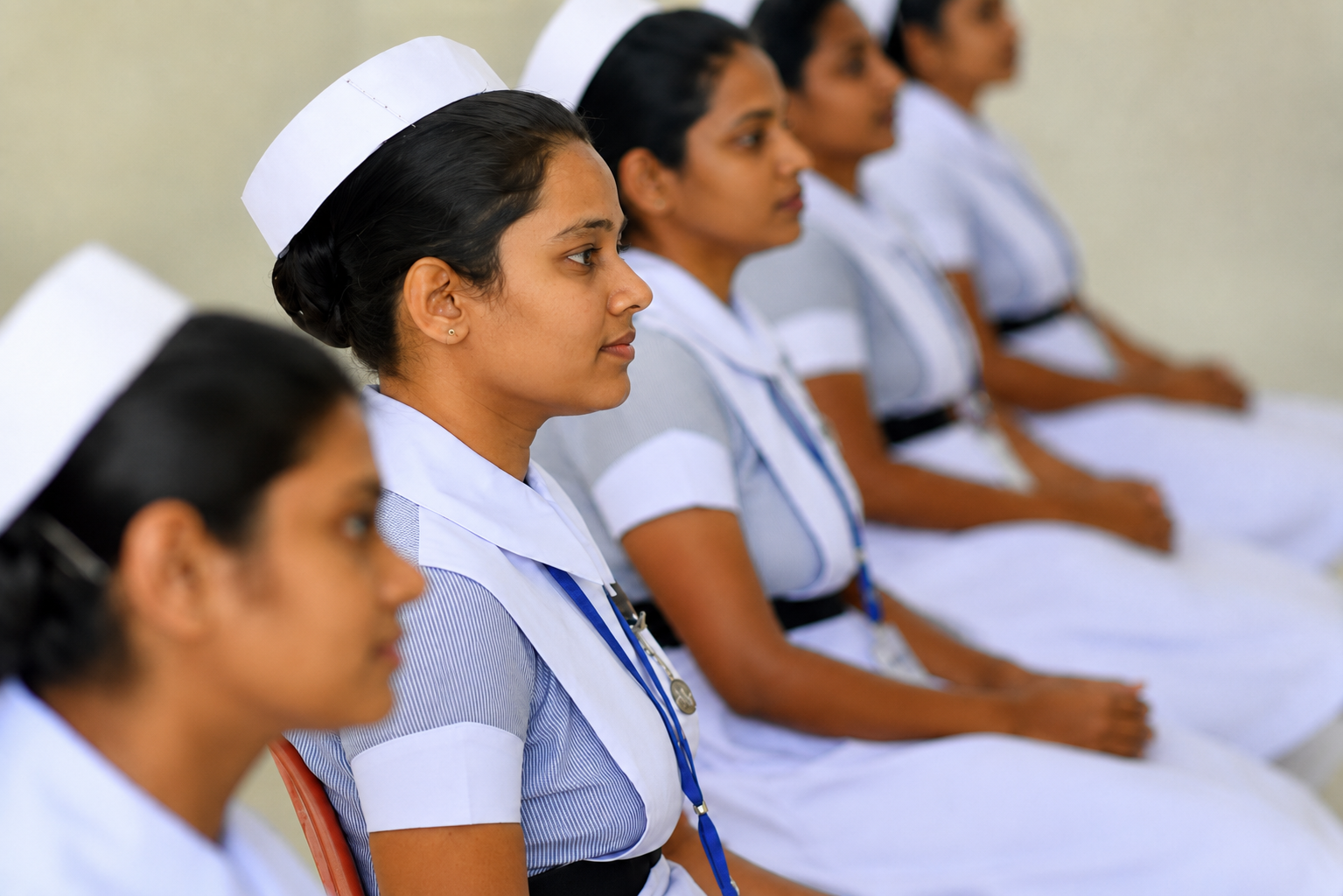
A Hospital That Never Sleeps
Hospitals never close. Patients need care twenty-four hours a day, seven days a week. That simple reality defines the working life of every Registered Nurse in Sri Lanka's government healthcare system and shapes everything that follows.
Officially, a full-time government nurse works a thirty-six-hour week spread across six days. That is the figure recorded on paper. The reality experienced by many nurses is very different. Chronic staff shortages mean scheduled hours are often only the starting point rather than the limit. For countless nurses, the working week extends well beyond what occupational health experts would consider safe or sustainable.
When a Twelve-Hour Shift Becomes Eighteen or MORE
Night shifts are typically twelve hours long. In many hospitals, however, they can stretch to sixteen or even eighteen hours when the incoming nurse is delayed, another colleague calls in sick, or an unexpected emergency prevents staff from leaving on time. There have also been reports, although not yet formally verified in published research, of nurses in some rural hospitals working continuous twenty-four-hour shifts. Whether every report is accurate or not, the fact that these stories are widely shared and widely believed reflects how seriously the public perceives the staffing crisis to be.
The Myth of the Six-Hour Shift
Despite these realities, a common misconception persists among the public that nursing is a short-shift profession. Many people still believe nurses work only six-hour shifts before returning home.
While some day and evening shifts are officially scheduled for six hours, experienced nurses know that a shift rarely ends when the clock says it should. Patient care cannot simply stop because working hours have ended. Treatments must be completed, documentation finished, equipment cleaned, medications prepared, and the next shift properly briefed before anyone can leave.
A Personal Experience
I experienced this reality many times during my years at Teaching Hospital Karapitiya.
Our morning shift officially ran from seven o'clock until one in the afternoon. I worked in the outpatient cytotoxic therapy unit, where the patient workload was consistently heavy. Finishing patient treatments, cleaning equipment, completing documentation, and preparing the unit for the following day often meant leaving at two or even three o'clock in the afternoon.
By then, both physical and mental exhaustion had already set in.
Yet it was not unusual for the ward sister to approach me with a familiar question.
"Can you stay for the night shift?"
I lived close to the hospital, which made me one of the easier people to ask. Saying no was never easy. If I declined, I knew the burden would fall on another exhausted colleague or, worse, patient care would suffer because there simply were not enough nurses available.
When Duty Comes Before Rest
This meant working from seven in the morning until two or three in the afternoon, going home for only a few hours of rest, then returning for a twelve-hour night shift before reporting back again at seven the following morning.
It was physically demanding.
It was mentally exhausting.
Most importantly, it was not unusual.
For many government nurses across Sri Lanka, this is simply what the profession has required for years.
Working Beyond Human Limits
During emergencies, disease outbreaks, or sudden staff shortages, nurses have reported working for more than twenty-four consecutive hours, taking only brief moments to eat, sit down, or catch their breath between urgent tasks. Nursing unions have repeatedly stated that many nurses continue working extended hours without additional pay and that the situation has become increasingly difficult to sustain.
These are not isolated complaints or exaggerations intended to attract public sympathy. They reflect a structural workforce problem that has existed within the healthcare system for many years.
Even a Meal Is Not Guaranteed
Long shifts do not necessarily include proper breaks.
In a busy ward, there is rarely a protected lunch hour. Nurses eat whenever patient care allows, often taking turns so someone is always available on the ward. Meals are frequently rushed, interrupted, or skipped altogether. In many government hospitals, food and tea are not provided during shifts, meaning nurses must bring their own meals from home. On particularly busy days, even those meals remain untouched.
Despite these conditions, nurses are expected to remain alert, make accurate clinical decisions, communicate compassionately with patients and families, and provide safe care throughout every hour of the shift.
That expectation is entirely reasonable.
The conditions under which nurses are expected to meet that expectation are not.