
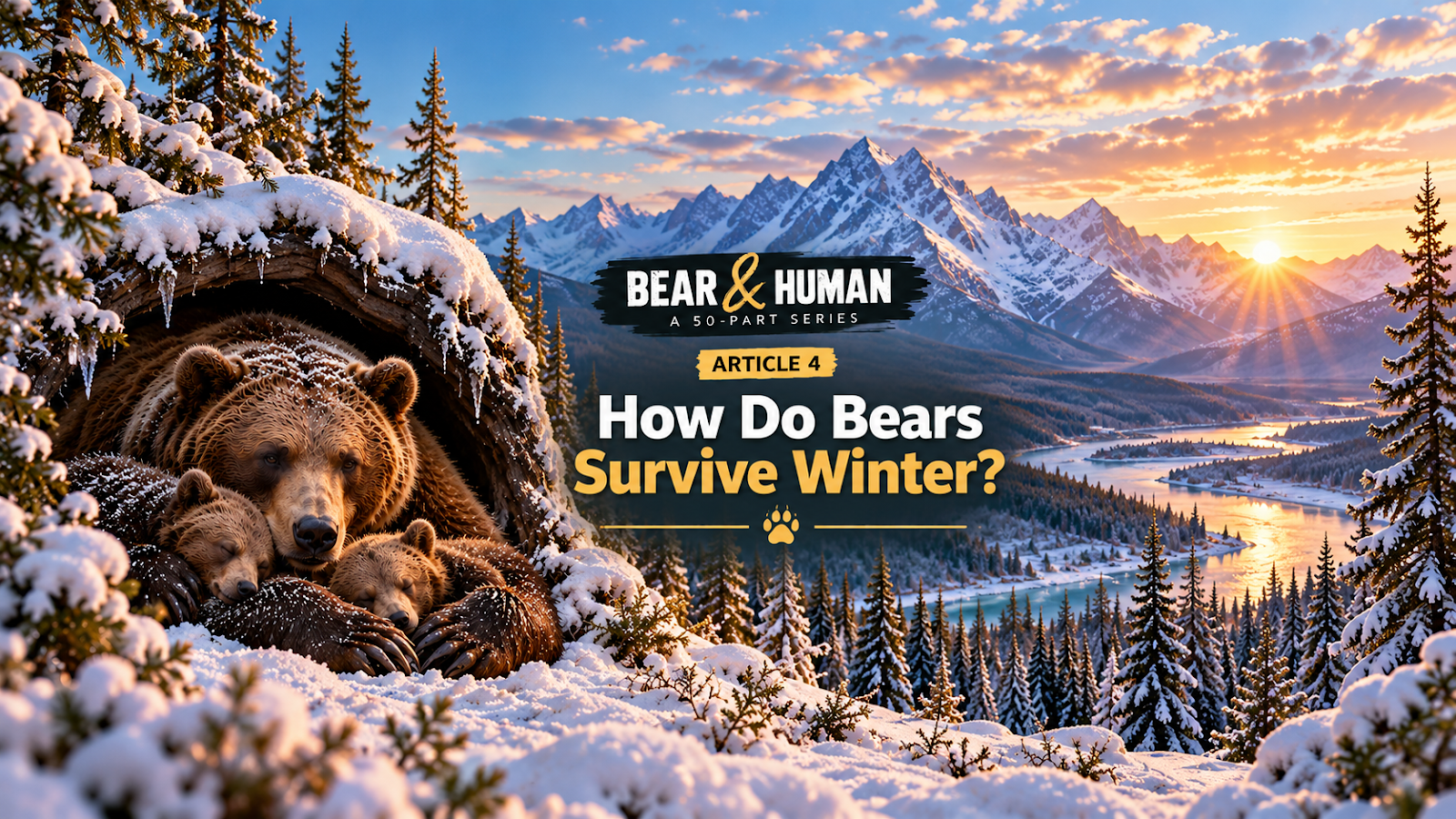
Article 4 of 50: How Do Bears Survive Winter?
Bear & Human Series | RecMike Chronicles
Imagine standing in an Alberta forest on a cold winter morning. Snow covers the ground, tree branches are frozen, and the temperature has dropped well below zero. You look around, but there is no sign of a bear.
Where did it go?
For many bears, winter brings a dramatic change in daily life. Food becomes harder to find, temperatures fall, and surviving the season requires careful preparation. Long before the snow arrives, a bear may already be eating more and building up the energy reserves it will need.
But here is the fascinating part: a bear does not simply escape the cold by going to sleep. Its body undergoes remarkable changes that help it survive for months with little or no food.
To understand this seasonal journey, we need to look at what happens before, during, and after winter.
Autumn: The Season of Preparation
For bears, autumn is not a time to slow down. It is a time to eat.
As the days grow shorter, many bears enter a period of intense feeding called hyperphagia. They search for berries, roots, fish, and other available foods, building up fat reserves that will fuel them through winter.
Think of it as preparing for a very long journey without knowing exactly when the journey will end. A bear cannot visit a supermarket when the snow covers the ground. It must rely on the energy stored in its own body.
The amount of food available can influence how well a bear prepares for winter. That is one reason healthy habitats matter so much. A landscape rich in natural food helps bears build the reserves they need.
Inside the Winter Den
When the time comes, a bear finds or digs a sheltered den. Depending on the environment, it might be beneath tree roots, inside a rock crevice, or dug into a hillside. In mountain regions, snow can help insulate the den against the cold.
Inside, the bear's body changes in remarkable ways. Its heart rate and breathing slow, and its metabolism decreases. It uses stored fat for energy and can go for months without eating or drinking.
But bear winter dormancy is not quite the same as the deep hibernation experienced by some small mammals. A bear's body temperature falls much less dramatically, allowing it to respond more readily if disturbed. Scientists often describe this as a form of hibernation or winter dormancy.
It is an extraordinary balance: conserving energy while remaining capable of responding to danger.
A New Life in the Middle of Winter
Perhaps one of the most remarkable parts of this story happens inside a mother's den.
Female bears can give birth during winter denning. Their cubs are born tiny and vulnerable, and they depend on their mother for warmth and milk. The den provides shelter during a time when the outside world offers little food and harsh conditions.
While the forest above may look lifeless, new life is growing beneath the snow.
It is a powerful reminder that winter is not simply a season of waiting. For some bears, it is also a season of motherhood.
When Spring Returns
Eventually, the days grow longer, temperatures rise, and food begins to appear again. Bears emerge from their dens, often noticeably leaner after relying on their stored fat.
They must begin searching for food once more, and mothers may emerge with cubs that are experiencing the outside world for the first time.
The cycle begins again: feeding, exploring, raising young, and preparing for the next winter.
More Than Just Sleeping
The next time you see a snow-covered forest, remember that a bear may be sheltered somewhere nearby, conserving energy through one of nature's remarkable adaptations.
Surviving winter takes more than a warm coat. It requires preparation, stored energy, and a body capable of changing with the seasons.
Coming next in Article 5: What Do Bears Eat, and Why Does It Matter? We will explore the surprising variety in a bear's diet and how its search for food connects it to the wider natural world.
References
- National Park Service. When Bears Prepare for Winter. https://www.nps.gov/articles/bears-winter.htm
- Parks Canada. Grizzly Bears: Habitat and Biology. https://parks.canada.ca/pn-np/mtn/ours-bears/generaux-basics/grizzli-grizzly
- Government of Canada. Grizzly Bear COSEWIC Assessment: Physiology. https://www.canada.ca/en/environment-climate-change/services/species-risk-public-registry/cosewic-assessments-status-reports/grizzly-bear/chapter-5.html
- National Park Service. Hibernation in Bears. https://home.nps.gov/katm/blogs/hibernation-in-bears.htm
- Grimm, O. (Ed.). (2023). Bear and Human: Facets of a Multi-Layered Relationship from Past to Recent Times, with Emphasis on Northern Europe. Brepols Publishers.