
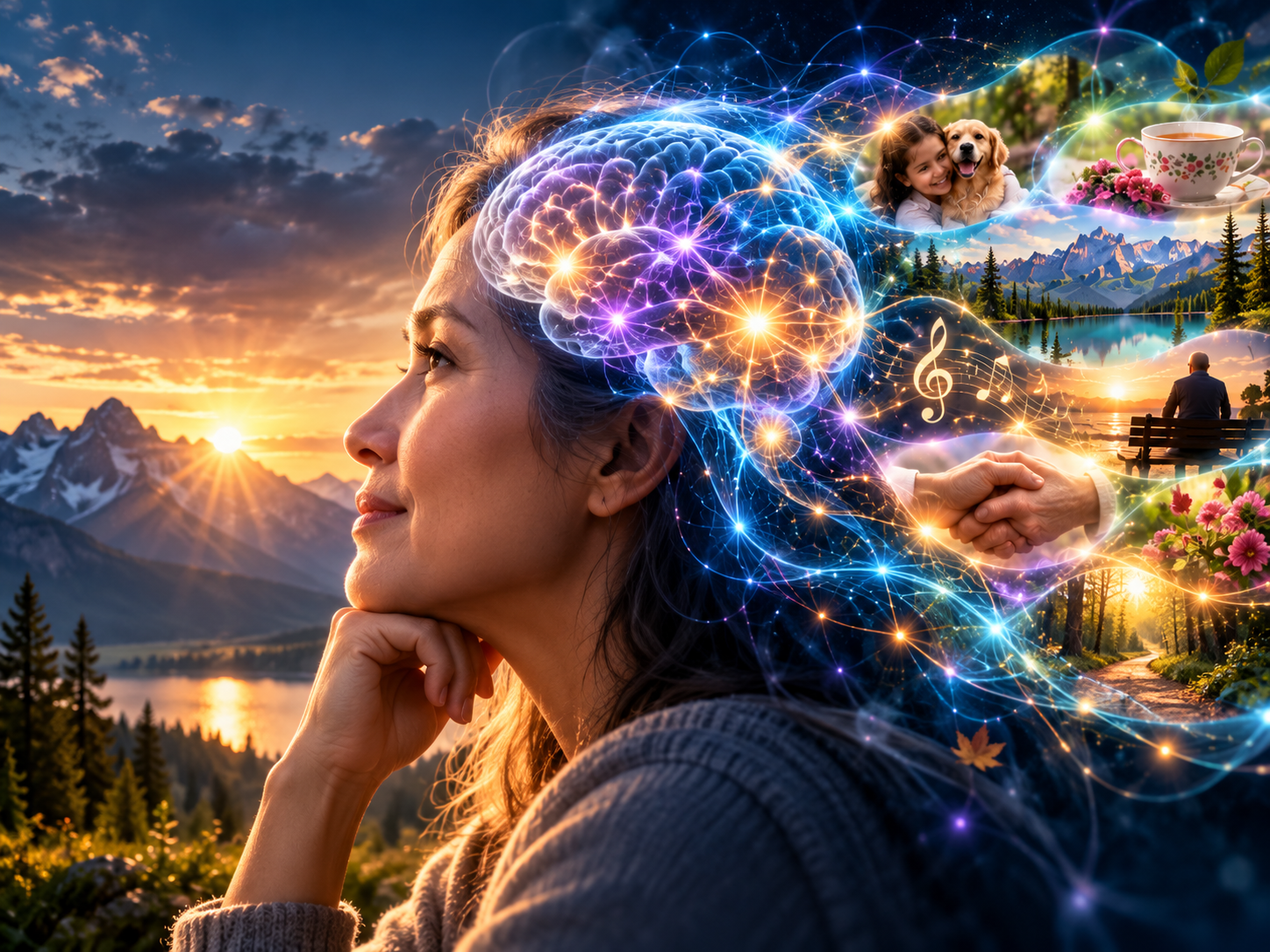
How Does the Brain Create the Experience of Being Here?
Imagine sitting quietly in a garden. You hear birds singing, feel the warmth of the sun, and notice a gentle breeze on your skin. You are not simply receiving information from your surroundings. You are experiencing the moment. But have you ever wondered how you know that you are experiencing it at all?
In our earlier articles, we explored how the brain contributes to identity, how memories connect us with our personal history, and how dementia can affect our ability to remember and communicate. Now, we move towards another question at the heart of our journey: What does it mean to be conscious?
More Than Being Awake
We often use the words awake and aware as though they mean the same thing, but they do not. Being awake is a state of the brain. Consciousness also involves the experience of sensations, thoughts, emotions, and the world around us. A person may be awake but confused, while someone who is deeply asleep may have dreams with vivid experiences.
Scientists study consciousness by examining brain activity, behaviour, perception, and responses to the environment. Although we have learned a great deal, consciousness remains one of the most challenging subjects in neuroscience because we cannot directly observe another person's private experience. We have to study the evidence that their brain and behaviour provide.
How Does the Brain Make Us Aware?
There is no single brain region that explains every aspect of consciousness. Instead, different systems work together. The brainstem helps maintain wakefulness, the thalamus helps coordinate communication between brain regions, and networks across the cerebral cortex contribute to processing information and making it available for conscious experience.
Think about hearing your name in a crowded room. Your ears receive many sounds, but your attention may suddenly focus on that familiar word. Several processes help you detect the sound, recognize its significance, and become aware of it. The brain is continuously processing far more information than you consciously notice, and scientists are still investigating how some information becomes part of our conscious experience while other information remains outside it.
Is Consciousness the Same as “I”?
This is where our original question becomes interesting. Consciousness and our sense of self are closely related, but they are not identical. You can experience a beautiful sunset without thinking about who you are. You can also reflect on your childhood or imagine your future, bringing your personal identity into the centre of your thoughts.
Consciousness concerns the experience itself, while our sense of self helps organize some of those experiences around the feeling of being a particular person. The brain's ability to connect these experiences across time contributes to our understanding of our own lives, but consciousness does not depend entirely on remembering our past.
What Dementia Can Teach Us
In my work with people living with dementia, I have learned how important it is to distinguish what a person can communicate from what they may be experiencing. Someone may struggle to answer a question, follow a conversation, or explain how they feel. These difficulties can make it challenging to understand their inner world, but an inability to give a clear answer does not, by itself, prove an absence of awareness.
Dementia affects people differently, and awareness can change as neurological conditions progress. We should not assume that every person understands everything happening around them, but neither should we conclude that someone has no meaningful experience simply because they cannot express it clearly. Observing their responses, allowing time, and communicating calmly can help us understand how they are responding to the present moment.
The Mystery Science Has Not Fully Solved
Neuroscience has identified many brain systems associated with consciousness, but an important question remains: Why does brain activity feel like something from the inside? We can study the neural activity associated with seeing a colour, feeling pain, or hearing music. Yet explaining how the brain processes these experiences is not necessarily the same as explaining why we experience them at all.
Researchers continue to investigate different theories of consciousness, and there is no single explanation that has resolved every aspect of the problem. Recognizing this uncertainty does not weaken science. It reminds us to distinguish what we know from what we are still trying to understand.
Where Does This Leave “Me”?
Throughout this series, we have explored how the brain supports our sense of identity, how memories become part of our personal story, and how neurological conditions can change the way we experience and communicate with the world. Consciousness adds another dimension to this picture. It raises the question of how biological activity becomes a personal experience, something that is felt rather than simply processed.
Perhaps the most useful approach is not to imagine a tiny observer hiding inside the brain, watching everything happen. Instead, we can investigate how the brain's many interacting processes support the experiences we call seeing, feeling, thinking, and being aware. We do not have every answer, but each discovery brings us closer to understanding the biological foundations of our everyday lives.
Next: Part 8
When the Brain Changes
What Happens to “I” in Advanced Dementia?
In the next article, we will explore how progressive neurological changes can affect perception, personality, awareness, and everyday experience. We will also consider what science can tell us about the changing sense of self, what remains uncertain, and why a person's dignity should never depend on how clearly they can express themselves.