
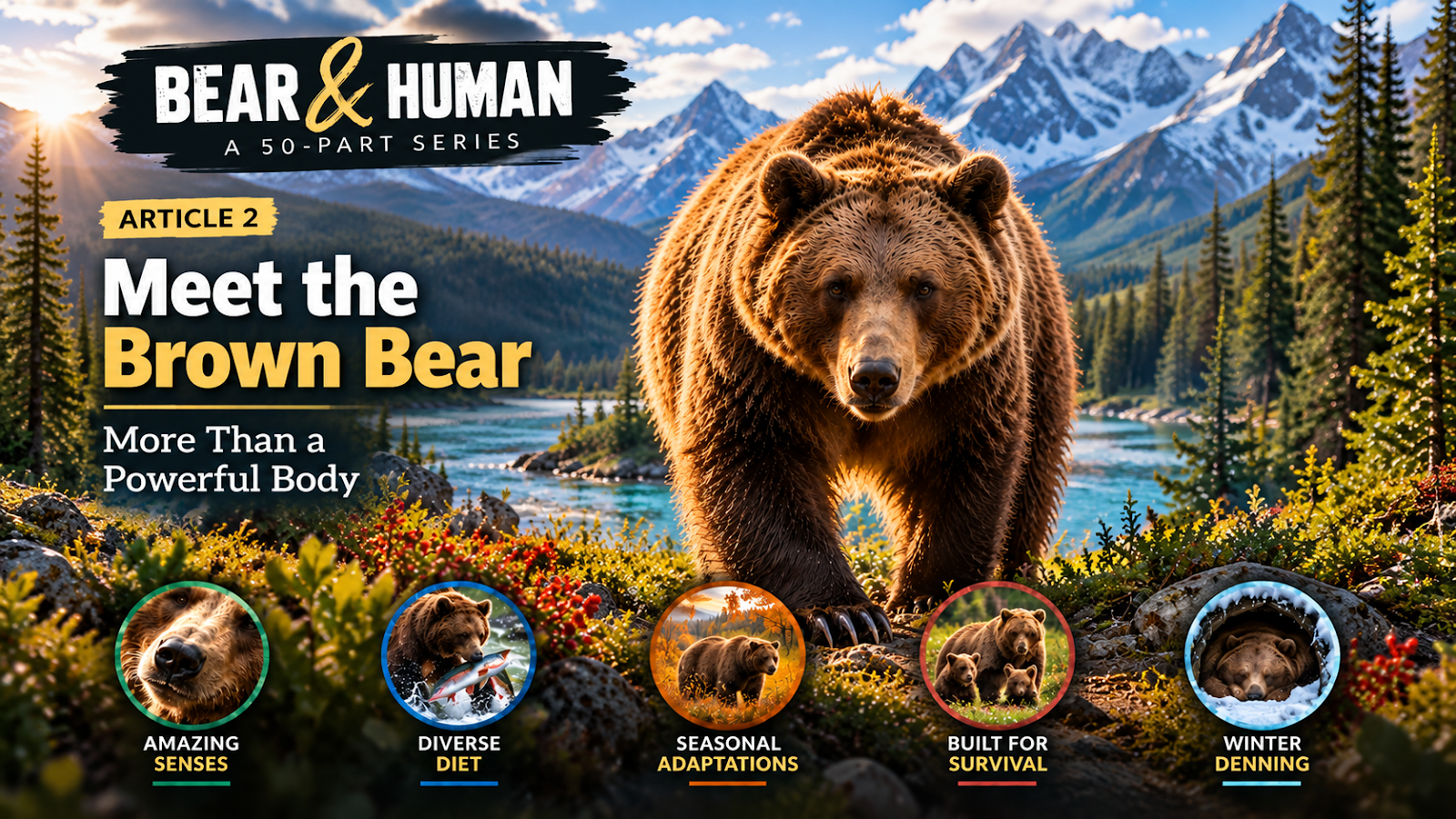
Bear & Human Series | Article 2 of 50
Imagine walking along a quiet mountain trail in Alberta. The air is fresh, the forest is peaceful, and suddenly, you notice a large brown bear moving through the trees. Your first thought might be about its size, powerful legs, and sharp claws. Perhaps you would feel a little nervous, too.
That reaction is understandable. Bears are powerful wild animals, and they deserve our respect. But what happens when we look beyond their strength?
We discover an animal with remarkable senses, flexible feeding habits, and an amazing ability to survive in changing environments. The brown bear is much more than the impressive body we see.
One Bear, Many Different Worlds
The brown bear, scientifically known as Ursus arctos, lives across parts of North America, Europe, and Asia. It is one of the most widely distributed bear species in the world.
Not all brown bears look alike. Their fur can range from very dark brown to reddish, blond, or almost black. Their size also varies, partly because of differences in genetics, habitat, and available food.
And here is something interesting: the grizzly bear is a type of brown bear. Grizzlies are not a separate species. The name is commonly used for certain brown bear populations in North America, particularly inland populations.
Now picture two bears living in different places. One searches for berries and roots in a forest, while another catches salmon beside a river. They belong to the same species, yet their daily lives may look very different.
Their ability to adapt to local conditions is one reason brown bears can live in such diverse landscapes.
A Powerful Body Built for Survival
A brown bear's strength is impressive, but its body is designed for much more than fighting.
Its strong legs help it travel across rough terrain. Its long claws are useful for digging, turning over soil, and searching for roots or insects. Powerful shoulders help the bear move through its environment while looking for food.
Then there is its nose.
A bear's sense of smell plays a major role in finding food and gathering information about its surroundings. While we might look around to understand what is happening, a bear often uses scent to explore its world.
Think about a bear sniffing the air or investigating the ground. It is not simply wandering without purpose. It may be detecting food, picking up the scent of another animal, or checking what has recently passed through the area.
The bear's world is full of information we might never notice.
Not Just a Meat-Eater
Films and wildlife photographs often show bears catching fish or hunting animals. These are real behaviours, but they tell only part of the story.
Brown bears are omnivores. Their diet can include grasses, roots, berries, nuts, insects, fish, and other animals. What they eat depends greatly on where they live and what food is available throughout the year.
In many areas, plant foods make up a substantial part of their diet.
This variety helps bears respond to changing seasons and food supplies. When one food becomes scarce, another may become available.
Their feeding habits also connect them to the wider ecosystem. Bears interact with other animals, disturb soil while digging, and can help move nutrients across the landscape.
A brown bear is not simply a hunter at the top of the food chain. It is also a forager, a seasonal traveller, and an important part of its environment.
Preparing for Winter
As autumn arrives, brown bears often spend more time feeding and building up fat reserves. This stored energy helps them survive periods when food is difficult to find.
Winter denning is more complex than simply falling asleep. A bear's metabolism slows, allowing it to conserve energy for an extended period without eating or drinking. Female bears may also give birth in their dens during winter and care for their newborn cubs there.
It is remarkable to think about. An animal capable of such physical strength also depends on carefully timed feeding, stored energy, and changes in its body to survive the colder months.
For bears, survival is not only about strength. It is also about preparation.
Seeing the Bear Differently
The more we learn about brown bears, the harder it becomes to describe them with just one word: dangerous, powerful, or wild.
They are powerful animals that can be dangerous, but they are also adaptable creatures responding to their surroundings in complex ways.
Understanding their behaviour does not mean we should approach them or forget the risks. It means learning to respect them for what they are, rather than judging them only by their appearance.
For me, that is part of the joy of learning about wildlife. Every new discovery gives us another reason to look more carefully at the natural world.
Coming next in Article 3: Where Do Bears Live Today? We will explore the landscapes brown bears call home, how their habitats differ, and how human activity has changed their world.
References
- National Geographic. Brown Bear: Facts and Information.
- IUCN Red List. Brown Bear (Ursus arctos).
- National Geographic Kids. Brown Bear.
- Grimm, O. (Ed.). (2023). Bear and Human: Facets of a Multi-Layered Relationship from Past to Recent Times, with Emphasis on Northern Europe. Brepols Publishers.