
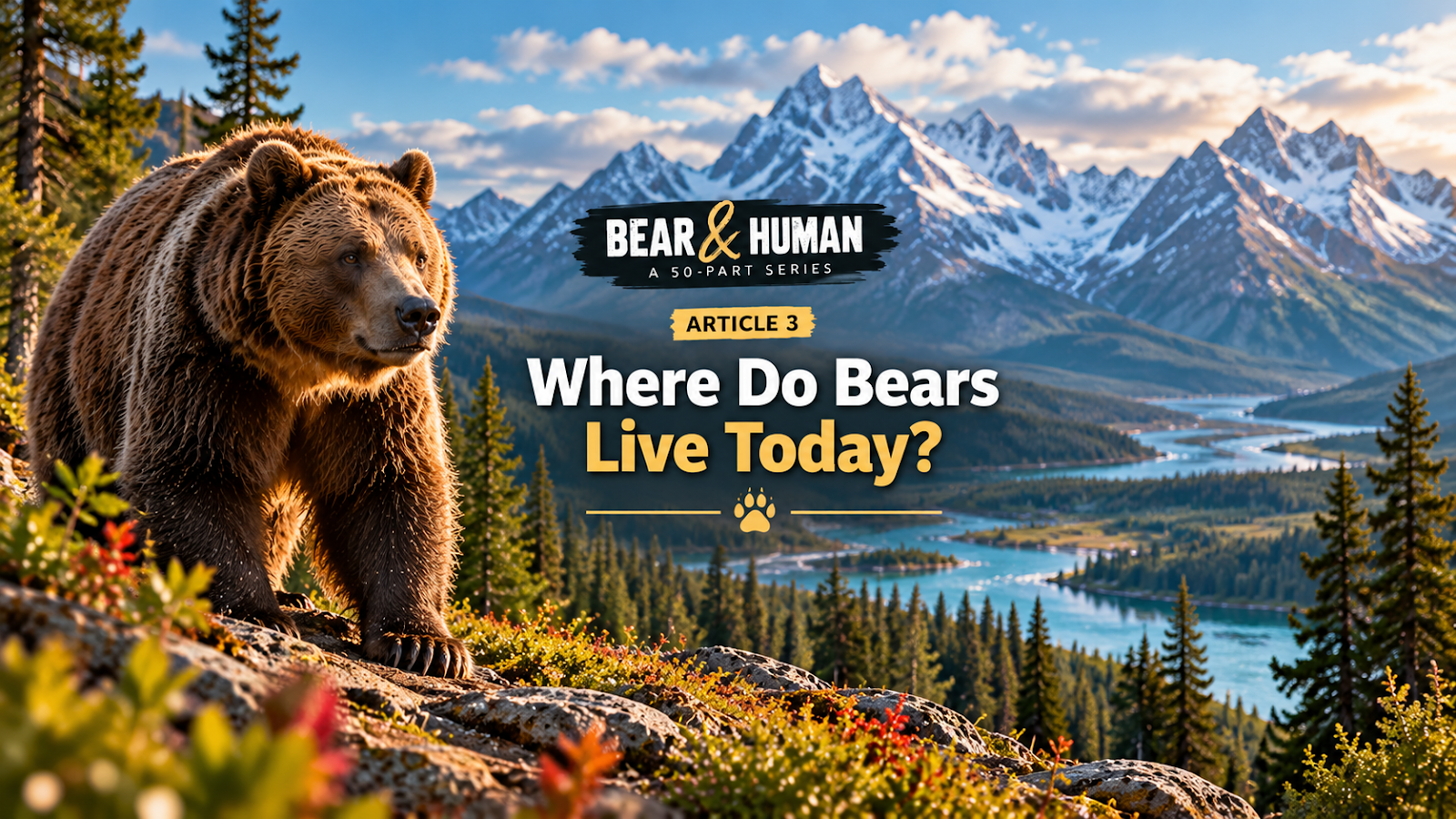
Bear & Human Series | Article 3 of 50
Imagine looking at a map of the world and trying to mark every place where bears live. You would need to travel across northern forests, rugged mountains, open tundra, and remote wilderness areas. Bears live in more places than many people realise, but they do not all live in the same kind of environment.
Some brown bears roam the forests and mountains of Europe and Asia. Others live in the wilderness of North America, including the Canadian Rockies. Each landscape offers different opportunities and challenges.
But there is an important question behind this diversity: if bears can adapt to so many environments, why have they disappeared from some places while continuing to survive in others?
To understand that, we need to look at both the bears and the changing world around them.
Across Continents and Landscapes
Brown bears are found across parts of North America, Europe, and Asia. In North America, they live in Alaska and parts of western Canada, including Alberta and British Columbia. Across Europe and Asia, populations survive in regions ranging from Scandinavia to Russia and other mountainous and forested areas. Their distribution is wide, but they are not present everywhere.
What makes a place suitable for a bear?
Food is essential, of course, but bears also need places to rest, suitable sites for winter dens, and enough space to move between feeding areas. These needs change with the seasons. In the Canadian Rockies, for example, grizzly bears may feed in valleys during spring, move to higher alpine areas in summer, and return to berry-rich areas in autumn.
A bear's home is not simply one patch of forest. It is a landscape that must provide different things at different times of the year.
Why Some Bears Have Disappeared
The map of brown bear country once looked very different. Over centuries, bears disappeared from many regions where they had previously lived. Hunting, the expansion of farms and settlements, and the loss of suitable habitat all contributed to this decline.
Consider the Canadian prairies. These open landscapes were once part of the grizzly bear's range. As human settlement expanded, grasslands were converted into agricultural fields, large prey animals declined, and bears were killed because they were seen as a threat. Today, grizzly bears no longer live as a resident population on the Alberta, Saskatchewan, and Manitoba prairies.
It is a reminder that even a powerful animal can lose its home when the landscape changes too quickly.
Is There Still Room for Bears?
The good news is that brown bears continue to survive across large areas, and some populations have recovered or expanded where protection and careful management have helped. But a wide global distribution does not mean every local population is safe. Some remain small and isolated, making them more vulnerable to human pressures.
Protected areas are important, but bears often travel beyond park boundaries to find food, mates, and seasonal habitat. Roads, railways, and development can make these journeys dangerous or divide once-connected areas. Parks Canada therefore works to protect wildlife corridors as well as important feeding and resting areas.
This brings us back to the question we started with. Bears can adapt to different environments, but adaptation has limits. They still need space, food, and a landscape that allows them to move safely.
Looking at the Landscape Differently
The next time you look at a forest, mountain range, or open valley, imagine seeing it through a bear's eyes. Where would it find food? Where could it rest undisturbed? Could it move between feeding areas without crossing a busy highway?
Those questions remind us that protecting bears is not only about protecting individual animals. It is also about caring for the connected landscapes that support wildlife.
Coming next in Article 4: How Do Bears Survive Winter? We will explore what happens when temperatures drop, food becomes scarce, and bears prepare for one of nature's most remarkable seasonal changes.
References
- IUCN SSC Bear Specialist Group. Brown Bear: Distribution and Conservation.
- Parks Canada. Grizzly Bears: Habitat, Range, and Biology.
- Government of Canada. Grizzly Bear COSEWIC Assessment: Executive Summary.
- Lehrasab, F., et al. (2025). Historical range of brown bears. Ursus, 36(3).
- Grimm, O. (Ed.). (2023). Bear and Human: Facets of a Multi-Layered Relationship from Past to Recent Times, with Emphasis on Northern Europe. Brepols Publishers.