
Part 9: When the Brain Begins to Shut Down
What Happens to Consciousness Near the End of Life?
In our previous article, we explored how progressive neurological changes can affect memory, personality, awareness, and the experience of being ourselves. Dementia showed us how the brain can gradually lose abilities that once seemed effortless. But there is another stage of the human journey that raises even deeper questions: what happens when the brain approaches the end of its biological life?
We spend much of our lives thinking about who we are, what we remember, and what makes us feel alive. Yet we rarely consider how much of that experience depends on a continuous supply of oxygen, blood flow, and energy to the brain. Near the end of life, these essential biological systems can begin to change, sometimes gradually and sometimes quite rapidly.
To understand what happens to the experience we call "I", we first need to understand what happens to the living brain.
The Brain Depends on a Continuous Supply of Energy
The human brain is remarkably active, even when we are resting. Its billions of neurons continuously exchange electrical and chemical signals, allowing us to think, recognize faces, feel emotions, regulate body functions, and remain aware of our surroundings.
All this activity requires a constant supply of oxygen and glucose, delivered through the bloodstream. Unlike some other tissues, the brain has very limited energy reserves and depends heavily on continuous circulation to maintain normal function.
When circulation becomes severely reduced, the brain receives less oxygen and glucose. Neurons begin to struggle to maintain their normal electrical activity, and communication between brain networks becomes increasingly disrupted.
This is not simply a matter of the brain becoming tired. It is a fundamental change in the biological conditions required for consciousness.
When Awareness Begins to Change
As the body approaches death, several physiological changes may affect brain function. Blood pressure may fall, circulation may become weaker, oxygen levels may decrease, and the brain may receive progressively less energy.
Depending on the underlying illness and circumstances, a person may become increasingly drowsy, confused, less responsive, or unconscious. Some people experience a gradual decline in awareness, while others deteriorate more suddenly.
It is important to understand that these changes do not follow one identical pattern. The dying process varies considerably depending on the person's condition, the cause of deterioration, and the medical circumstances.
The ability to remain conscious depends on biological systems that the brain cannot function without.
When Electrical Activity Begins to Change
One way scientists study brain function is through an electroencephalogram, commonly known as an EEG. This test records electrical activity produced by groups of neurons in the brain. It helps researchers understand how brain activity changes during sleep, anesthesia, seizures, and certain critical medical conditions.
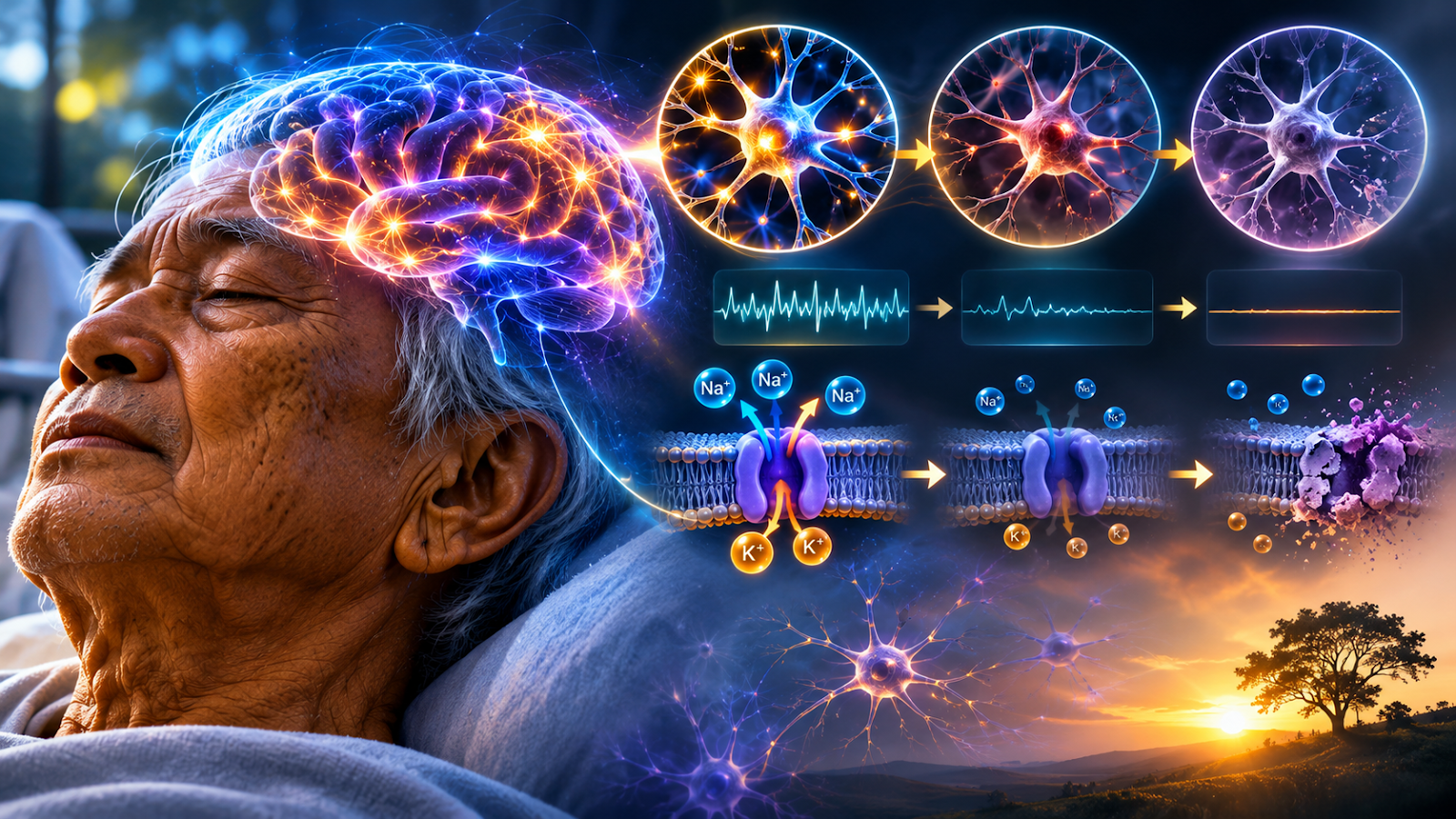
Research involving cardiac arrest has shown that, following an abrupt loss of circulation, measurable EEG activity can disappear very rapidly, sometimes within seconds. However, the exact timing varies depending on the circumstances, the person's condition, and how brain activity is measured. Loss of an EEG signal should also not be treated as a complete measurement of every process occurring inside the brain.
This is an important distinction. The brain does not necessarily stop every biological process at the same instant. Electrical communication, cellular metabolism, and the ability to maintain normal cell function are related, but they do not all end at precisely the same moment.
The Final Changes Inside Brain Cells
To understand this process more deeply, we need to look at something happening inside individual neurons.
Brain cells maintain tiny electrical differences across their membranes. These differences depend on carefully controlled concentrations of ions, particularly sodium and potassium. Special proteins called sodium-potassium pumps use energy from ATP to maintain this balance.
When the brain is severely deprived of oxygen and glucose, ATP production falls. The pumps gradually lose their ability to maintain the normal electrical balance. Sodium and calcium regulation becomes disrupted, water movement changes, and neurons begin to lose their normal structure and function.
Researchers have observed a phenomenon called spreading depolarization in the severely injured human brain. It is a wave of widespread electrical and chemical disturbance that moves through brain tissue when neurons can no longer maintain their normal electrical gradients.
A small human study published in Annals of Neurology in 2018 recorded this process in patients with devastating brain injuries near the end of life. The findings provided valuable insight into the final physiological changes of the cerebral cortex.
It is sometimes described informally as the "wave of death." However, it is important not to misunderstand this term. It describes a biological process in brain tissue, not a wave of consciousness, a final thought, or evidence of a particular experience.
What About a Final Burst of Brain Activity?
You may have come across reports suggesting that the brain produces a sudden electrical surge just before death, sometimes associated with vivid memories or a review of one's life.
There is genuine scientific interest in this subject. Some animal experiments and a small number of human observations have reported increases in certain forms of electrical activity during severe physiological crises. Researchers are investigating whether these changes might be related to the brain's response to oxygen deprivation.
However, there is an important limitation: electrical activity does not automatically mean conscious experience.
A recorded increase in gamma activity, for example, cannot by itself establish that someone is seeing memories, experiencing a life review, or remaining consciously aware. The relationship between these electrical patterns and subjective experience is still being investigated.
We should be careful not to turn an interesting scientific observation into a conclusion that the evidence does not support.
Near-Death Experiences: What Can Science Tell Us?
Some people who survive cardiac arrest describe remarkable experiences. They may report seeing bright lights, feeling detached from their bodies, encountering familiar people, or experiencing memories from different periods of their lives. These experiences are commonly known as near-death experiences (NDEs).
They are fascinating because they raise questions about consciousness under extreme physiological conditions. Researchers are investigating how reduced blood flow, oxygen deprivation, changes in brain chemistry, and disrupted neural activity might contribute to these experiences.
A 2025 review in Nature Reviews Neurology discusses several possible neurological and psychological explanations, including changes in brain activity and neurotransmitter systems during severe physiological crises.
But we need to make an important distinction. People reporting near-death experiences have survived the event. Their experiences do not establish what happens to consciousness after irreversible loss of brain function.
Science can investigate experiences reported by survivors. It cannot use those reports alone to establish what happens beyond biological death.
What Does This Mean for Someone at the Bedside?
For families, the science of dying is not simply an academic subject. It has very personal meaning.
When someone they love is approaching the end of life, family members may wonder whether the person can hear them, recognize their presence, or understand what is happening.
The answer depends on the person's condition and stage of dying. As consciousness declines, the ability to respond becomes increasingly limited. However, an absence of response does not always tell us precisely what someone is experiencing internally.
This is why gentle communication, familiar voices, comfortable surroundings, and appropriate touch can remain meaningful parts of compassionate end-of-life care. We should not promise that someone can hear or understand everything, but there is also no need to withhold kindness simply because they cannot respond.
Sometimes, sitting quietly beside someone and holding their hand is all we can offer. And sometimes, that is enough.
When the Biological Process Reaches Its End
As circulation and oxygen delivery fail permanently, the brain progressively loses the ability to maintain the electrical and chemical processes necessary for normal function. Neurons lose their ability to regulate their internal environment, communication between networks ceases, and irreversible cellular damage develops.
Death is not simply the moment someone stops speaking, opens their eyes for the last time, or takes their final breath. Medical determination of death follows established clinical criteria, including the permanent loss of brain function and consciousness, assessed according to the applicable medical standards.
At this point, the biological systems that supported thought, memory, awareness, and the experience of being a person can no longer function.
And this brings us back to the question that started our entire journey.
What happens to "I" when the brain can no longer support it?
The Question We Cannot Avoid
Throughout this series, we have explored how the brain contributes to our sense of self, how experiences become memories, how memories shape identity, and how dementia can gradually change the way a person experiences and communicates with the world.
Now we are approaching the biological boundary of that journey.
We can study neurons, electrical signals, blood circulation, oxygen deprivation, and cellular changes. We can observe how the brain loses its ability to maintain the processes that support consciousness. But science must remain honest about the limits of what it can establish.
Understanding the biology of dying does not answer every philosophical or religious question about death. It does, however, help us understand what happens to the living brain.
Perhaps that understanding can change how we look at life itself. The ability to think, remember, recognize someone, enjoy music, or simply experience the world around us depends on an extraordinary biological system that we often take for granted.
The experience we call "I" is deeply connected to the living brain. Understanding that connection may help us appreciate life while we have it.
Next: Part 10
The Last Moments of the Brain
What Happens Inside the Brain When Circulation Stops?
In the next article, we will look more closely at the final physiological changes following the loss of circulation, including electrical silence, cellular energy failure, and spreading depolarization. We will also examine what researchers have actually observed in human brains, separating established findings from theories that remain under investigation.