
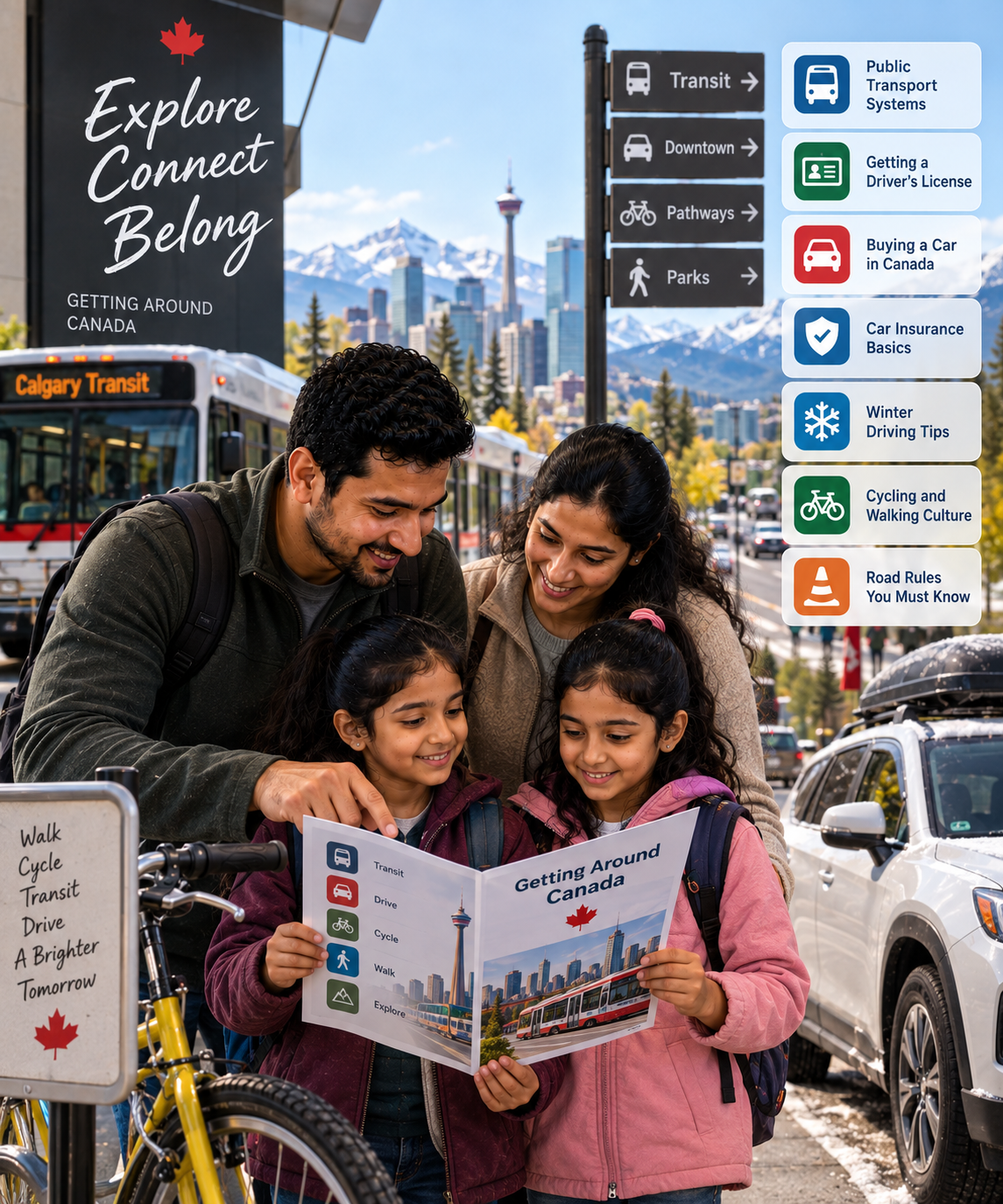
🚗 Finding Your Way Around
In the previous article, we looked at how to navigate Canada's healthcare system and build healthy routines. As your life becomes more settled, another practical part of everyday life is learning how to get around your community. Canada is a large country, and transportation can look very different depending on where you live.
In larger cities, public transportation may be enough for work, school, shopping, and appointments. In smaller communities or suburban areas, having a car may make everyday life easier. Understanding your options can help you choose what works best for your family.
🚌 Public Transportation
Canadian cities have different public transportation systems, including buses, trains, light rail, and rapid transit. Most systems use transit passes, cards, or mobile payment options, and many have apps that help you plan your journey.
Learning how to use public transportation can be especially useful when you first arrive because it allows you to explore your community without immediately needing to buy a vehicle.
🪪 Getting a Driver's Licence
If you decide to drive, you will need a valid driver's licence. Each province and territory manages its own licensing system, so the requirements can vary depending on where you live.
Newcomers with a driver's licence from another country may be able to receive credit for some of their previous driving experience, depending on the province and the country where the licence was issued. You may still need to complete knowledge or road tests.
Before driving, make sure you understand the licensing requirements where you live. Driving without the appropriate licence is not worth the risk.
🚘 Buying Your First Car
Buying a car can be a major financial decision for a newcomer. The purchase price is only one part of the cost. You also need to consider insurance, fuel, maintenance, registration, parking, seasonal tires, and unexpected repairs.
Before buying a vehicle, think about how often your family actually needs one. Sometimes a reliable used vehicle may meet your needs, while in other situations public transportation, walking, cycling, or car-sharing may be enough.
Avoid making a large vehicle purchase simply because owning a car feels like an important part of settling into Canada. Choose something that fits your transportation needs and your budget.
🛡️ Understanding Car Insurance
If you drive a vehicle in Canada, you generally need the required automobile insurance for your province or territory. Insurance costs can vary based on factors such as your driving history, location, vehicle, and coverage.
Newcomers may sometimes find that their previous driving experience is not fully recognized by an insurer. Ask what documentation may help demonstrate your previous driving history and compare available insurance options before making a decision.
Understanding your coverage is just as important as knowing the price. Make sure you understand what your policy covers and what you may have to pay yourself after an accident.
❄️ Winter Driving Is Different
For newcomers from warmer countries, Canadian winter driving can be one of the biggest transportation adjustments. Snow, ice, freezing temperatures, and reduced visibility can make roads more challenging.
Driving safely in winter means slowing down, leaving more space between vehicles, checking weather and road conditions, and making sure your vehicle is properly prepared. Winter tires are also an important consideration in many parts of Canada, particularly where snow and ice are common.
If you are new to winter driving, give yourself time to learn. Your first experience driving on a snowy road does not need to happen during a major storm.
🚲 Walking and Cycling
Not every journey needs a car. Walking and cycling are important parts of transportation in many Canadian communities, and they can also be affordable ways to stay active.
As we discussed in the previous healthcare article, regular physical activity can support your overall wellbeing. Walking or cycling to a nearby store, park, transit stop, or community centre can combine transportation with exercise.
Always use designated paths and crossings where available, wear appropriate safety equipment, and learn the rules that apply to cyclists and pedestrians in your community.
🚦 Road Rules You Must Know
Canadian road rules may be different from what you learned in your home country. Drivers are expected to follow posted speed limits, traffic signals, lane markings, and rules about intersections, pedestrians, school zones, and emergency vehicles.
Rules can vary between provinces and territories, so take time to learn the requirements where you live. Never assume that a rule is the same simply because the road looks familiar.
Understanding the rules is not only about avoiding tickets. It is about protecting yourself, your passengers, pedestrians, cyclists, and everyone else sharing the road.
🌱 Reflection: Finding Your Own Way
When you first arrive in Canada, transportation may simply be about getting from one place to another. Over time, it becomes part of how you experience your new community.
You learn which bus takes you to work, which path is safe for cycling, where to find a grocery store, how to drive through your first Canadian winter, and eventually which routes feel like second nature.
Whether you walk, cycle, take public transportation, drive, or use a combination of all of them, learning how to move around your community is another small but important step toward feeling at home in Canada.