
From Sri Lanka’s Internet Cafés to Canada’s Fibre Networks
(If Telecom Giants Can Protect Our Homes, Why Can’t They Protect Their Own Cables?)
#mythoughts #TELUS #mylifestory
For nearly three weeks, my home was without “high-speed” internet. Yes, not “just” my home, but our whole community. No Wi-Fi. No high-speed fibre. No simply connecting a device and getting on with whatever I needed to do. Instead, I was relying heavily on mobile hotspot data just to stay connected.
The reason was not some mysterious technical failure. A cable had been cut and stolen. I know the situation and the repair were probably much more complicated than those few words suggest. But from where I was sitting, that was what it came down to: a cable was cut, and our internet was gone for nearly three weeks.
Though this situation is inconvenient, I found myself thinking less about the inconvenience and more about how strange the whole situation was. We are living in 2026. We talk about artificial intelligence, smart homes, connected cars, smart cities and technology that can do things that would have sounded like science fiction when I was younger. But cut a cable, and suddenly we are back to square one.
🕰️ I Remember When Getting Online Was an Event
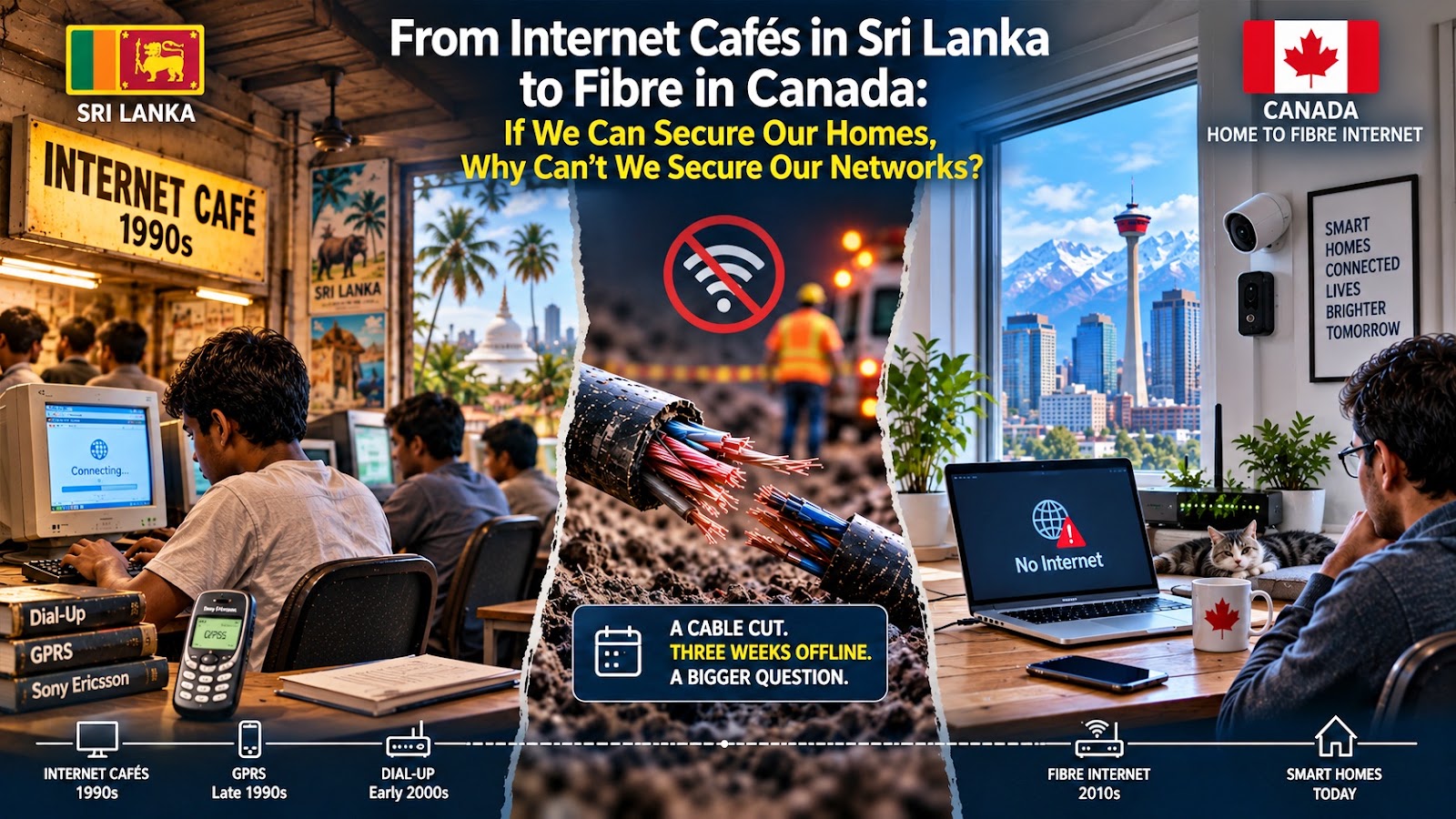
My relationship with the internet goes back to the late 1980s and early 1990s. Back then, getting online was nothing like it is today. You did not just pick up your phone and open a browser. You usually had to physically go somewhere. For me, that often meant an Internet Café.
You paid by the hour, sat in front of a computer and waited for the internet to do its thing. Web pages appeared slowly, sometimes line by line. We had plenty of time to make a cup of tea while we waited. But we didn't really think of it as a problem. The internet itself was still fascinating. Being able to find information and communicate with people online felt like something special.
Then came mobile internet. By the mid-to-late 1990s, I remember trying an early GPRS connection on a Sony Ericsson phone. Compared with today's internet, it was painfully slow. But at the time, I thought it was incredible. The best part was that the internet was no longer tied to a computer in an internet café. It was beginning to follow us around.
By the early 2000s, I was using the internet much more regularly. I started with dial-up through the main telephone line. Using dial-up phone cable and a Telecom internet card, I heard the digital handshake sound and waited, watching dots one by one until it magically said, “connected.” Eventually, we got a second telephone line dedicated to the internet.
At the time, I was living in Sri Lanka, a developing country, but the internet infrastructure was reasonably good for the time. Internet access was also relatively affordable, so even though the connection was not particularly fast, it was accessible to many people. Internet speeds were modest, connections could be intermittent, and the infrastructure was still developing across the country. It wasn't perfect, but we adapted. We were used to waiting.
🌐 But the most important part was that, since I first started using the internet, I had never experienced an outage lasting more than a few hours. Maybe part of the reason is that we live in an area where many healthcare facilities are located.
✈️ Then We Moved to Canada
Over the years, internet access became faster and much more reliable. Eventually, my household moved to a fibre connection through Telus. It was the kind of internet connection you stop thinking about because you simply expect it to work. And that is probably where I became too comfortable.
✂️ Then the Cable Was Cut
When our internet first went down, I assumed it would be fixed quickly. Maybe there was a technical issue. Maybe some equipment had failed. Maybe it was routine maintenance. Then we found out what had happened.
The cable had been cut and stolen. Thieves targeted copper infrastructure, damaging the network and disrupting service in our area. We had to rely on Bell mobile data to stay connected. That worked, but only temporarily. Trying to use mobile hotspot data as a replacement for your normal home internet for days, and then weeks, gets old very quickly.
And that's when I started asking myself a question.
❓ How is it that we can use technology to protect almost every corner of our homes, but the infrastructure connecting those homes can still be so vulnerable? ❓
💡 The Part That Doesn't Quite Make Sense to Me
Think about what telecom companies sell us. Smart security cameras. Motion detectors. Doorbell cameras. Automated alerts. 24/7 monitoring. All of these technologies are designed to help protect our homes from unwanted activity.
But outside the house, some of the infrastructure carrying our internet is still exposed in trenches, on poles, inside utility boxes and along other accessible routes.
I'm not saying telecom companies don't take security seriously. I'm sure there are many things happening behind the scenes that customers never see. But as a customer, I cannot help wondering whether more could be done.
Because that cable is not “just” a cable anymore. It carries our work. Our communication. Our entertainment. Our banking. Our family connections. For many people, it is also part of their home security. When that cable is cut, a lot more than Netflix stops working.
🛡️ Could the Infrastructure Be Smarter?
I started looking into some of the technologies that could potentially help.
One example is Distributed Acoustic Sensing, or DAS. The basic idea is pretty interesting. Fibre-optic infrastructure can potentially be used to detect vibrations and physical disturbances around the cable. Activities such as digging or cutting could potentially trigger an alert. Imagine if the network could tell someone, “something unusual is happening here,” before the cable is completely destroyed.
Another possibility is making utility cabinets and access points smarter. We already have sensors on our doors and windows at home. Why couldn't important telecom cabinets have tamper sensors, location tracking or silent alarms? If somebody opens a cabinet at 2 a.m. who shouldn't be opening it, maybe somebody should know about it.
There is also the longer-term question of copper itself. The more telecommunications networks move toward fibre, the less valuable infrastructure there is for copper thieves to target. Fibre does not have the same scrap-metal value. Where copper still has to remain, better identification and tracing systems could potentially make stolen cable more difficult to sell.
Then there is AI. We are putting AI into just about everything these days, so why not use some of it to protect critical infrastructure? High-risk areas could potentially use AI-powered cameras, sensors or even drones. Instead of having people watch camera feeds all night, the system could identify unusual activity and alert someone when something actually needs attention.
I'm sure there are technical, legal and financial challenges involved. But the technology is certainly worth discussing.
✂️ And What If Someone Still Cuts the Cable?
There is another part of this that interests me. Even with better security, cables will still get damaged. Construction crews make mistakes. Equipment fails. Weather causes problems. And unfortunately, people will continue to steal things. So maybe the answer is not just better security.
Maybe the network itself needs to be better prepared for failure. Could there be alternative routes for the data to travel? Could traffic automatically move through another part of the network when one connection is cut?
In simple terms, could the network keep us connected while technicians are fixing the physical problem? We have become used to technology recovering from failures almost instantly. Perhaps our internet infrastructure should be designed with the same philosophy.
🖥️ Looking Back, It Is Kind of Funny
When I think about my internet journey, the contrast is pretty incredible. I started by paying for internet access by the hour at an internet café. Then I experienced GPRS on a Sony Ericsson.
Then came dial-up, where someone picking up the home phone could disconnect me from the internet. Now I have fibre internet at home. And yet, after all those technological advances, I ended up spending nearly three weeks relying on a mobile hotspot because somebody stole a copper cable.
There is a certain irony in that.
It also reminded me how much we have come to depend on being connected. We don't think about the internet when it works. We just expect it to be there. We work online. We study online. We communicate with family overseas. We run businesses online. We manage appointments, banking, entertainment and so many other parts of our lives through that connection.
Then suddenly the Wi-Fi disappears, and you realize how much of everyday life is sitting on the other side of that little icon.
💡 Maybe We Need to Think Differently
I don't expect telecom companies to build a completely theft-proof network. That probably isn't realistic. But perhaps we need to put more thought into protecting the physical infrastructure that has become so important to our everyday lives.
If we can put smart cameras and motion sensors around our homes, surely we can explore similar ideas for critical telecom infrastructure. If technology can detect someone approaching my front door, perhaps it can also detect someone digging beside an important cable.
If a security system can tell me that someone has opened a door, perhaps a telecom cabinet can tell an operator that someone has opened it without authorization. And if a cable is cut, perhaps the network should already have another route available.
After nearly three weeks without proper home internet, I came away with a much greater appreciation for something I normally don't even notice.
That little Wi-Fi symbol. It looks simple. But behind it is an enormous amount of infrastructure, technology, investment and physical cable stretching through our communities.
We have come a very long way from internet cafés and dial-up. Maybe the way we protect the infrastructure behind our internet needs to make the same journey.
🛰️ And Yes, I Know Someone Will Ask About Satellite Internet
I can already imagine someone asking me, “Why don’t you just switch to satellite internet? It’s more reliable.”
Yes, I understand that point, and I know satellite internet can be a good option, especially in areas where traditional connections are unreliable. But for me, there is another consideration. I still try to spend my Canadian dollars, or at least most of them, here in Canada whenever I can.
I am not getting into politics here, so I will leave that part of the conversation for another day.
For now, I think I have said enough about my internet adventure.
Disclaimer
I just want to say that I am not an expert in this area. I am simply a customer sharing my personal experience and thoughts. My views are based mainly on what I experienced during this outage, along with a little bit of research I did while writing this article.
I have no intention of harming, criticizing, or promoting any particular business or company. I am simply expressing my thoughts and frustration as a customer who experienced a prolonged internet disruption and started wondering whether things could be done differently. 😊