
Part 17: Learning That Never Stops: The Case for Mandatory Professional Development
In the previous part, we looked at why stronger professional regulation and proper licensure could help strengthen Sri Lanka's nursing profession. But regulation alone is not enough. If a nurse is expected to maintain a professional license throughout a career, there also needs to be a clear pathway for that nurse to keep learning, updating skills, and demonstrating continued competence.
When I was a practicing nurse in Sri Lanka, continuing education was something that happened informally, if it happened at all. We learned from experience, absorbed knowledge from senior colleagues, and read when we had the time, which was rarely. What we did not have was a structured, mandatory professional development system that required nurses to regularly update their knowledge and demonstrate that their practice remained current and evidence-based.
This is not just a personal observation. It reflects a systemic gap that can have real consequences for the quality and safety of nursing care.
Learning Should Not End With Graduation
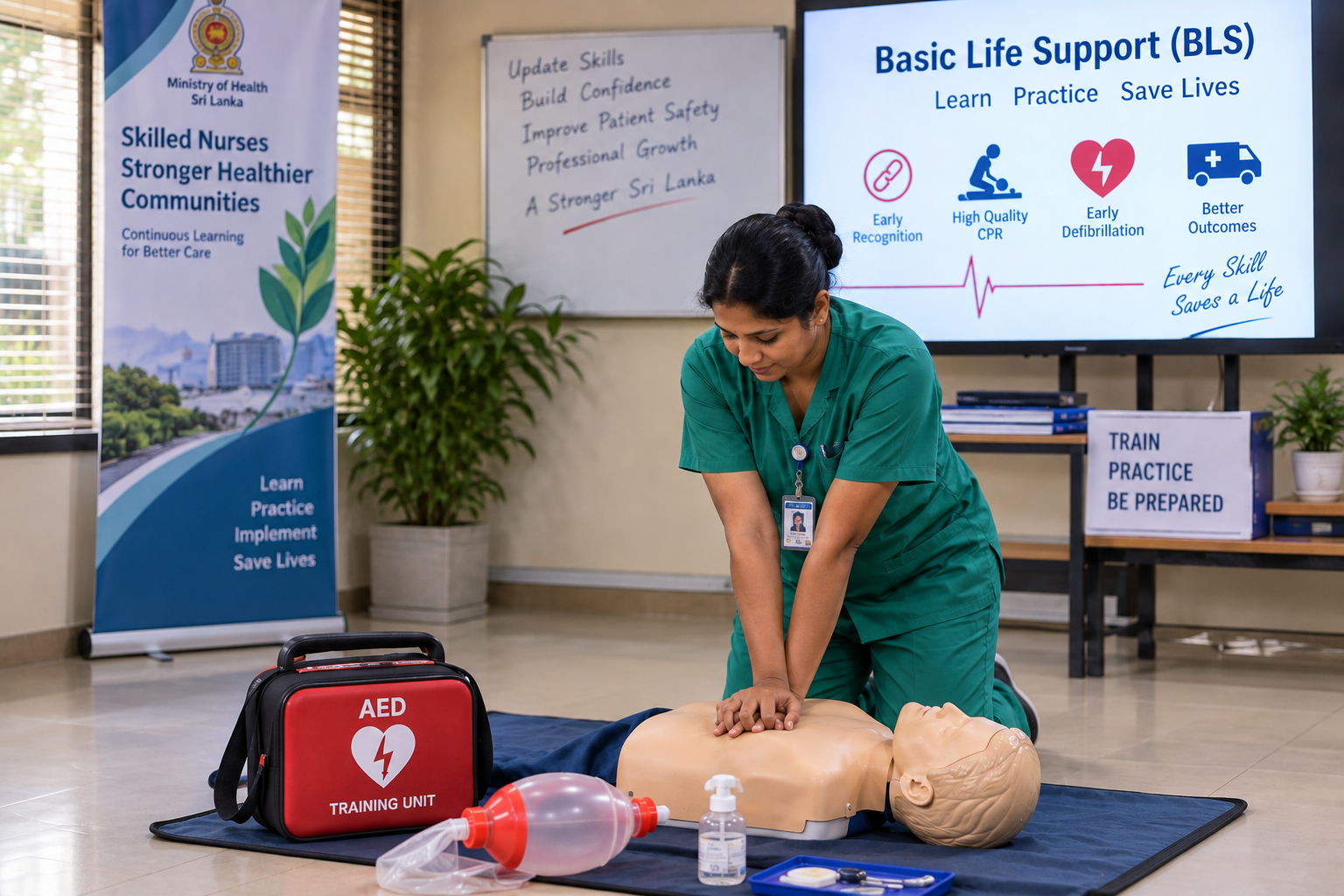
Consider Basic Life Support. During nursing school, we learned CPR and first aid, including some practical training. After qualification, however, there was no accredited refresher system, mandatory recertification, or requirement to demonstrate BLS competence every one or two years, as is standard in many other countries.
Some nurses working in intensive care or emergency settings may have had access to additional training, but there was no national requirement or systematic approach.
The same gap existed in other important areas. We cared for patients who had experienced trauma or were living with mental health challenges without necessarily receiving structured training in trauma-informed care after nursing school. We managed aggressive or distressed patients without formal training in nonviolent crisis intervention.
We learned to manage these situations through experience and instinct. That is a testament to the adaptability of Sri Lankan nurses, but experience alone should not be considered a substitute for structured professional training in a modern healthcare system.
The Role of Continuing Professional Development
Mandatory Continuing Professional Development, commonly known as CPD, is one established way of addressing this gap. In many healthcare systems, professional development is not something nurses undertake only when they have spare time. It is built into the expectations of maintaining professional practice.
The concern that Sri Lanka may not be able to afford such a system is understandable. However, CPD does not necessarily have to be expensive or difficult to access. Countries with significantly fewer resources than Sri Lanka have implemented effective and affordable CPD frameworks. Bangladesh provides one example.
CPD can be delivered through online learning modules, workplace workshops, practical skills sessions, and peer-learning groups. The important part is that the learning is structured, recorded, verified, and connected to professional requirements.
What Should Sri Lankan Nurses Be Learning?
A good CPD framework for Sri Lankan nurses could cover a broad range of areas. These could include evidence-based practice updates, clinical skills refreshers, ethical and legal knowledge, quality improvement methods, basic digital and health technology literacy, communication and teamwork, and specialty-specific education.
The system should also recognise that nurses working in different areas have different learning needs. A nurse working in an intensive care unit will require some specialised education that may not be relevant to a nurse working in community health, oncology, mental health, or maternal care.
This is where a well-designed CPD system could become more than a requirement. It could become a practical professional development pathway.
Connecting Learning With Licensure
This also connects directly with the licensure reform discussed in Part 16.
If Sri Lanka moves toward periodic license renewal, completion of a defined number of CPD hours could become one of the requirements for renewal. Nurses would have a clear expectation to maintain their knowledge and skills, while the regulatory system would have a mechanism to verify that continuing development is actually taking place.
The two systems would therefore reinforce each other. Licensure would confirm that a nurse remains authorised to practise, while CPD would provide a structured pathway for maintaining and developing professional competence.
The Benefits Go Beyond the Nurse
The benefits of continuing education extend far beyond individual nurses.
When nurses remain current in their knowledge and clinical skills, patient safety can improve. When CPD is structured and verified, it can strengthen public confidence in the profession. And when lifelong learning becomes part of nursing culture, it can change how nurses see themselves and how the wider healthcare system sees them.
Nursing then becomes more than a job that someone qualifies for once and continues performing for decades. It becomes a profession that expects, supports, and rewards ongoing learning.
That shift matters for recruitment, professional development, retention, and ultimately the quality of care that Sri Lankan patients receive.
The nurses of previous generations built the foundation. The responsibility of the next generation is not simply to continue what they inherited, but to keep learning and make the profession stronger than they found it.