
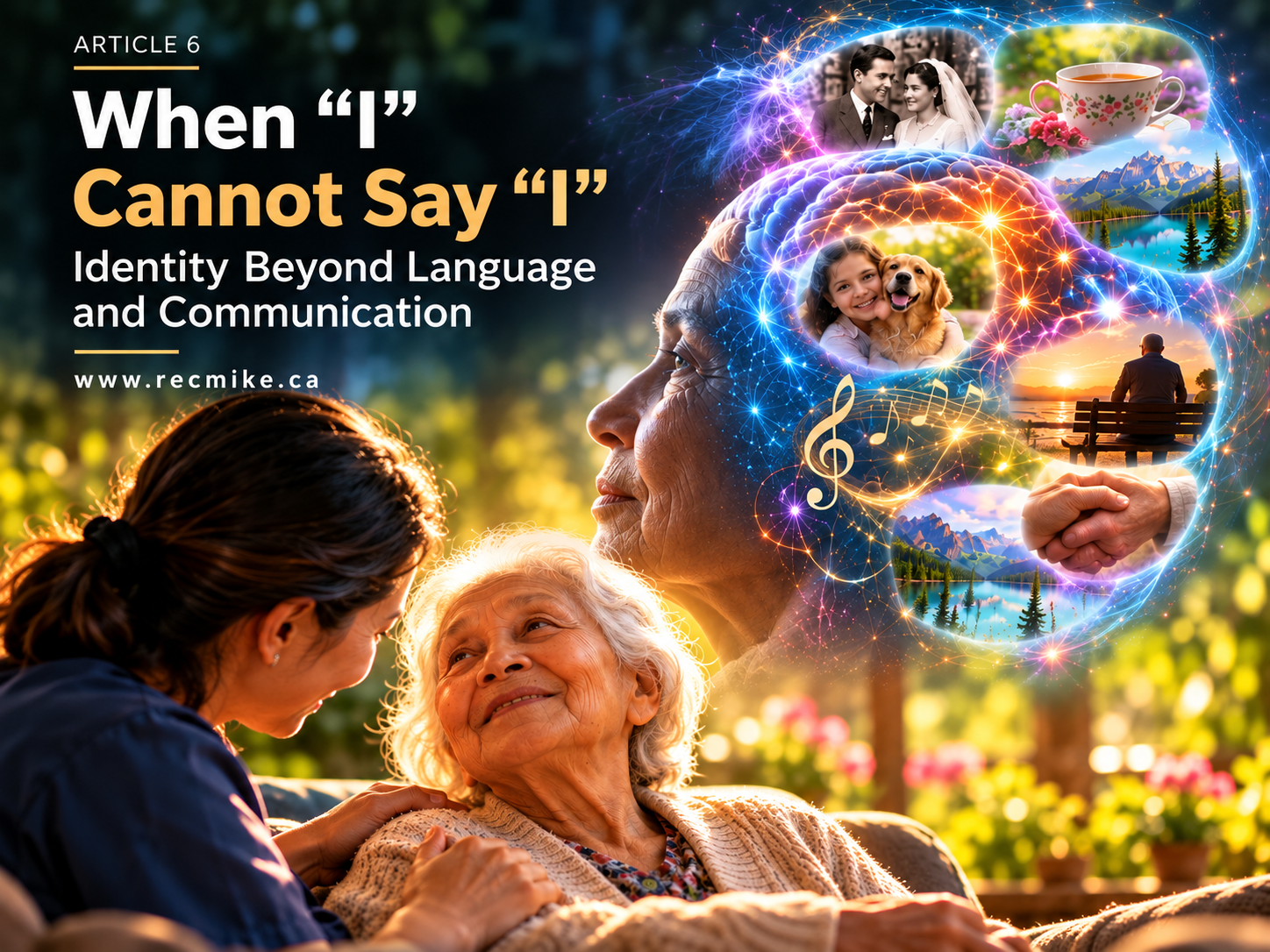
Part 6: When “I” Cannot Say “I”
Identity Beyond Language and Communication
In the previous article, we explored what can remain when autobiographical memories begin to fade. We saw that a person may lose access to parts of their life story while still responding to music, familiar routines, emotions, touch, and the presence of another person.
But dementia can eventually affect something else that we often use to understand a person's inner world: language.
When someone can no longer find the right words, answer a question, or tell us what they are feeling, it is easy to assume that their thoughts and awareness have also disappeared. But language and awareness are not the same thing.
When Words Become Difficult
Language is a complex brain function. Understanding and producing speech involves several connected brain regions and networks working together. These systems allow us to find words, understand meaning, organize sentences, recognize sounds, and communicate our thoughts.
In dementia and other neurological conditions, some of these abilities can become impaired. A person may know what they want to say but be unable to find the word. They may understand more than they can express. Sometimes they may communicate through gestures, facial expressions, movement, or changes in behaviour instead.
This creates an important distinction:
Not being able to say something does not necessarily mean not having something to say.
A Different Kind of Conversation
In my work with people living with dementia, I have learned that communication does not always look like a normal conversation.
Sometimes a person may not answer a question, but their face changes when someone they recognize enters the room. They may reach toward something they want, turn away when they are uncomfortable, smile when they hear a familiar voice, or become more relaxed when a familiar activity begins.
These are forms of communication too.
They may not give us a complete explanation of what is happening inside the person's mind, but they give us information about how the person is responding to the world around them.
The Brain Has More Than One Way to Communicate
Our understanding of another person often depends heavily on words because words are convenient. We can ask, “Are you comfortable?” and expect an answer.
But the brain communicates through many channels. Facial expression, body movement, tone of voice, posture, attention, and emotional responses can all provide information.
Some of these processes can continue even when language becomes significantly impaired.
This is particularly important in dementia care because the loss of speech can sometimes lead others to speak about a person as though they are no longer present.
That conclusion can be much too simple.
What About Recognition?
Recognition can also become complicated.
A person may not be able to say your name, yet your presence may still feel familiar. They may not be able to explain who you are, but they may respond differently when you enter the room.
We should not automatically interpret every positive response as proof that the person consciously remembers a specific relationship. The brain is too complex for that kind of certainty.
But neither should we assume that the absence of a verbal answer means the absence of connection.
Sometimes the safest approach is simply to notice the response without demanding an explanation.
Why Questions Can Become Difficult
Imagine being asked several questions when your brain is struggling to process language, attention, and memory at the same time.
“What's your name?”
“Do you remember me?”
“What did you do this morning?”
“Where are you?”
For someone with dementia, these may feel less like simple questions and more like a series of difficult tests.
If the person cannot answer, we may conclude that they do not understand or do not remember. But the problem may involve several different processes, including language, attention, memory retrieval, or the ability to organize a response.
This is why communication in dementia often works better when we reduce pressure and give the person time.
Connection Does Not Always Need Words
A familiar song can create connection. Sitting quietly beside someone can create connection. Helping with a familiar activity can create connection. A calm voice, a familiar routine, or a reassuring presence can also create connection.
None of these requires a person to explain their experience in words.
This does not mean that every person with dementia remains fully aware or understands everything happening around them. Awareness can also change as neurological disease progresses. The important point is that we cannot determine the whole of someone's inner experience simply from their ability to speak.
When “I” Becomes Quiet
Earlier in this series, we asked what happens when the Story Self begins to lose pieces of its history. Now we are asking what happens when the person can no longer easily communicate that story.
Perhaps the most important lesson is that the word “I” does not depend entirely on speech.
A person does not become less human because they cannot find a word. They do not stop having a history because they cannot tell the story. And silence does not automatically mean that nothing is happening inside.
The way a person experiences the world may be changing. Their ability to communicate that experience may be changing too.
But we should be careful not to confuse the loss of communication with the loss of the person.
The Question Gets Deeper
So far, our journey has taken us from “I,” to the brain systems involved in self, to memory, identity, dementia, and communication.
But there is another layer we have not fully explored.
If the brain can create a sense of self, build memories, connect those memories into a personal story, and allow us to experience the world from a first-person perspective, then we have to ask:
What exactly is consciousness?
Is consciousness the same thing as the self?
Is it the same thing as memory?
And when the brain changes profoundly, what happens to the experience of being here at all?
These questions take us into the next stage of the journey.
Next: Part 7
What Is Consciousness?
The Brain, Awareness, and the Experience of Being Here
In the next article, we move beyond memory and language and explore one of the deepest questions in neuroscience: how does brain activity become the experience of being aware?