
A country's healthcare system can be a window into that country, not through the modernity of its hospitals or the amount of funds funnelled into the latest technology and equipment, but through what you see when you work with patients and families, listening to what makes them tick when life hasn't turned out the way they expected. After decades of doing that, you begin to see the country for what it is in ways that have nothing to do with its brochures.
I have been working in the healthcare system for nearly thirty years and in three countries. Today, working in a community in a beautiful province in Canada, I see houseless people, people struggling with addictions, refugee claimants, international students who have no idea what the future holds, and people labelled terrorists in their home countries for reasons that had little to do with who they were.
None of these people are what the intake form asks for. A person's immigration status, diagnosis, home address, or occupation tells me something about their circumstances, but not about who they are.
I try to see the person first.
And the way I see people is also the way I see the communities they form. I notice not only their backgrounds, but the ways they contribute to the neighbourhoods they're part of and the ways their daily lives impact the places in which they live.
One Neighbourhood, Two Feelings
A few months ago, I was sitting on a porch on the east side of Calgary, waiting for a client to finish a phone call. Kids were riding bikes down the street. Somewhere nearby, someone was cooking with cumin and curry leaves, and for a moment, I forgot I was in Canada.
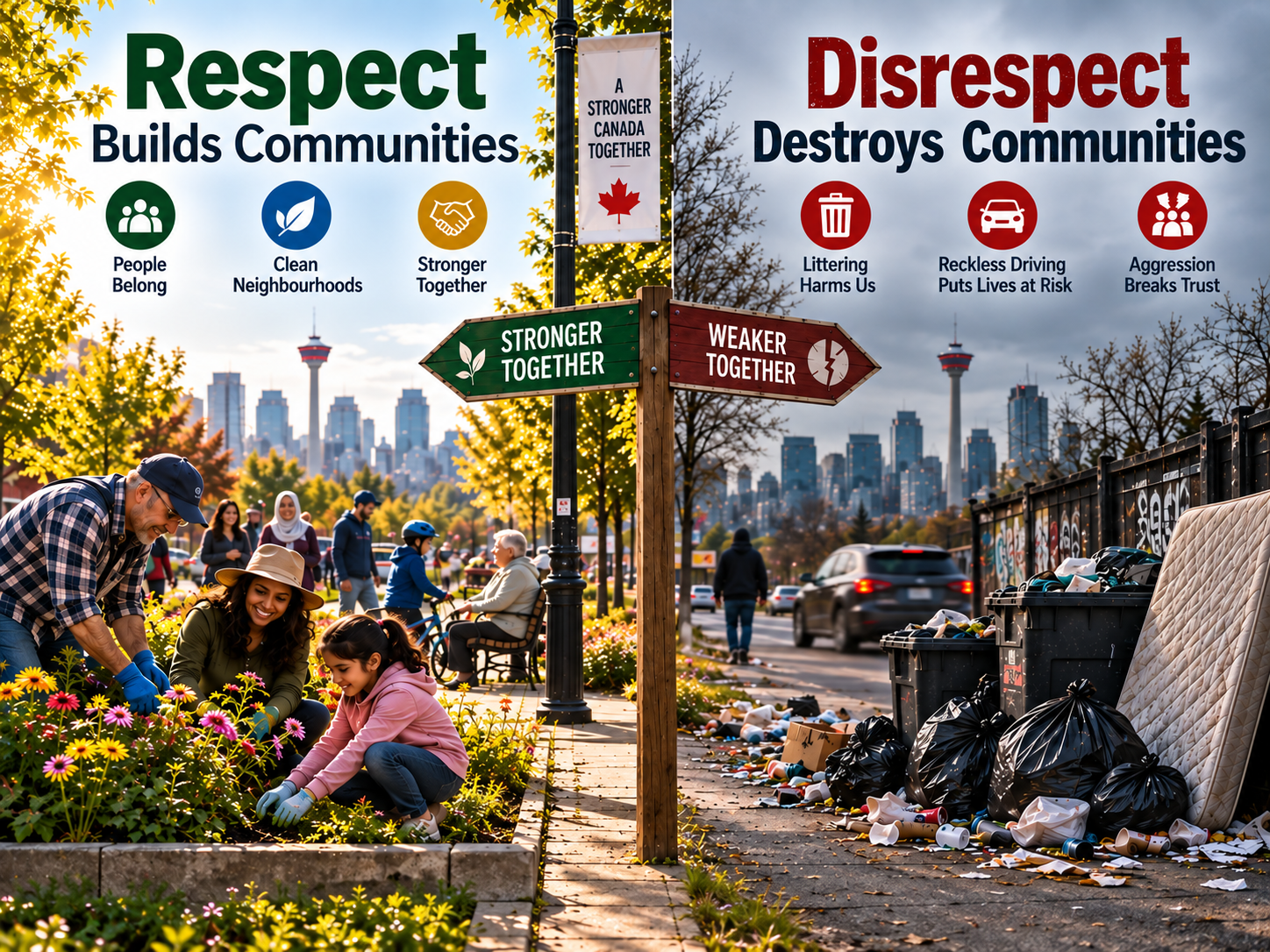
Then a car flew down the street, swerving around a child on a bike with no attempt to slow, and a few houses up, someone had dumped an old mattress beside the recycling bins as if it was no longer their problem.
I sat with two feelings at once: proud of this community and a little uneasy about some of what I saw.
Both were true.
The Good and the Uneasy
Immigration has changed Canadian neighbourhoods in ways I welcome. Empty storefronts have become small businesses. New families have brought life to once sleepy streets. I hear languages I can't identify and eat food from places I've never been.
That's a good thing, clearly.
But I've also seen garbage dumped instead of in the bins, lines cut, late-night arguments spilling into the street, and drivers treating stop signs as suggestions.
And when this happens in my own community, I find myself asking an uncomfortable question:
Did we move to Canada, or did we bring our old habits with us and put snow on them?
I'm asking this question because I think it's one Canada needs to ask itself.
The Welcome and the Unease
The polling reflects some of that tension. In 2024, the Environics Institute found that 58 percent of Canadians felt that Canada was accepting too many immigrants. A separate study on multiculturalism in 2026 found that 66 percent of Canadians believed that multiculturalism had benefited Canadian identity.
These numbers are not contradictory.
One person could feel that immigration has enriched the country, but still feel uneasy about the speed of it, housing, hospital waiting lists, and the settlement of new arrivals.
The welcome mat and the feeling of unease can live in the same person, often at the same time.
The federal government has responded by adjusting the numbers. Under the 2026-2028 Immigration Levels Plan, temporary resident arrivals will peak at 385,000 and then 370,000 for the following two years, while permanent resident admissions will hold at approximately 380,000 a year.
These numbers are each a matter of debate, but the fact that the government is adjusting them is telling.
Immigration Is More Than Arrival
There is one discussion that gets less attention because it's more complicated than the simple issue of numbers, but is equally important.
Immigration is not just a matter of arrival. It is a matter of what follows.
Some newcomers bring habits with them that reflect their home country but do not always fit their new surroundings: how they drive, treat public space, behave in a line, talk loudly in shared places, and make assumptions about the boundaries of other people.
Small things, mostly, but a country is made up of a million small expectations.
We expect people to wait their turn, stop at red lights, argue politely, extend basic respect to strangers despite differences, and so on. None of it was written down. It's just understood.
When people refuse to go along with it, the fallout doesn't affect only them. It lands on neighbours, coworkers, and very often people who share their language or background, who had nothing to do with the reason for the suspicion.
Adapt Without Losing Yourself
I'm not saying that immigration is the problem. I think the issue is much more nuanced than that.
To me, the discussion is more personal:
When you choose to build a life in a new country, are you willing to learn, adapt, and participate without losing the parts of yourself that matter to you?
You can keep your language, your food, your music, your faith, your family stories, and your connection to the country you came from. All of it can be a part of who you are.
But Canadian laws, and the tacit expectations that bind a community together, cannot be made optional simply because they are unfamiliar.
Integration was never a matter of erasing who you are. It is a matter of learning how to participate, responsibly and respectfully, in a new society.
What Does It Mean to Be Canadian?
But if we ask people to adapt, another question naturally follows:
What are we adapting to? What does it mean to be Canadian?
I don't buy into the idea that Canada has no culture of its own or that it is simply a confluence of other cultures living side by side.
Canadian culture may be quieter and less obvious than elsewhere, but it is present.
It takes the form of apologizing when you bump into someone, even if you are right, and the expectation that a junior worker will challenge a senior manager without fear. It is having an ingrained sense of the rights of strangers, even when they look or pray or speak differently than you.
It includes patience, fairness, and a kind of understated decency that doesn't trumpet itself.
These are things worth learning. Integration can be a process of discovering what is worth keeping and adopting as your own.
Keeping Where You Came From
None of it means erasing who you are. The opposite, in fact.
Keep your language. Cook your food. Tell your children stories about your homeland and your grandparents' lives. Celebrate the festivals you grew up with.
You can be proudly Sri Lankan, Ukrainian, Somali, Indian, Filipino, Chinese, Iranian, or from anywhere else on earth and proudly Canadian at the same time.
All of these things can exist side by side.
Culture Is Never an Excuse for Harm
What I won't accept is culture as an excuse for hurting someone.
Canadian law protects people's safety and equal treatment. Forced marriage, honour-based violence, female genital mutilation, and spousal abuse are not acceptable traditions, and none are a reason to ignore Canadian law.
Respecting where someone comes from does not mean looking away when someone is being hurt.
Don't Live Inside the Bubble
There is one message I would give newcomers because I am one, and in a lot of ways still think of myself that way.
Watch out for the bubble.
Your community is incredibly important when you first arrive, and it can provide you with the support to find an apartment, a job, a family doctor who understands what it was like for you to start from nothing.
That kind of support is invaluable and important.
However, if every friend, every show you watch, and every event you attend comes from the country you left, you can feel like you've joined a country without actually joining it.
You don't have to give up that community, but build a second one beside it.
Talk to your neighbour. Attend a local event. Volunteer somewhere. Get to know people who grew up completely differently than you.
That's where the feeling of belonging starts.
Integration Is Not a One-Way Street
Integration is not a one-way street, however.
Canada owes newcomers something too.
Credential recognition can take years. Housing has become extremely expensive in most Canadian cities. Discrimination hasn't disappeared, sometimes loudly, more often in quiet ways.
"Canadian experience" creates a catch-22: how can you get it if no one will give you the chance to earn it?
Learning to work within a system doesn't mean staying silent when it fails you.
You can respect this country and still expect it to treat you fairly.
You can love it and still ask it to do better.
What Are We Asking of Newcomers?
So, stripping away the political noise, what is it that is being asked of newcomers?
I think it boils down to something simple.
Learn the laws. Learn how your workplace works. Be aware of what your new community expects.
And be honest with yourself about which habits from home still serve you and which tend to cause friction.
If you're unsure, ask.
There is no harm in asking:
"Back home we did it this way. How do you do it here?"
That question can head off a lot of unnecessary problems.
Respect, Participation, and Responsibility
I never expected Canada to be perfect when I arrived, and I don't think most immigrants do.
We know we are entering a new system with new complications and that we'll need to work through the process of starting over.
We came here because most of us wanted to build something better.
That doesn't mean Canada gets blind loyalty.
But respecting this country, showing up, and taking responsibility for the place we chose to build our lives in all matter.
A country isn't built on one big idea. It's built on millions of small actions by everyday people.
Waiting your turn at the checkout. Putting your garbage where it belongs. Slowing the car down when a child crosses. Checking in on a struggling neighbour. Treating a coworker well. Following the rules when no one is watching.
None of it makes the headlines. None of it is the law.
But all of it is what holds a place together.
Immigration Doesn't End When You Arrive
We spend a lot of energy discussing how to get into Canada: the paperwork, the application for permanent residency, the job search, the points system.
We spend much less time discussing what it means to become somebody's neighbour, somebody's coworker, somebody whose absence will be noticed.
Immigration doesn't end the day you land. That's usually when the real work starts.
Learning the country. Adapting without disappearing. Contributing without forgetting where you came from. Building a life that is both yours and belongs to the place you've chosen.
That's what it means to belong.
The Question I Keep Coming Back To
I'm not sure what the answer is, even after years of seeing neighbourhoods change and people try to navigate the process.
I keep coming back to the question of how to belong to the country we chose without losing who we were that brought us here.
Maybe that's the conversation we should be having.